Nuclear Energy Ordinance (NEO) (NEO)
English is not an official language of the Swiss Confederation. This translation is provided for information purposes only and has no legal force.
Art. 7 Requirements concerning nuclear safety
The following measures must be taken in order to guarantee nuclear safety: a. Established or proven high-quality processes, materials, technologies and organisational structures and processes must be used in connection with design, construction, commissioning and operation of nuclear installations. This applies especially to the areas of planning, manufacture, testing, operation, surveillance, maintenance, quality assurance, evaluation of operational experience feedback, ergonomic design as well as basic and advanced training and professional development. b. Any deviations from normal operation should be countered as far as possible by ensuring that the behaviour of the installation is self-regulating and fault-tolerant. Wherever possible, the behaviour of the installation must be inherently safe. The term «inherently safe» is understood to mean that a given system functions safely on its own, i.e. without the support of auxiliary systems. c. In order to deal with accidents, the instal
Art. 8 Requirements concerning measures to prevent accidents
1 Preventive and protective measures must be taken to avoid accidents in nuclear installations that may originate either within (internal) or outside (external) the installation. 2 Internal initiating events include reactivity disturbance, loss of coolant, loss of heat sink, fire, flooding, mechanical damage due to component failure, damage to cladding when handling fuel elements, failure of operating systems, unintentional activation or faulty functioning of safety systems, and mistakes made by personnel. 3 External initiating events include earthquake, flooding, accidental crash of civil or military aircraft, squall, lightning strike, shock wave, fire, loss of off-site power, impairment or loss of external cooling water supply. 4 For the design of a nuclear installation in accordance with Article 7 letter c, accidents within the meaning of paragraph 2 and accidents not triggered by natural events within the meaning of paragraph 3 must be classified by the frequency specified in Artic
Para. 4 — SR 814.501 Para. 4 — Amended by No I of the O of 7 Dec. 2018, in force since 1 Feb. 2019 (AS 2019 183). Para. 4bis let. b — Inserted by No I of the O of 7 Dec. 2018, in force since 1 Feb. 2019 (AS 2019 183). Para. 5 — Amended by No I of the O of 7 Dec. 2018, in force since 1 Feb. 2019 (AS 2019 183).
Art. 9 Requirements concerning security
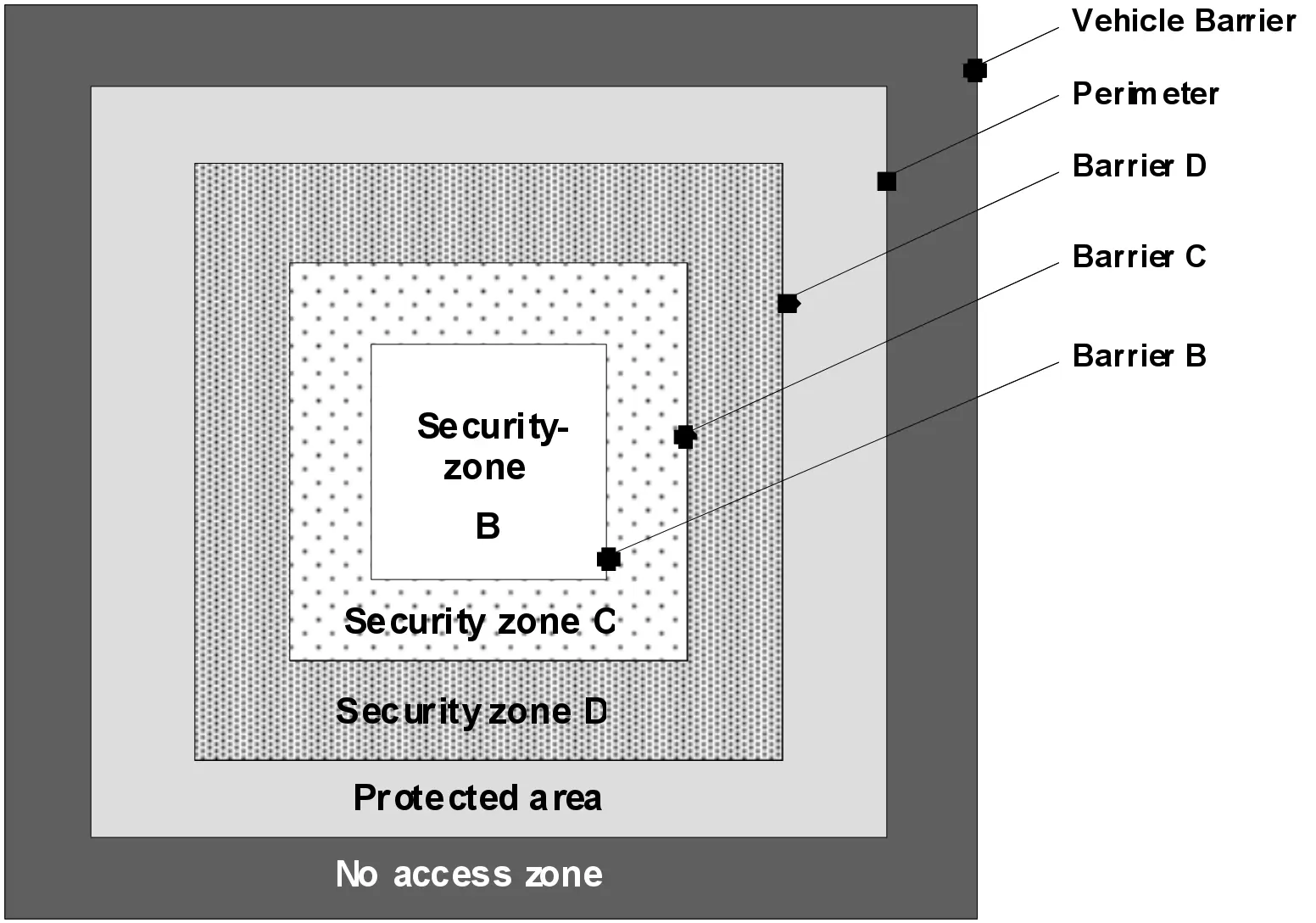
1 The protection of nuclear installations and nuclear material against sabotage, malicious acts and unauthorised removal must be based on the principle of defence in depth, which encompasses structural, technical, organisational, personnel and administrative measures. 2 The principles for security zones and barriers and for the protection of nuclear installations, nuclear materials and radioactive waste are defined in Annex 2. 3 The Department shall define the principles for hazard assumptions and for structural, technical, organisational and administrative security measures in an ordinance.
Art. 10 Basic principles for the design of nuclear power plants
1 The following principles apply to nuclear power plants: a. Safety functions must also remain effective even if a single failure occurs independently of an initiating event, and also if a component is not available due to maintenance or repair. Such separate single failures include the random failure of a component that results in its incapacity to perform its intended safety function. Subsequent failures arising from such random failures are also regarded as part of the original single failure. b. Wherever possible, safety functions must be implemented in accordance with the principles of redundancy and diversity. Redundancy refers to the existence of a larger number of functional devices than are required for fulfilling the intended safety function. Diversity refers to the use of different types of physical or technical principles. c. Redundant trains of safety systems installed for performing safety functions must as far as possible be independent of one another in terms of functio
Para. 2 — Amended by Annex No 12 of the O of 12 Nov. 2008 on the Swiss Federal Nuclear Safety Inspectorate, in force since 1 Jan. 2009 (AS 2008 5747).
Art. 11 Design principles for deep geological repositories
1 In order to guarantee long-term safety, the site for a deep geological repository must meet the following requirements: a. sufficient extent of suitable host rock; b. favourable hydro-geological conditions; c. long-term geological stability. 2 A deep geological repository must be designed to ensure that: a. it complies by analogy with the principles of Article 10 paragraph 1; b. it guarantees long-term safety through multiple passive safety barriers; c. steps to ease surveillance and repairs of the repository, or for the recovery of the waste, in no way impair the effectiveness of the passive safety barriers after closure of the repository; d. it can be closed within a period of a few years. 3 ENSI shall issue guidelines that specify: a. detailed design principles for deep geological repositories; b. the requirements for proof of the long-term safety deep geological repositories.
Para. 3 let. b — Amended by No I of the O of 31 May 2024, in force since 1 July 2024 (AS 2024 280).
Art. 12 Design principles for other nuclear installations
1 Article 10 paragraph 1 applies by analogy to the design of nuclear installations other than nuclear power plants and deep geological repositories. 2 An interim storage installation for radioactive waste must be designed to ensure that: a. the suitability for disposal of the waste packages will not be impaired; b. sufficient storage capacity is available for the anticipated volume of waste. 3 ENSI shall specify detailed design principles for individual types of nuclear installations in guidelines.
Para. 3 — Amended by Annex No 12 of the O of 12 Nov. 2008 on the Swiss Federal Nuclear Safety Inspectorate, in force since 1 Jan. 2009 (AS 2008 5747).