Coat of Arms Protection (CAPA)
English is not an official language of the Swiss Confederation. This translation is provided for information purposes only and has no legal force.
Section 1 Definitions
Art. 1 Swiss cross
The Swiss cross is a white, upright, free-standing cross depicted against a red background, whose arms, which are all of equal size, are one-sixth longer than they are wide.
Art. 2 Swiss coat of arms
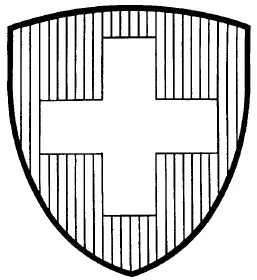
1 The Coat of Arms of the Swiss Confederation (the Swiss coat of arms) is a Swiss cross in a triangular shield. 2 The example depicted in Annex 1 defines the shape, colour and proportions.
Art. 3 Swiss flag
1 The Swiss flag shows a Swiss cross on a square background. 2 The example depicted in Annex 2 defines the shape, colour and proportions. 3 The following remain reserved: a. the Navigation Act of 23 September 1953; b. the Civil Aviation Act of 21 December 1948; c. the Armed Forces Act of 3 February 1995.
Para. 3 let. a — SR 747.30 Para. 3 let. b — SR 748.0 Para. 3 let. c — SR 510.10
Art. 4 Other emblems of the Confederation
The Federal Council shall designate other emblems of the Confederation; these include, in particular, the federal signs indicating control and guarantee.
Art. 5 Coats of arms, flags and other emblems of the cantons, the communes and other public authorities recognised under cantonal law
The coats of arms, flags and other emblems of the cantons, the communes and other public authorities recognised under cantonal law are determined by cantonal law.
Art. 6 Official designations
The following terms are considered official designations: a. «Confederation»; b. «federal»; c. «canton»; d. «cantonal»; e. «commune»; f. «communal»; g. any other terms that imply a Swiss authority or an official or semi-official activity.
Art. 7 National figurative or word signs
Signs that refer to national symbols such as Swiss landmarks, heroic figures, sites or monuments are considered national figurative or word signs.
Section 2 Use
Art. 8 Coats of arms
1 The Swiss coat of arms, those of the cantons, the communes and other public authorities recognised under cantonal law, the characteristic elements of cantonal coats of arms in connection with a coat of arms shield and signs that could be confused with them may only be used by the public body to which they belong. 2 Paragraph 1 also applies to word signs that refer to the Swiss coat of arms or the coat of arms of a canton, a commune or other public authority recognised under cantonal law. 3 The signs referred to in paragraphs 1 and 2 may not be licensed or assigned. 4 The use of coats of arms under paragraph 1 by persons other than the public body entitled to use them is permissible in the following cases: a. as illustrations in dictionaries, reference works, scientific works or similar works; b. for the decoration of festivals and events; c. for the decoration of objects of artistic craftsmanship such as cups, heraldic stained glass and commemorative coins for festivals and events; d
Para. 4 let. d — SR 232.14
Art. 9 Official designations
1 Official designations and terms with which they could be confused may only be used on their own by the public body to which they belong. 2 The use of designations under paragraph 1 by persons other than the public body entitled to use them is only permissible when such persons are carrying out an official or semi-official activity. 3 Designations under paragraph 1 may be used in conjunction with other word or figurative elements to the extent that such use is neither misleading nor contrary to public policy, morality or applicable law.
Art. 10 Flags and other emblems
Flags and other emblems of the Confederation, cantons, communes and other public authorities recognised under cantonal law, as well as signs that could be confused with them may be used to the extent that such use is neither misleading nor contrary to public policy, morality or applicable law.
Art. 11 National figurative and word signs
National figurative and word signs may be used to the extent that such use is neither misleading nor contrary to public policy, morality or applicable law.
Art. 12 Public Swiss signs and public foreign signs
The use of coats of arms, flags and other public Swiss emblems that may be used under this Act may not be prohibited for the reason that the sign in question could be confused with a public sign of a foreign state.
Art. 13 Use of signs as indications of source
Where signs under Article 8 paragraphs 1 and 2, 10 and 11 are understood by the relevant public to be an indication of the geographical origin of goods and services, they are considered to be indications of source within the meaning of the Trade Mark Protection Act of 28 August 1992 (TmPA) and are subject to Articles 47–50 TmPA.
SR 232.11
Section 3 Prohibition on Registration
Art. 14
1 A sign whose use is prohibited under Articles 8–13 may not be registered as a trade mark, design, business name or name of an association or foundation or as an element of such. 2 The prohibition on registration also applies to those cases in which use is permissible under Article 8 paragraphs 4 and 5. 3 Excluded from the prohibition on registration are signs for which the Federal Department of Justice and Police has granted a right to continued use under Article 35.