Does alcohol help you sleep?
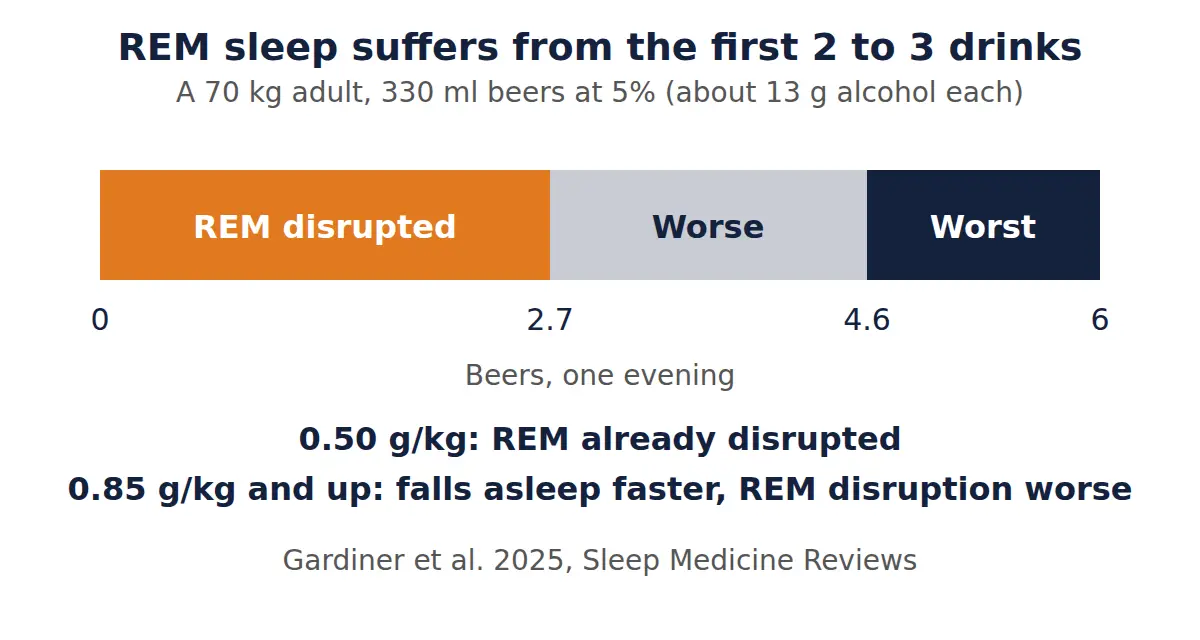
Dose where REM disruption showed
0.50 g/kg or less
Dose where falling asleep got faster
0.85 g/kg or more
Review type
Systematic review and meta-analysis
Year, journal
2025, Sleep Medicine Reviews
Why a drink feels like it helps
Alcohol is a sedative. In the 2025 review of lab studies in healthy adults, the drop in time to fall asleep and time to reach deep sleep appeared only at high doses, from about 0.85 g of alcohol per kg of body weight. Falling asleep faster is the part you can feel. The cost shows up in REM sleep, which the same review found was disrupted even at low doses, and worse as the dose rose.
The earlier review, 2013
An older review by Ebrahim and colleagues in Alcoholism: Clinical and Experimental Research reached a similar picture. REM sleep was delayed at all doses studied, and the effect on first-half-of-the-night deep sleep was more robust than the effect on REM, with total-night deep sleep rising at high doses.
These are sleep lab results in healthy adults. They do not cover people who drink heavily or who have sleep apnea, where alcohol can make breathing during sleep worse. Ask a doctor in those cases.