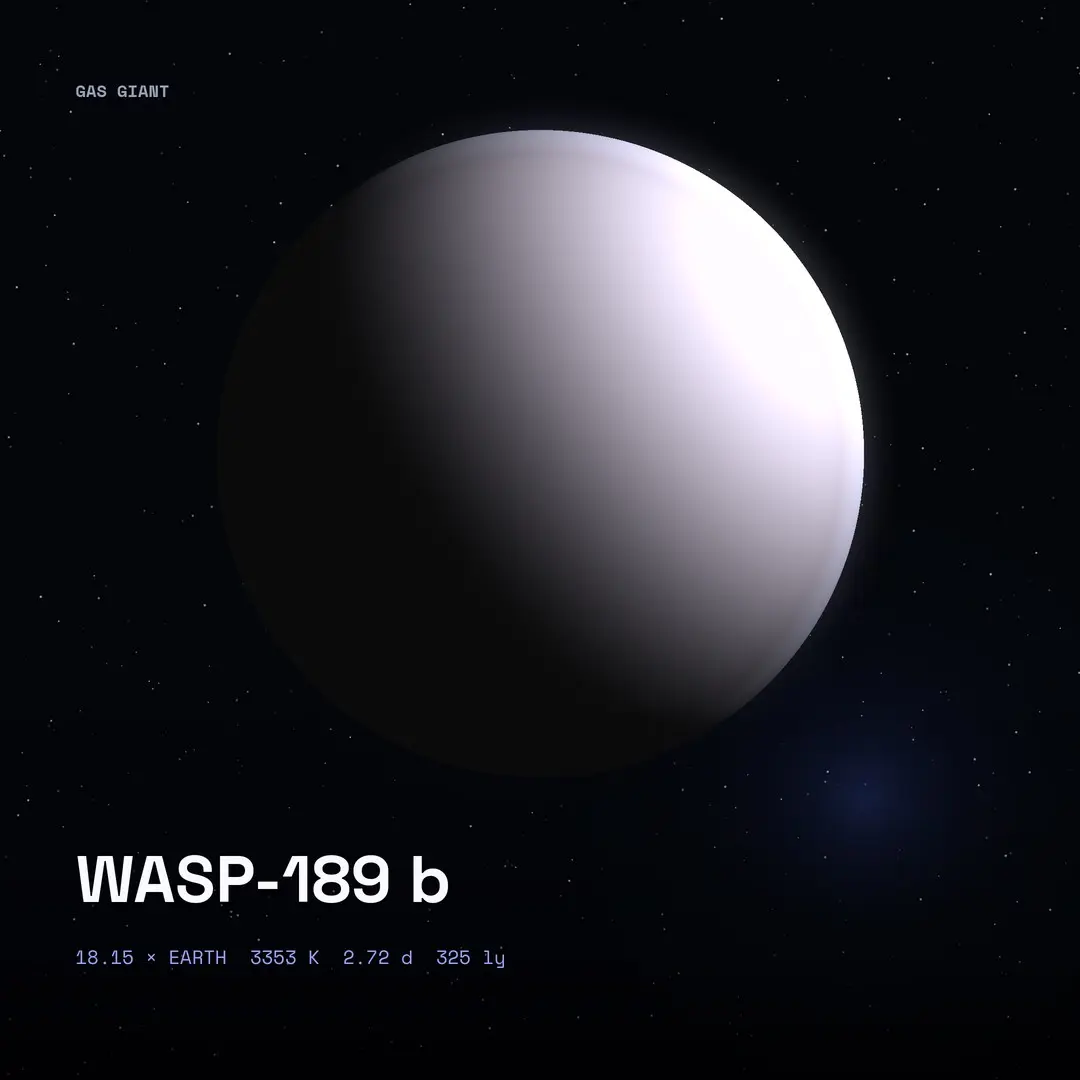
WASP-189 b: 3353 Kelvin
Gas giant around WASP-189
It is 1.62 times Jupiter's radius, closest in size to Jupiter, and 632.5 times Earth's mass, at 0.62 g/cm3, less dense than Earth. A year there lasts 2.72 days, on an orbit 8 times closer to its star than Mercury is to the Sun. Its equilibrium temperature is 3353 K, hotter than the surface of many stars. The host star WASP-189 runs at 8000 K with 2.03 times the Sun's mass.
3353K: hot enough to vaporise rock on the dayside
Radius
18.15 Earth radii
Mass
632.5 Earth masses
Equilibrium temperature
3353 K (measured)
One year
2.72 days
Orbit radius
0.0505 AU
Host star
WASP-189 at 8000 K
Distance
325 light-years
Starlight blocked
0.496% at each transit
What a crossing measures
Block a known fraction of a known star and you have measured a width.
The size came from a crossing, the mass did not. That pairing is uncommon and it is what lets anyone say whether this is rock or gas.
Found by CHaracterising ExOPlanets Satellite (CHEOPS) in 2020.
