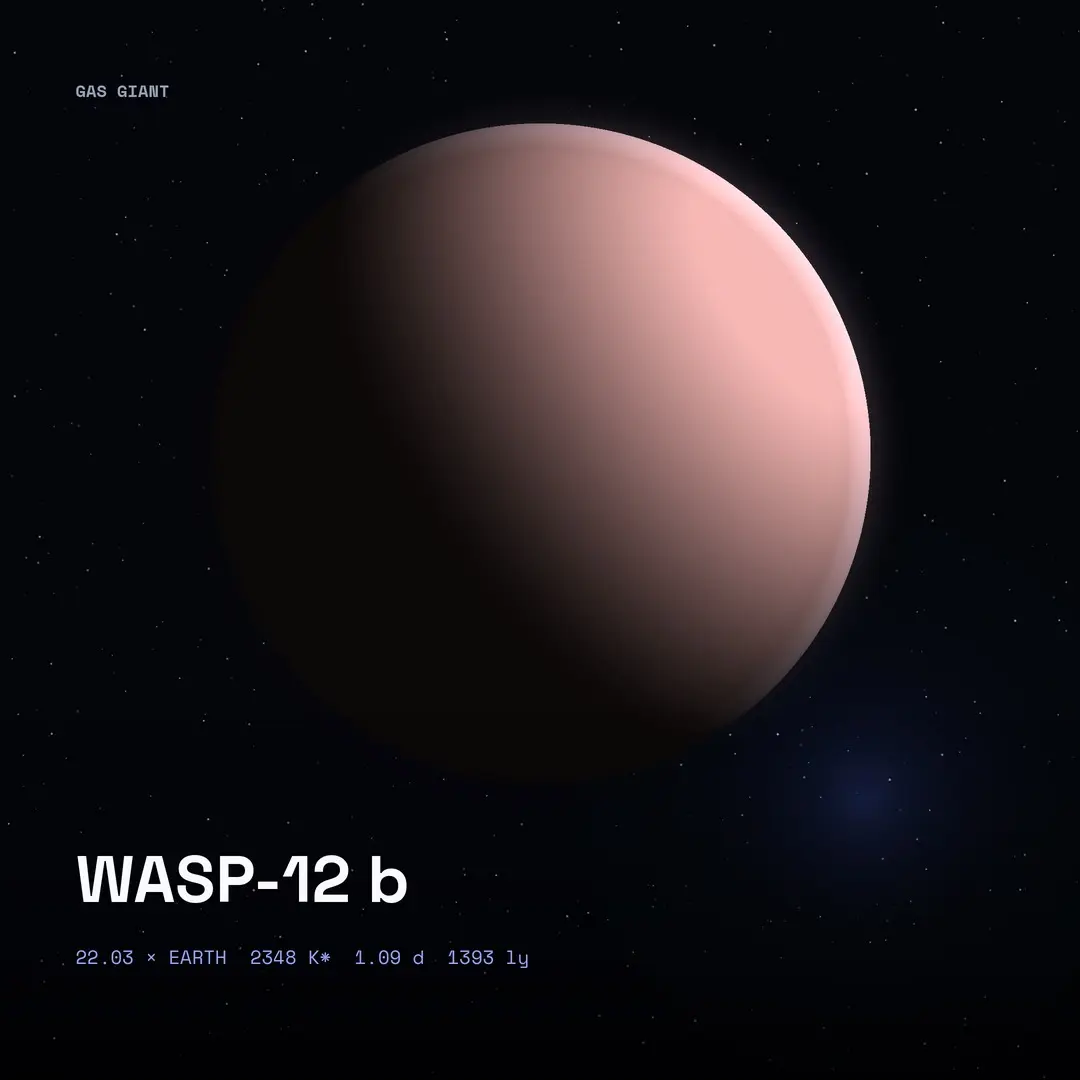
WASP-12 b: A Planet Falling Into Its Star
The first planet we have watched begin to die
Most of what we know about planetary death is inference. WASP-12 b is the exception: it is measurably falling into its star, and the measurement is a clock. Every transit arrives slightly earlier than the last, and across more than a decade of timings the interval between them is shrinking by 29 milliseconds per year. Orbital decay was favoured over the competing explanation of apsidal precession by a Bayes factor of 70,000, which is about as close to settled as this kind of observation gets.
Orbital decay
29 plus or minus 2 milliseconds per year
One year
1.091 Earth days
Radius
22.0 Earth radii, nearly 2 Jupiters
Host star
WASP-12 at 6265 K and 1.69 solar radii
Orbit radius
0.023 AU, inside where most planets survive
Distance
about 1393 light-years
How a hot Jupiter dies
Damage
/
Stage
Three million years is the headline and it deserves a caveat. It is what you get by extrapolating the current decay rate forward, and the rate itself depends on how efficiently the star dissipates tidal energy, a quantity that is poorly known and probably not constant as the orbit tightens. The measurement that the orbit is shrinking is solid. The date of death is an extrapolation.
The archive has no equilibrium temperature for this planet, so the figure on the cover is derived from the star's output and the orbital distance and carries an asterisk.
Everything here rests on timing, not imaging. Nobody has seen the planet deform or the stream of gas directly. What was measured is that transits keep arriving early, by an amount you could not notice without a decade of data.