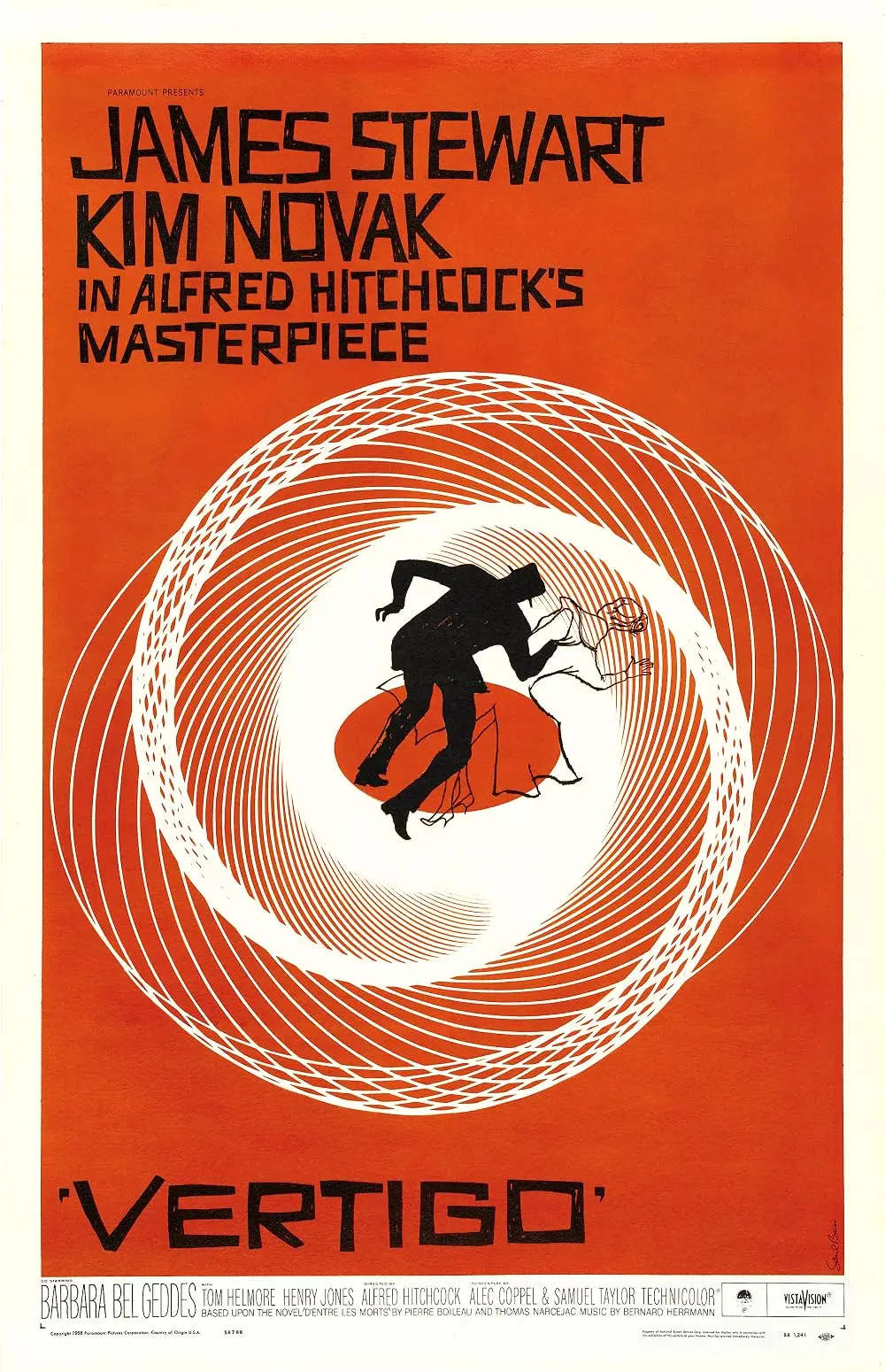
Vertigo: A Flop That Took Fifty Years To Win
Vertigo (1958)
Reviewers shrugged in 1958 and Hitchcock pulled it out of circulation. In 2012 it was voted the greatest film ever made.
Obsession Built As Machinery
A detective with a fear of heights is hired to follow a friend's wife, falls in love with her, fails to save her, and then finds a shop girl he can rebuild into her. Hitchcock gives away the twist two thirds of the way through rather than saving it, which converts the last act from mystery into something far more uncomfortable: the audience knows exactly what is being done to a woman and watches it happen. The technical inventions all serve that. The dolly zoom, built for this film by Irmin Roberts, makes a staircase stretch away while staying the same size. Bernard Herrmann's score circles the same unresolved phrases for two hours. Edith Head's grey suit becomes a uniform a living person is forced into.
Runtime
128 minutes
Director
Alfred Hitchcock
Budget
$2.5 million
Box office
$7.8 million worldwide
Cinematography
Robert Burks
Watching Vertigo
Unease
/
Part
"Only one is a wanderer. Two together are always going somewhere.
"Madeleine Elster · Vertigo · 1958
The dolly zoom, a track backwards combined with a zoom in, was built specifically for this film and is still called the Vertigo effect. It cost about nineteen thousand dollars for a few seconds.
Hitchcock withdrew the film from circulation in 1973 along with four others. It was unavailable for a decade, restored in 1996, and topped the Sight and Sound critics poll in 2012 after fifty years of Citizen Kane.
The reappraisal is not just fashion. What changed is the willingness to watch the film as a study of a man remaking a woman to specification, rather than as a thriller with a slow middle. Read that way it is Hitchcock's most self incriminating picture, made by a director who did exactly this to actresses, and its influence runs straight into Mulholland Drive, Phantom Thread and every film about a man who loves an image more than a person.