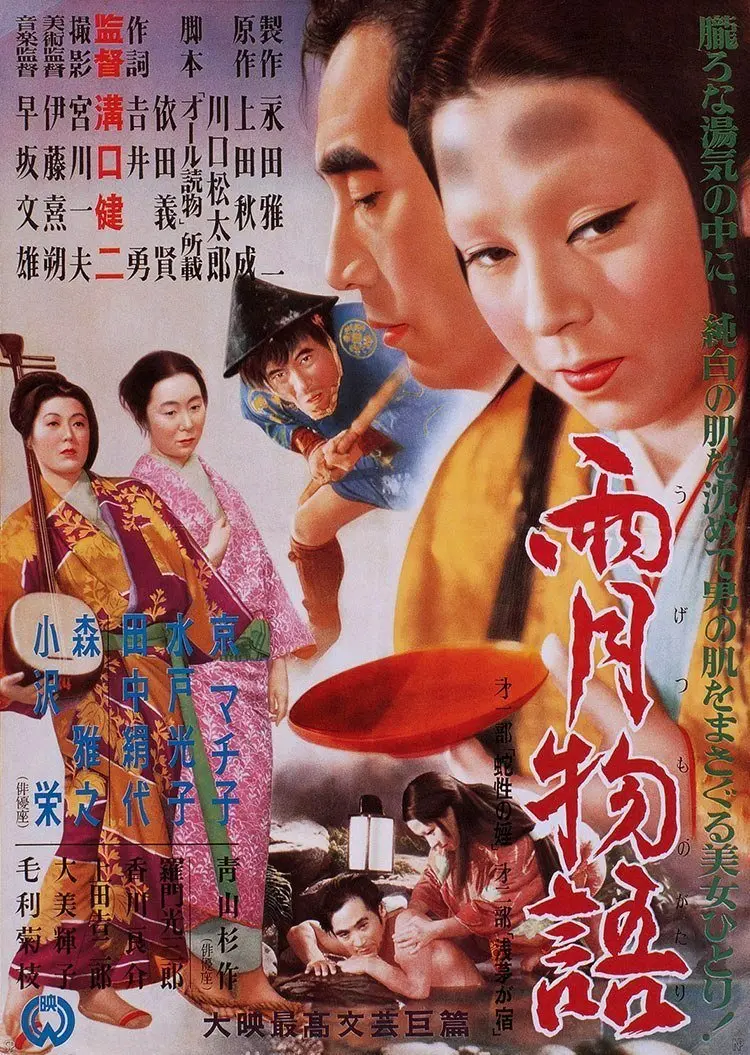
Ugetsu: A Ghost Story Shot In Long Takes
Ugetsu (1953)
Mizoguchi films a supernatural tale with a crane and a boat in the mist, and never once cuts for effect.
Runtime
96 minutes
Director
Kenji Mizoguchi
Country
Japan
Award
Silver Lion
Cinematography
Kazuo Miyagawa
Two Ambitions And A War
Adapted from Ueda Akinari's eighteenth century tales, the film follows a potter and his brother in law during a civil war. One wants money, the other wants to be a samurai, and both leave their wives behind to get it. Mizoguchi shoots in long unbroken takes with a moving camera, so scenes play out in continuous space and the supernatural arrives without a cut to announce it. The crossing of Lake Biwa in fog, with a boat emerging from white nothing and a dying boatman warning of pirates, is one of the most beautiful sequences ever committed to film and was shot on a studio tank. The ghost story that follows is not a trick. It is the exact shape of what the potter wants, offered to him at the price of never knowing what happened at home.
Watching Ugetsu
Wonder
/
Chapter
"I never dreamed of finding happiness in this world.
"Lady Wakasa · Ugetsu · 1953
Kazuo Miyagawa, who had shot Rashomon three years earlier, photographed the lake sequence on a tank with smoke and scrims, and Mizoguchi refused to break it into shots.
It won the Silver Lion at Venice in 1953, the third Japanese film in three years to take a major prize there, and effectively ended the idea of Japanese cinema as a curiosity.
Mizoguchi was fifty five and had been directing since the silent era when he made this, and he died three years later. Ugetsu is the film that convinced European critics that the long take was a moral choice rather than a technical one: by refusing to cut, he refuses to let the audience off, and the ghost sequence becomes unbearable precisely because it is filmed like the domestic scenes. Rivette, Godard and Tarkovsky all named him.