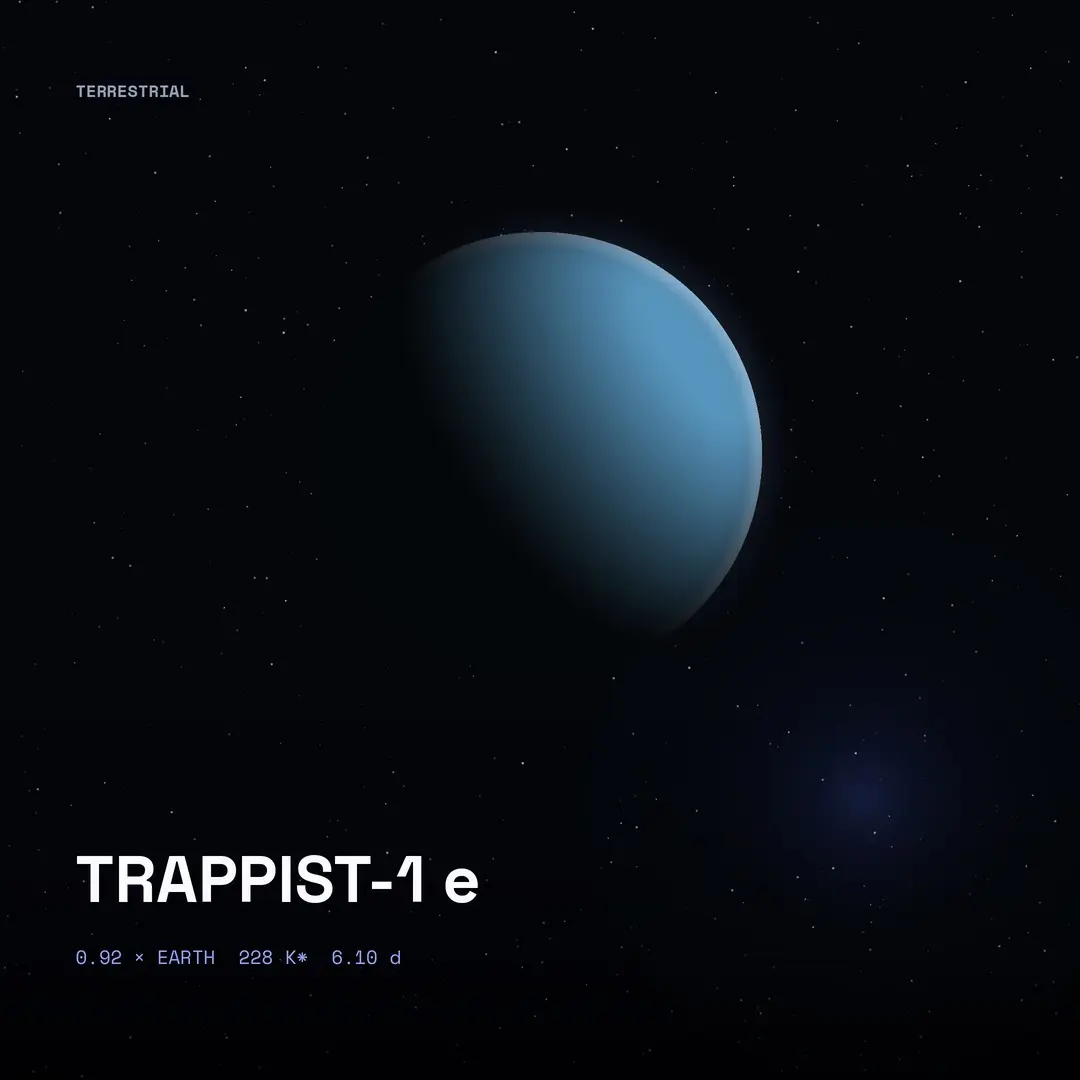
TRAPPIST-1 e: Still No Answer On The Air
The best rocky world we can actually check
Of every planet outside the solar system, this is the one best suited to the question people actually care about: does it have air? It is rocky, it sits in its star's habitable zone, and it crosses a very small, very dim star, which is what makes an atmosphere detectable at all. A planet passing a large bright star hides its thin shell of air in the glare. TRAPPIST-1 is barely bigger than Jupiter and cooler than a candle flame, so the contrast works in our favour. That combination is rare enough that JWST has spent significant time here.
Radius
0.920 Earth radii
Mass and density
0.692 Earth masses at 4.90 g/cm3
One year
6.101 Earth days
Host star
TRAPPIST-1 at 2566 K and 12% of the Sun's radius
Orbit radius
0.029 AU or about one thirteenth of Mercury's
Habitable zone
inside it, fourth of the seven planets
What four transits of JWST settled
Cloudy hydrogen-dominated atmosphere above 80 percent by volume. Ruled out at better than three sigma.
A Venus-like atmosphere. Disfavoured by the data.
A Mars-like atmosphere. Disfavoured by the data.
A nitrogen-rich atmosphere with traces of methane and carbon dioxide. Still permitted.
No atmosphere at all. Still permitted.
The hardest problem is not the planet, it is the star. Red dwarfs are covered in spots and faculae, and starlight crossing those regions imprints a signal that looks very like an atmosphere. The published spectra show that contamination across 3 to 5 microns, which is exactly where the interesting molecules live.
The archive lists no measured equilibrium temperature for this planet. Derived from the star's output and distance, assuming a third of the light is reflected, it lands near 228 K, about minus 45 C. That is an estimate from two numbers, not a measurement, and the real surface depends on the air question above.
Two readings fit the same data: a thin nitrogen atmosphere, or bare rock with no \
air at all. Which would you bet on, and what observation would change your mind?