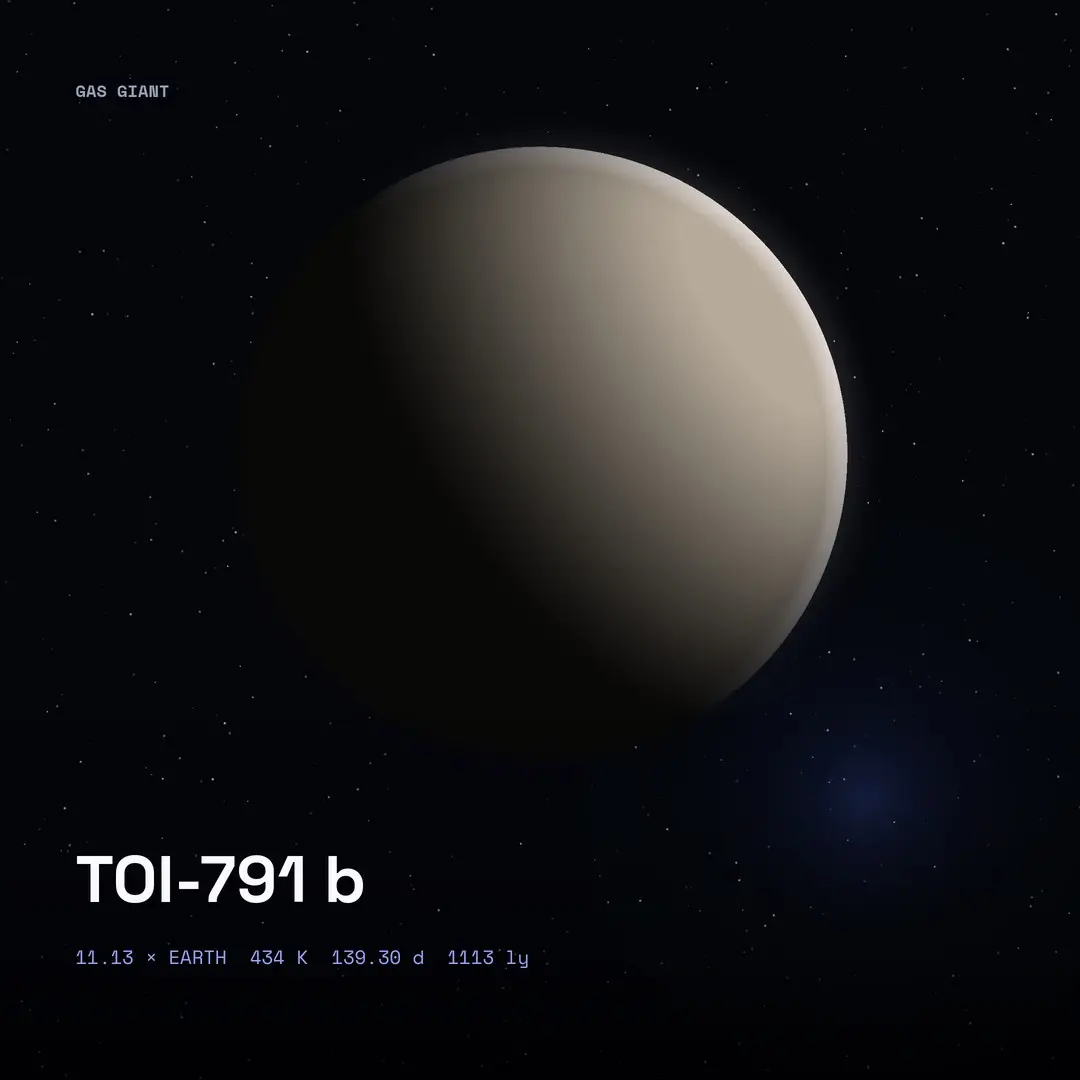
TOI-791 b: Less Dense Than Cork
Gas giant around TOI-791
It is 0.99 times Jupiter's radius, closest in size to Jupiter, and 9.5 times Earth's mass, at 0.04 g/cm3, less dense than Earth. A year there lasts 139.30 days, on an orbit 1.6 times Mercury's distance from the Sun. Its equilibrium temperature is 434 K, hotter than any desert. The host star TOI-791 runs at 6294 K with 1.28 times the Sun's mass.
Radius
11.13 Earth radii
Mass
9.5 Earth masses
Equilibrium temperature
434 K (measured)
One year
139.30 days
Orbit radius
0.6020 AU
Host star
TOI-791 at 6294 K
Distance
1113 light-years
Starlight blocked
0.478% at each transit
0.04g/cm3: less dense than cork
What the dip tells you
How deep the star dims fixes the planet's size relative to it.
A transit gives the radius and a separate measurement gives the mass. Having both is what makes a density, and a density is the only clue to composition at this range.
Found by Transiting Exoplanet Survey Satellite (TESS) in 2026. TESS scans most of the sky in 27-day stretches, so it favours bright nearby stars and short orbits over the faint distant ones Kepler specialised in.
TOI-791 has 2 known planets. A crowded system is worth more than the sum of its planets: the timing of each transit constrains the others.
