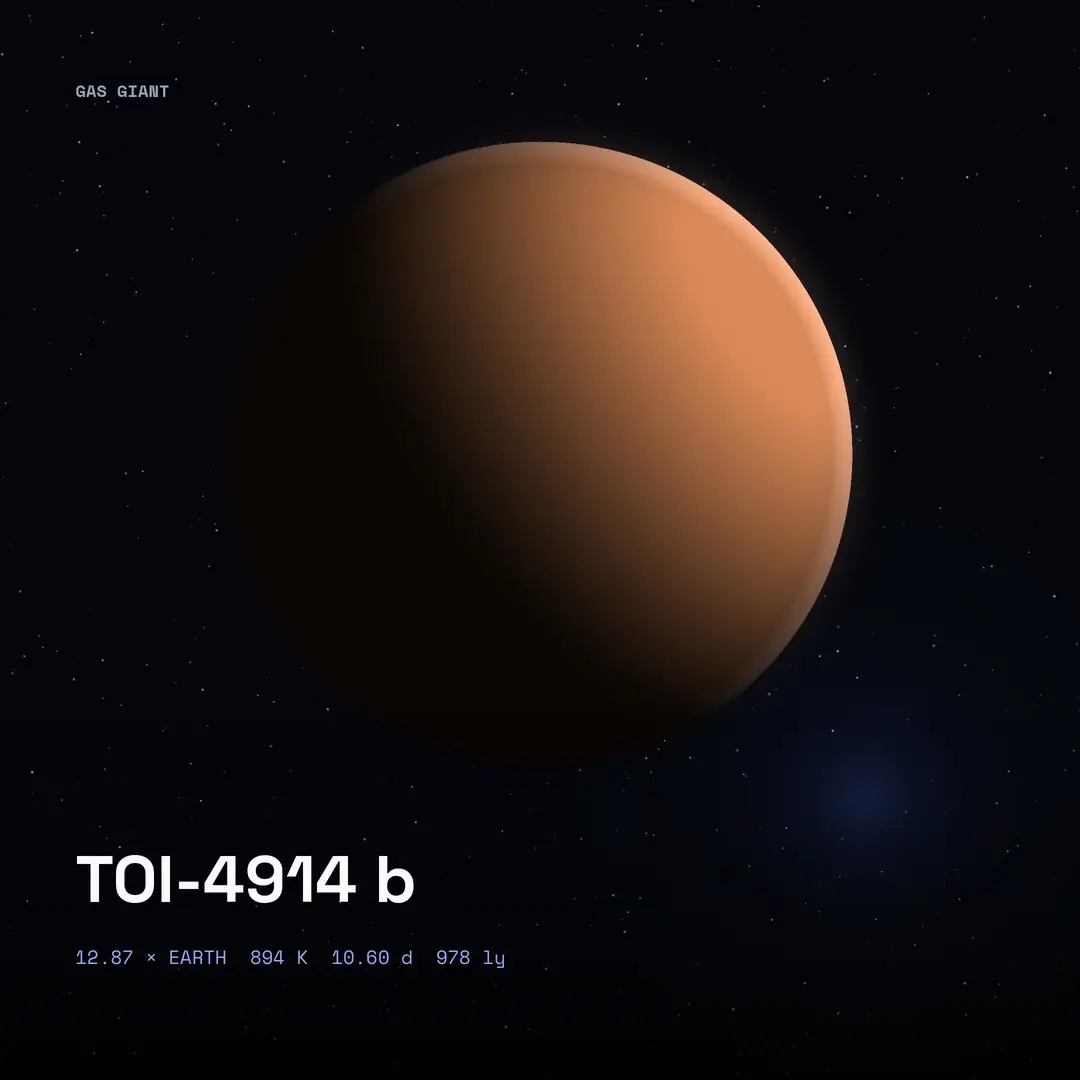
TOI-4914 b: 227.0 Earth Masses
Gas giant around TOI-4914
It is 1.15 times Jupiter's radius, closest in size to Jupiter, and 227.0 times Earth's mass, at 0.59 g/cm3, less dense than Earth. A year there lasts 10.60 days, on an orbit 4 times closer to its star than Mercury is to the Sun. Its equilibrium temperature is 894 K, hot enough to melt lead. The host star TOI-4914 runs at 5805 K with 1.03 times the Sun's mass.
Radius
12.87 Earth radii
Mass
227.0 Earth masses
Equilibrium temperature
894 K (measured)
One year
10.60 days
Orbit radius
0.0980 AU
Host star
TOI-4914 at 5805 K
Distance
978 light-years
Starlight blocked
1.389% at each transit
What the transit gives
The depth of the dip is the ratio of the two discs, so the radius follows.
Its orbit is noticeably elliptical, eccentricity 0.41, so the starlight it receives changes substantially over one year.
Found by Transiting Exoplanet Survey Satellite (TESS) in 2024. TESS scans most of the sky in 27-day stretches, so it favours bright nearby stars and short orbits over the faint distant ones Kepler specialised in.
Two independent measurements sit behind this page: a dip in starlight for the size, and something else entirely for the mass. Together they make a density.
