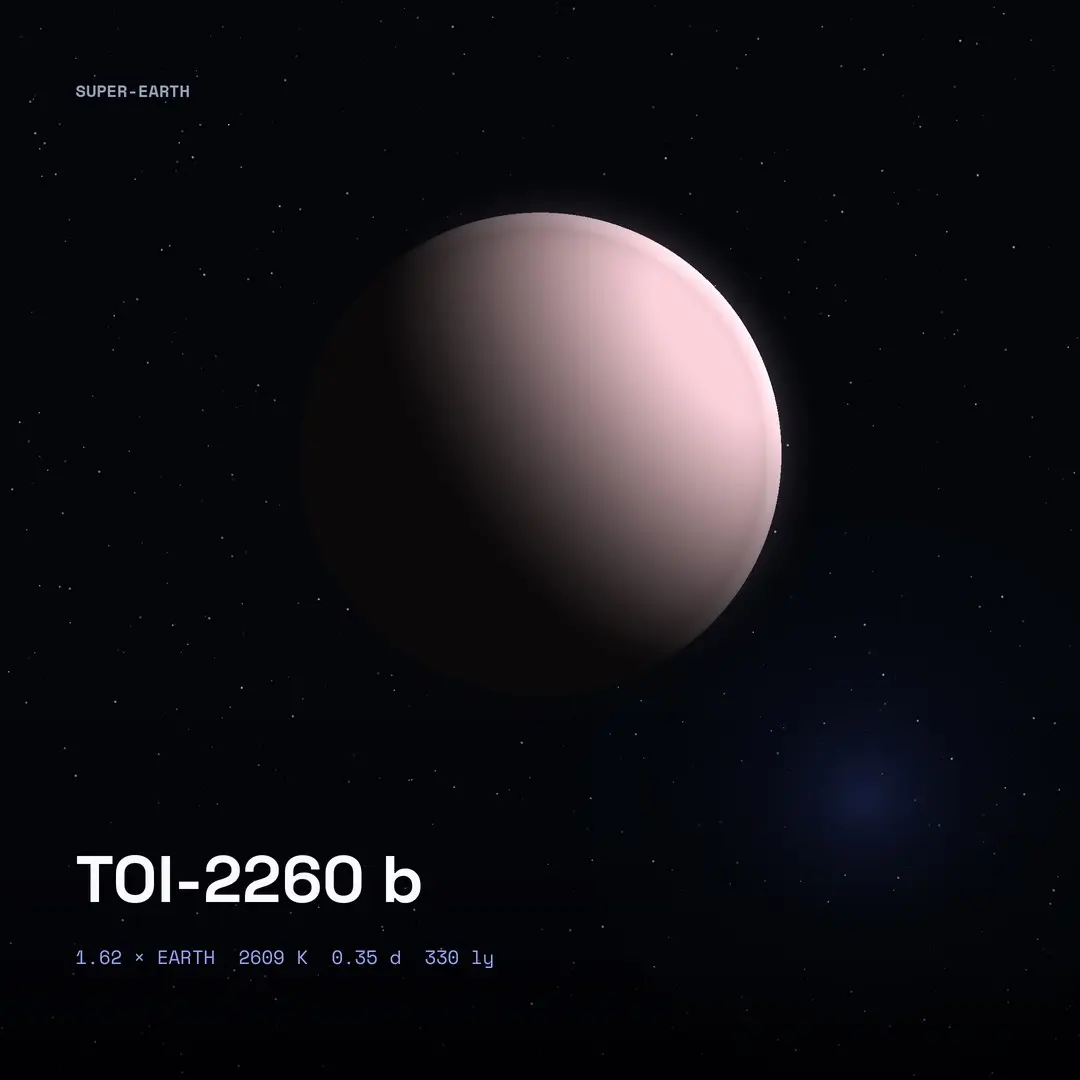
TOI-2260 b: A Year In 8.5 Hours
Super-earth around TOI-2260
It is 1.62 times Earth's radius, closest in size to Earth. A year there lasts 8.5 hours, on an orbit 40 times closer to its star than Mercury is to the Sun. Its equilibrium temperature is 2609 K, hotter than the surface of many stars. The host star TOI-2260 runs at 5534 K with 0.99 times the Sun's mass.
2609K: hot enough to vaporise rock on the dayside
Radius
1.62 Earth radii
Equilibrium temperature
2609 K (measured)
One year
8.5 hours
Orbit radius
0.0097 AU
Host star
TOI-2260 at 5534 K
Distance
330 light-years
Starlight blocked
0.025% at each transit
What the transit gives
The depth of the dip is the ratio of the two discs, so the radius follows.
Known and unknown, as the archive has it
A size. Yes.
A mass. No.
A density, so rock and gas can be told apart. No.
A semi-major axis. Yes.
A temperature someone observed rather than calculated. Yes.
An eccentricity, so we know if the orbit is a circle. No.
A transit is a silhouette. It gives a width and says nothing about how heavy the thing casting it is, so this planet has no mass on record.
Found by Transiting Exoplanet Survey Satellite (TESS) in 2022. TESS scans most of the sky in 27-day stretches, so it favours bright nearby stars and short orbits over the faint distant ones Kepler specialised in.
