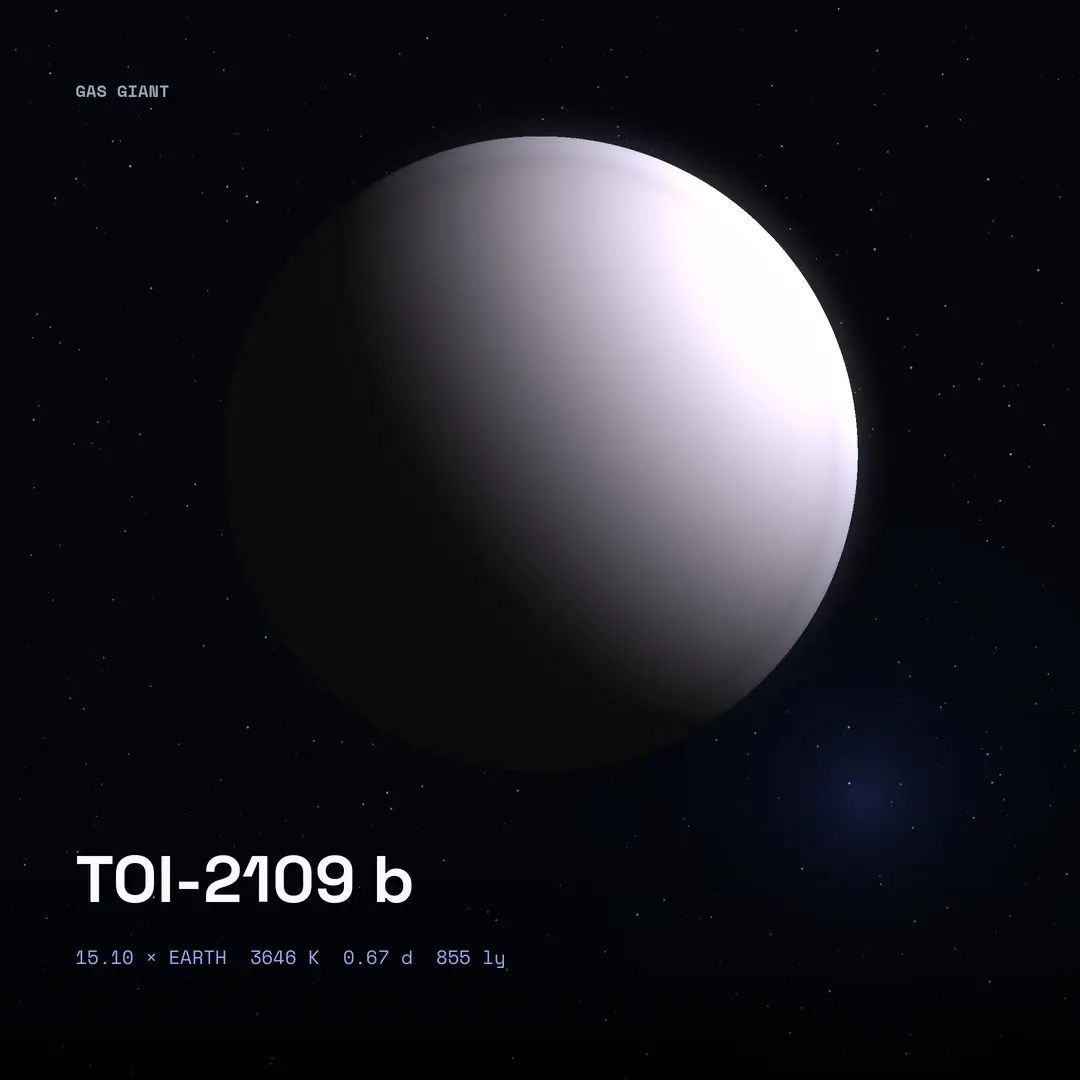
TOI-2109 b: A Year In 16.1 Hours
Gas giant around TOI-2109
It is 1.35 times Jupiter's radius, closest in size to Jupiter, and 1595.5 times Earth's mass. A year there lasts 16.1 hours, on an orbit 22 times closer to its star than Mercury is to the Sun. Its equilibrium temperature is 3646 K, hotter than the surface of many stars. The host star TOI-2109 runs at 6540 K with 1.45 times the Sun's mass.
3646K: hot enough to vaporise rock on the dayside
Radius
15.10 Earth radii
Mass
1595.5 Earth masses
Equilibrium temperature
3646 K (measured)
One year
16.1 hours
Orbit radius
0.0179 AU
Host star
TOI-2109 at 6540 K
Distance
855 light-years
Starlight blocked
0.663% at each transit
What has been measured here and what has not
A measured radius. Yes.
A weight, not just a width. Yes.
A density, which decides rock or gas. No.
A semi-major axis. Yes.
A measured temperature rather than a derived one. Yes.
An eccentricity, so the orbit shape is known. No.
What the transit gives
The depth of the dip is the ratio of the two discs, so the radius follows.
Found by Transiting Exoplanet Survey Satellite (TESS) in 2021. TESS scans most of the sky in 27-day stretches, so it favours bright nearby stars and short orbits over the faint distant ones Kepler specialised in.
Size from the shadow, mass from elsewhere. Most transiting planets never get the second half, and without it composition stays a guess.
