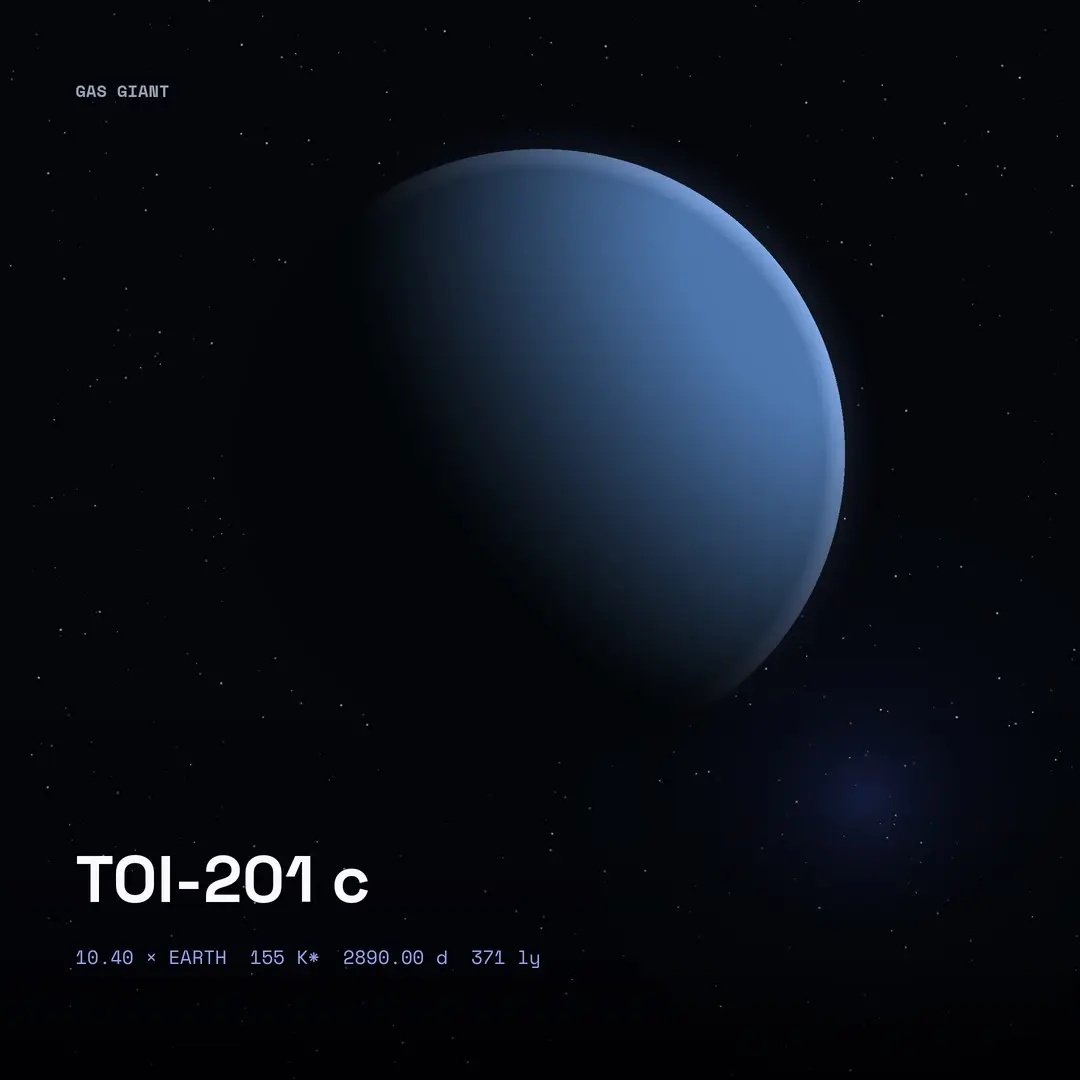
TOI-201 c: 24.0 Grams Per Cubic Centimetre
Gas giant around TOI-201
It is 0.93 times Jupiter's radius, closest in size to Jupiter, and 4990.0 times Earth's mass, at 24.00 g/cm3, denser than Earth. A year there lasts 7.9 years, on an orbit 11.3 times Mercury's distance from the Sun. Its equilibrium temperature is 155 K (derived from the star rather than measured), colder than anywhere on Earth. The host star TOI-201 runs at 6423 K with 1.32 times the Sun's mass.
24.0g/cm3: denser than iron at Earth surface pressure
TOI-201 from the inside out
Orbit
/
Planet
Radius
10.40 Earth radii
Mass
4990.0 Earth masses
Equilibrium temperature
155 K (derived)
One year
7.9 years
Orbit radius
4.3700 AU
Host star
TOI-201 at 6423 K
Distance
371 light-years
The habitability checklist, honestly scored
Within the zone where liquid water could persist. No.
Dense enough to be rock rather than gas, at 24.00 g/cm3. Yes.
A measured mass, not just a radius. Yes.
A measured temperature rather than one derived from the star. No.
Any detection of an atmosphere. Not recorded in the archive.
The archive lists no measured equilibrium temperature for this planet. The 155 K quoted here is derived from the star's output and the orbital distance, assuming a third of the light is reflected. It is an estimate from two numbers, not an observation.
Found by Transiting Exoplanet Survey Satellite (TESS) in 2025. TESS scans most of the sky in 27-day stretches, so it favours bright nearby stars and short orbits over the faint distant ones Kepler specialised in.
TOI-201 has 3 known planets. A crowded system is worth more than the sum of its planets: the timing of each transit constrains the others.
Its orbit is noticeably elliptical, eccentricity 0.65, so the starlight it receives changes substantially over one year.
Half the temperatures quoted for exoplanets are calculated from the star, not \
measured at the planet. Should a page like this show them at all, or leave the field blank?
