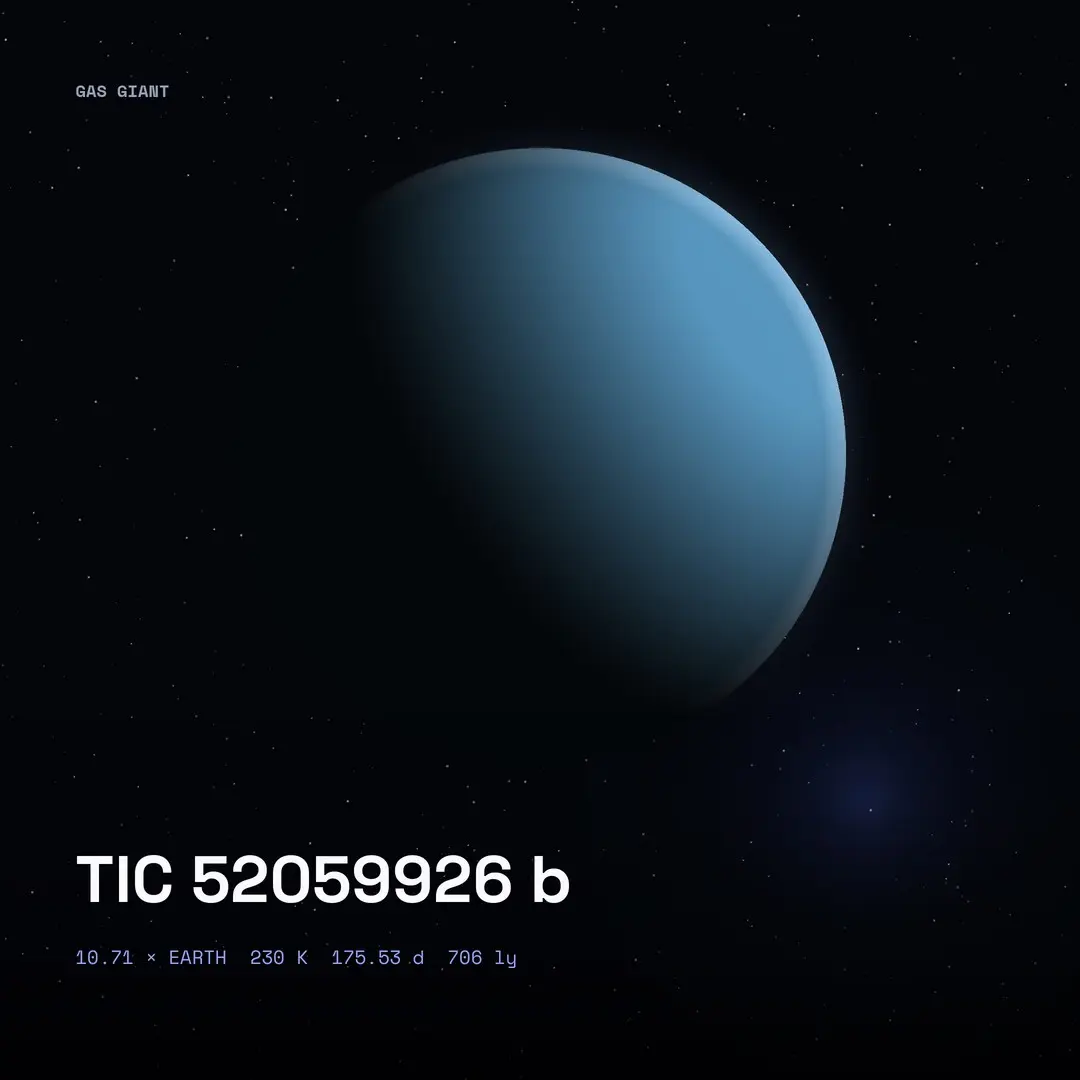
TIC 52059926 b: Habitable Zone, 176-Day Year
Gas giant around TIC 52059926
It is 0.96 times Jupiter's radius, closest in size to Jupiter, and 5380.0 times Earth's mass, at 24.10 g/cm3, denser than Earth. A year there lasts 175.53 days, on an orbit 1.4 times Mercury's distance from the Sun. Its equilibrium temperature is 230 K, in the range where liquid water is possible. The host star TIC 52059926 runs at 4505 K with 0.73 times the Sun's mass.
What is established here and what is missing
Orbits within the zone where liquid water could persist. Yes.
Dense enough to be rock rather than gas, at 24.10 g/cm3. Yes.
A measured mass, not just a radius. Yes.
A measured temperature rather than one derived from the star. Yes.
Any detection of an atmosphere. Not recorded in the archive.
24.1g/cm3: denser than iron at Earth surface pressure
Radius
10.71 Earth radii
Mass
5380.0 Earth masses
Equilibrium temperature
230 K (measured)
One year
175.53 days
Orbit radius
0.5530 AU
Host star
TIC 52059926 at 4505 K
Distance
706 light-years
Starlight blocked
1.856% at each transit
What the dip tells you
The fraction of starlight blocked sets the radius against the star's.
Found by Transiting Exoplanet Survey Satellite (TESS) in 2026. TESS scans most of the sky in 27-day stretches, so it favours bright nearby stars and short orbits over the faint distant ones Kepler specialised in.
A transit gives the radius and a separate measurement gives the mass. Having both is what makes a density, and a density is the only clue to composition at this range.
Its orbit is noticeably elliptical, eccentricity 0.51, so the starlight it receives changes substantially over one year.
TIC 52059926 b sits in the habitable zone on the arithmetic alone. That says \
where it orbits, not what it is like. What would you want measured next before calling it promising?
