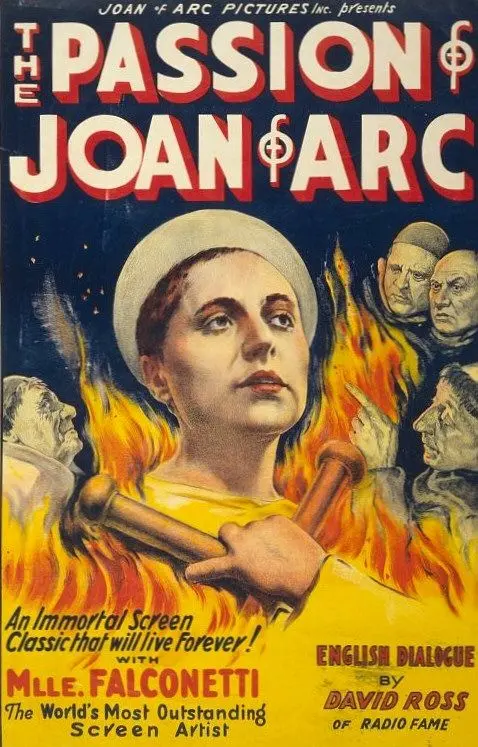
The Passion of Joan of Arc: A Print Found In An As
The Passion of Joan of Arc (1928)
Dreyer built a vast medieval set and then pointed the camera almost entirely at faces.
Runtime
82 minutes
Director
Carl Theodor Dreyer
Country
France
Cinematography
Rudolph Maté
Trial Transcripts And Close Ups
Dreyer worked from the surviving records of the 1431 trial and compressed months of interrogation into what plays as a single day. He had a full medieval fortress built in concrete and then largely refused to show it, shooting instead in close up on faces without makeup, lit flat and hard, often from below. Renee Jeanne Falconetti had come from light comedy on the Paris stage and never made another film. What she does here is not performance in the theatrical sense at all. The camera stays on her while judges lean in from the edges of frame, and the drama becomes a question of whether a person can be argued out of what they know. Dreyer cut the ground out from under the audience by refusing to establish the geography of the room, so the viewer is as disoriented as the accused.
Watching The Passion of Joan of Arc
Tone
/
Entry
The original negative burned in a Berlin fire in 1929. Dreyer assembled a second version from alternate takes and that one burned too, which is why the film was watched in poor reconstructions for fifty years.
In 1981 a complete original print turned up in a janitor's closet at the Dikemark psychiatric hospital in Oslo, still in its Danish shipping cans. That print is the basis of every version screened today.
"Do you believe you are in a state of grace?
"The examiner at the trial of Jeanne d'Arc