The One Event That Won't Go Away
One Event. Three Years of Checking. No Explanation.
On June 16, 2023, the LUX-ZEPLIN detector, buried nearly a mile underground in a former South Dakota gold mine, recorded a flash of light and a cluster of electrical charge that its 250-member collaboration has not been able to explain. Not in three years of checking. The collaboration presented the result at the 2026 TeV Particle Astrophysics conference in Japan, and submitted the paper to Physical Review Letters. The significance is 2.6 sigma: about a 0.5% chance the event is ordinary background. The threshold to claim a discovery in physics is 5 sigma. They are not claiming a discovery. But they cannot make the event disappear. "This event just won't go away even after many, many checks," said Dr. Theresa Fruth of the University of Sydney. "It's also kind of scary to think, 'Oh, this could be it.'"
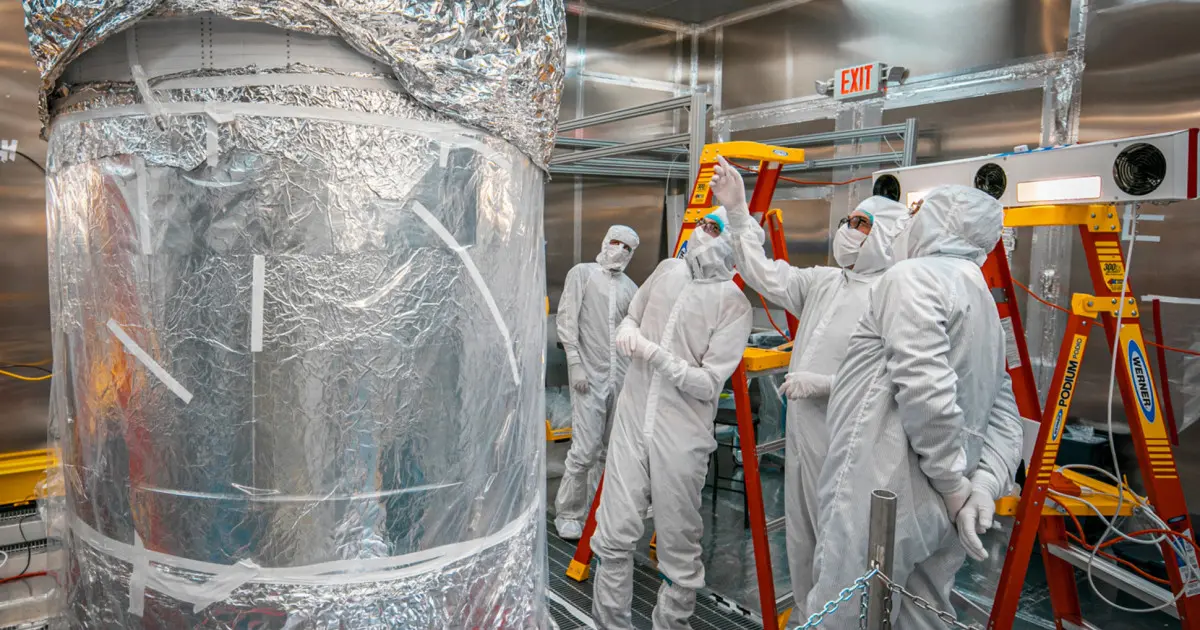
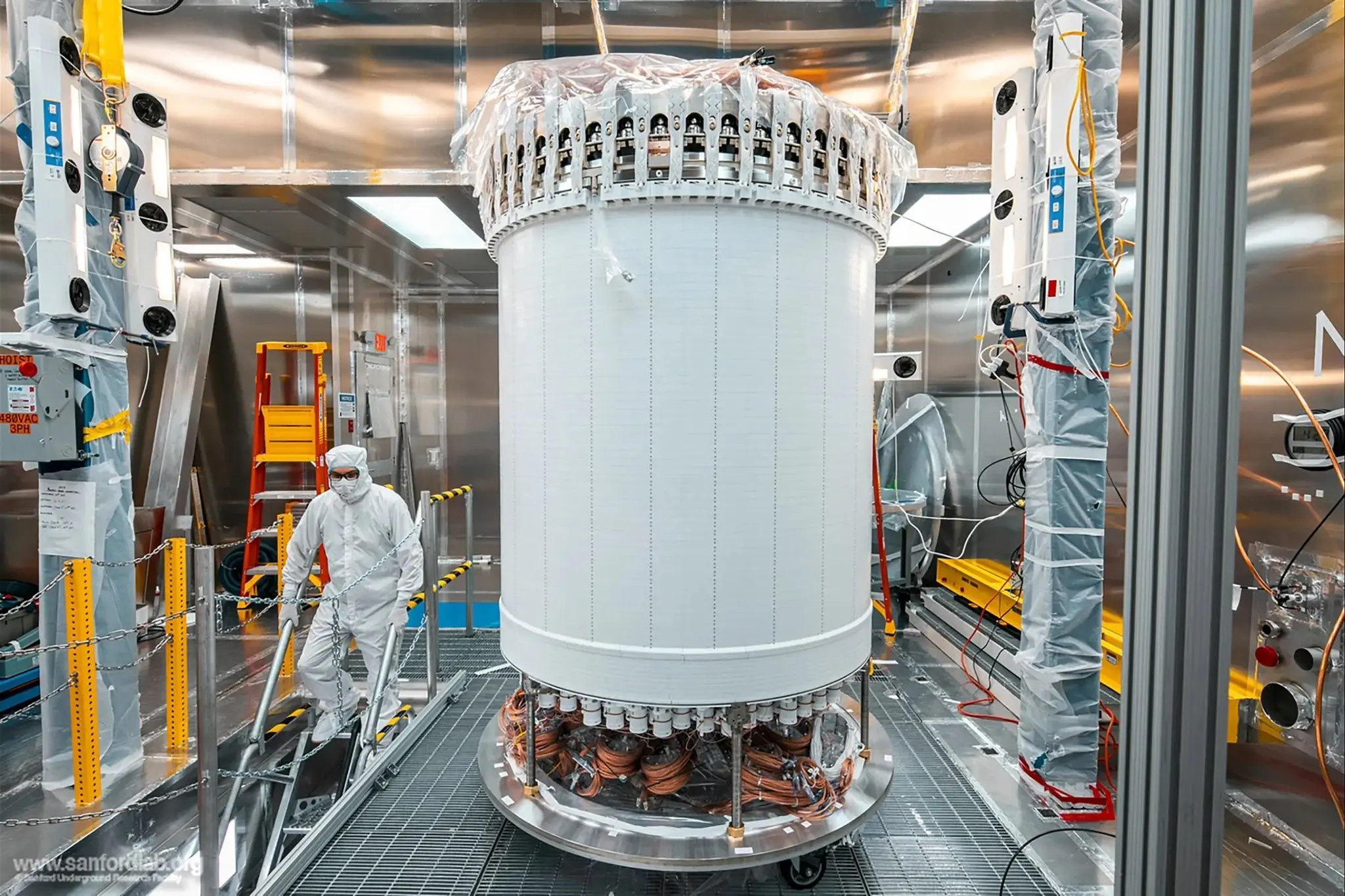
Workers prepare sections of the LZ experiment at SLAC before installation at the Sanford Underground Research Facility.
The titanium cryostat at the centre holds 10 tonnes of ultrapure liquid xenon chilled to minus 108 degrees Celsius.
85% of the Universe, and We Have Never Touched It
Dark matter does not emit, absorb or reflect light. Astronomers know it exists because it bends light from distant galaxies and holds galaxy clusters together in ways ordinary matter cannot. It accounts for roughly 85% of all mass in the universe. No experiment has ever directly detected a dark matter particle. The leading candidate is the WIMP: a weakly interacting massive particle that passes through ordinary matter almost without interaction but occasionally strikes an atomic nucleus and deposits a measurable amount of energy.
Three Years of Silence, Then One Thing
In a 280-day run published in August 2024, LZ found nothing, setting the tightest limits ever placed on WIMP interactions, ruling out a vast swath of parameter space predicted by supersymmetry. In a 417-day low-mass run published in December 2025, it found nothing in the low-mass range either, pushing the frontier down to 3 GeV. The detector is the most sensitive dark matter instrument ever built. Then it reported one thing.
Xenon in the detector
10 tonnes (5.5 tonne active mass)
Depth underground
0.9 miles (SURF, South Dakota)
Data analysed
220 live days (March 2023 to April 2024)
Signal significance
2.6 sigma (0.5% chance of background)
Discovery threshold
5 sigma
WIMP mass if real
more than 200 GeV (200x a proton)
Collaboration size
250 scientists, 39 institutions
Prior 2024 run result
no signal (world-best exclusion limits)
What the Event Actually Looked Like
The LZ detector works in two stages. When a particle strikes a xenon nucleus, it produces a prompt flash of scintillation light (S1). Recoiling electrons drift upward through the liquid and produce a second, amplified flash in a gas layer (S2). The ratio of S1 to S2 fingerprints what kind of particle hit. The June 2023 event deposited 248 keV, well above the low-energy window where most WIMP searches focus. It is strange in two directions at once: too energetic for the most common WIMP models, yet it lands in a region of the detector where known backgrounds are extremely sparse.
"The Most Interesting Single Event I Have Ever Seen"
Rick Gaitskell, Brown University professor and LZ Spokesperson: "We're very intrigued to see this event in the data, in the region where we expect dark matter to show up, and the competing backgrounds are very low. With only one event, we don't want to get ahead of ourselves. We are not claiming to have seen dark matter. But we have seen something interesting that we want to share." Sam Eriksen, University of Bristol, lead author: "We understand our detector and the backgrounds so well that even a single outstanding event, like the one we found, is important."
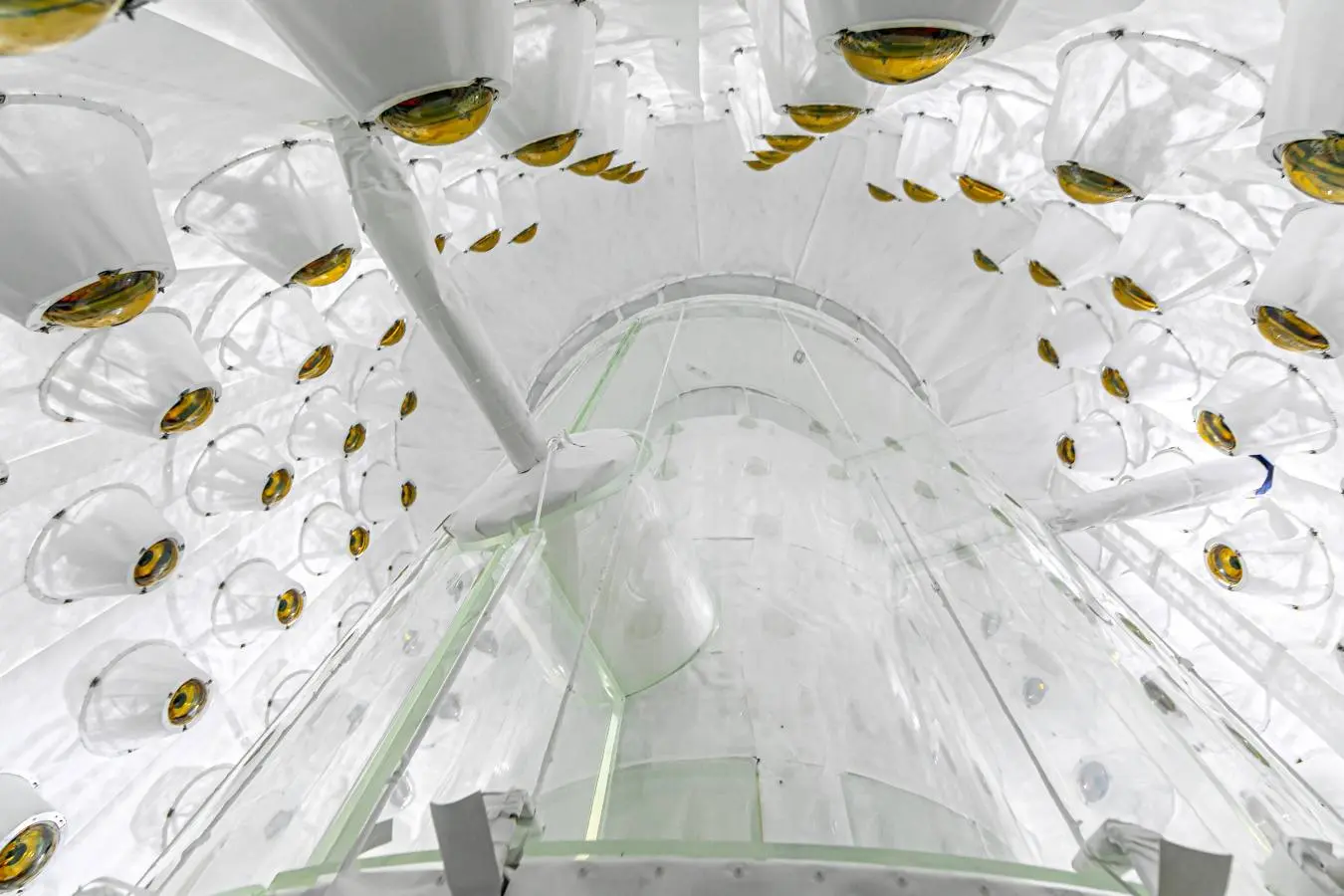
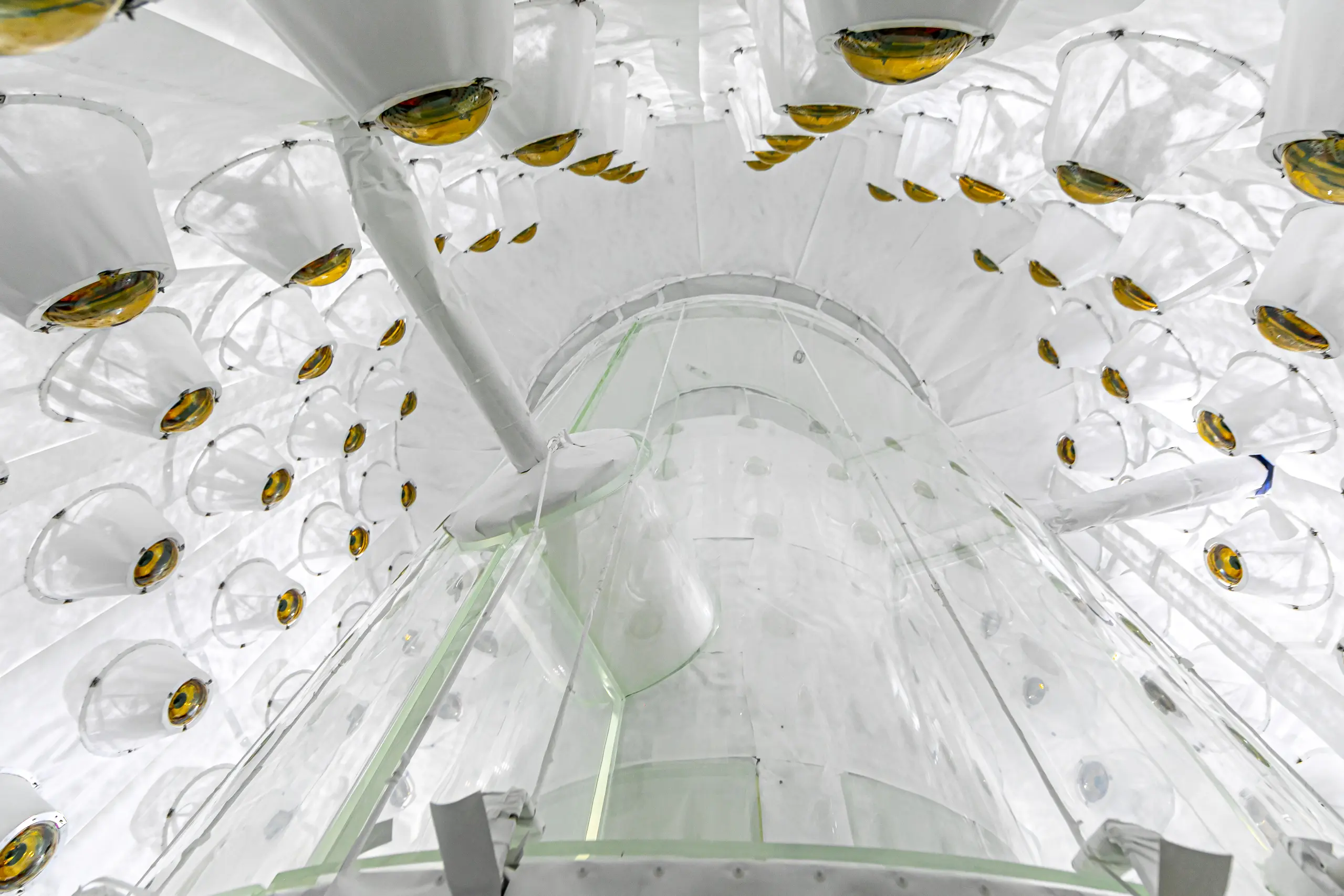
Looking up into the LZ outer detector.
The gadolinium-loaded liquid scintillator veto surrounding the main xenon tank flags any radioactive particle that enters from outside. The June 2023 event passed this veto cleanly, which is part of what makes it difficult to dismiss.
Why One Event Is Not Nothing
Particle physics has a long history of signals that vanish with more data. In 1983, the W and Z bosons were discovered with a handful of events at CERN. In 2012, the Higgs boson announcement came at 5 sigma with a few dozen candidates. The DAMA/LIBRA experiment in Italy has claimed a dark matter signal for over twenty years; no other detector has confirmed it. Aaron Manalaysay, Berkeley Lab physicist and LZ Institutional Board Chair: "This is the first example in any experiment I've worked on of an outlier that appears valid in every way." Eric Dahl, Northwestern University professor and LZ member: "In the 20 years that I've been involved in the search for dark matter, this is the most interesting single event that I've seen."
What Happens in the Next Two Years
LZ has analysed one quarter of the data it will ultimately collect. The experiment runs until 2028, targeting 1,000 live days total. By early 2027, a new analysis covering data through mid-2026 will be complete. If the June 2023 event is dark matter, more events should appear and the sigma will climb. If it is a statistical fluke, the sigma will fade. Two independent detectors are watching. XENONnT operates at Gran Sasso in Italy. PandaX-4T operates in China. Both use xenon. A confirmation from either one would change everything. For now, the experiment keeps running, a mile underground, in the dark, watching for a second event that has not appeared and may never come, or may come next week.