The Chip That Writes DNA
What just happened at Harvard SEAS
Engineers at Harvard John A. Paulson School of Engineering and Applied Sciences have built a silicon chip that writes DNA sequences using electricity and water, replacing the toxic organic solvents that have underpinned DNA synthesis since 1981. The work was published in Nature Electronics on 17 June 2026 by Donhee Ham's lab, in collaboration with the Broad Institute, DNA Script, and POSTECH. The chip synthesised 64 distinct DNA sequences in parallel and encoded 169 bytes of text into molecules, setting a new benchmark for enzymatic DNA synthesis.
Institution
Harvard SEAS and the Broad Institute of MIT and Harvard
Journal
Nature Electronics, 17 June 2026
Sequences synthesised in parallel
64 (previous enzymatic record: 12)
Data encoded
169 bytes of text written into synthesised DNA
Chip architecture
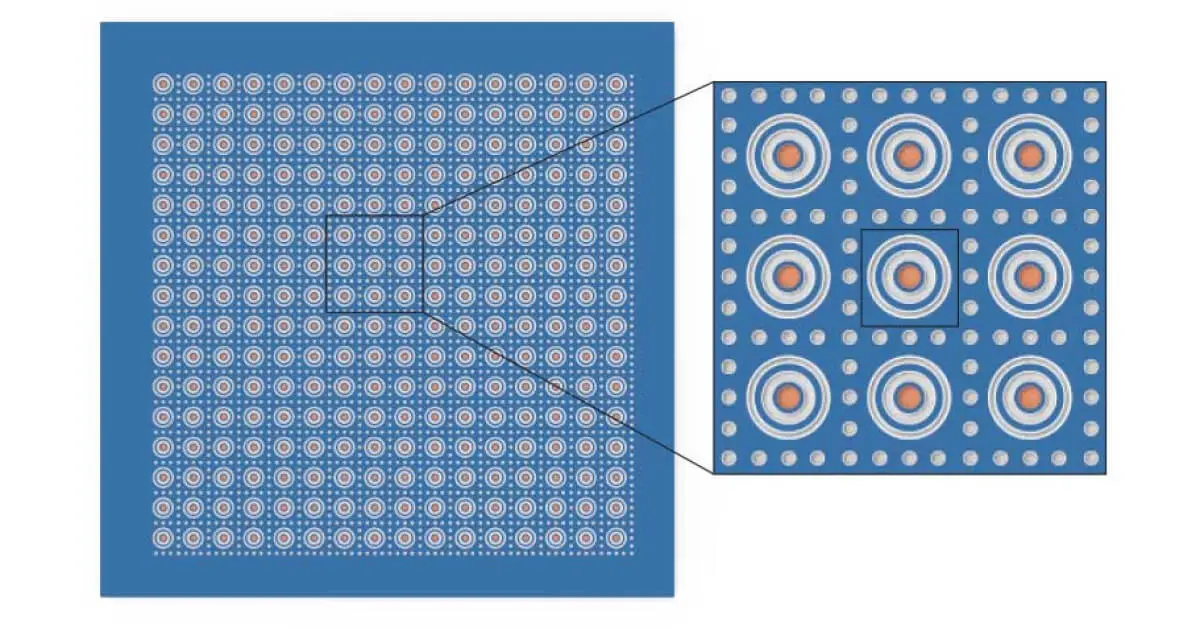
256 ring-electrode pairs on a CMOS chip
Solvent used
Water (replacing hazardous organic solvents)
Lead researcher
Professor Donhee Ham, Harvard SEAS
How it actually works
Traditional DNA synthesis, invented by Marvin Caruthers in 1981, builds strands nucleotide by nucleotide using phosphoramidite chemistry: a series of organic solvent washes that couple each new letter to the growing strand. It works well at scale but requires hazardous reagents, large facilities, and significant chemical waste. The approach has not changed in four decades.
The Chip Itself
The Harvard chip works entirely differently. The CMOS semiconductor carries 256 ring-electrode pairs. At each synthesis site, two concentric rings sit around an anchored DNA strand. When the inner electrode passes a small current through water, it generates protons, lowering the local pH. That acidic pocket activates an enzyme, a DNA polymerase, which snaps the next nucleotide onto the growing strand. The outer ring simultaneously draws current to mop up stray protons, preventing the acid zone from drifting to neighbouring sites and corrupting their sequences. Cycling through these steps at selected sites builds up to 64 unique sequences simultaneously, each letter at a time.
Where The Idea Came From
The conceptual origin of the chip is striking: Donhee Ham's lab originally built this precision current-injection platform for neuroscience, to permeabilise neuron membranes for intracellular recording. Somewhere in the process of studying cells, the team realised the same localised electrochemical control could be turned on molecules instead.
"A defining feature of the chip was precision current injection, which we used to permeabilise neuronal membranes ... At a certain point, we wondered whether that same current control could be redirected from cells to molecules. It worked.
"Donhee Ham · Harvard SEAS · Nature Electronics 2026
Seven things this chip could change
- DNA data storage at scale. DNA can pack an estimated 215 petabytes into one gram. The chip encoded 169 bytes. Scaling parallel synthesis beyond 64 sequences opens a credible path to chip-scale storage: dense, durable and readable centuries from now.
- Portable synthesis devices. Because the chip uses water and standard CMOS fabrication, it works with existing semiconductor manufacturing. That means smaller, safer synthesis devices outside central facilities: a hospital lab or a field diagnostic unit.
- Synthetic biology on demand. Gene circuits, biological sensors, and engineered organisms all require custom DNA sequences. Faster, cheaper, water-based synthesis accelerates the design-build-test cycle that drives synthetic biology.
- CRISPR guide RNA production. Every CRISPR experiment needs guide RNA molecules that are themselves written from a DNA template. More agile synthesis means more rapid genome-editing research and clinical applications.
- Cancer diagnostics. Tumour profiling requires synthesising panels of DNA probes matched to patient mutations. Localised, fast synthesis improves the speed and cost of personalised cancer diagnostics.
- Pandemic preparedness. Rapid synthesis of viral genome fragments underpins diagnostic test design and vaccine development. A chip-scale platform could compress the timeline from outbreak identification to test availability.
- Environmental monitoring. Synthetic DNA probes designed to bind specific pathogens or pollutants can be deployed in water and air monitoring systems. Cheaper synthesis makes denser, more widespread deployment practical.
"... That is why enzymatic synthesis in water can matter. If far more than 64 sequences can be synthesised in parallel, it could offer an environmentally friendly route toward writing DNA at very large scale.
"Woo-Bin Jung · co-first author · now at POSTECH
The honest bottleneck
The CMOS chip itself is not the limitation. Its 256 electrode pairs already outnumber the 64 sequences synthesised in this paper. The constraint is chemical. Between each nucleotide addition, a temporary blocking group must be removed in a deprotection step. The intermediate molecules released during deprotection drift to neighbouring sites and interfere with their synthesis, limiting how densely sites can be packed and how long the sequences can grow. The team's current record is 39 nucleotides per strand. Co-first author Han Sae Jung put it plainly: the chip did what was asked of it; the limitation came from the chemistry, not the silicon. The next engineering challenge is developing a more spatially confined, direct acid-driven deprotection chemistry that can keep pace with the chip's precision. That is a hard problem, but it is a defined one, and the field now has a clear target.
The paper, "Parallel enzymatic DNA synthesis using a semiconductor chip," appears in Nature Electronics, June 2026 (DOI: 10.1038/s41928-026-01662-9). Funding came from Harvard, the Broad Institute, the US National Science Foundation, and DNA Script. This is academic research, not a commercial product. Replication and independent validation by other groups is the next step before applications.