The Battery That Does Not Burn
The Dendrite Paradox, Solved.
What a Solid-State Battery Actually Is
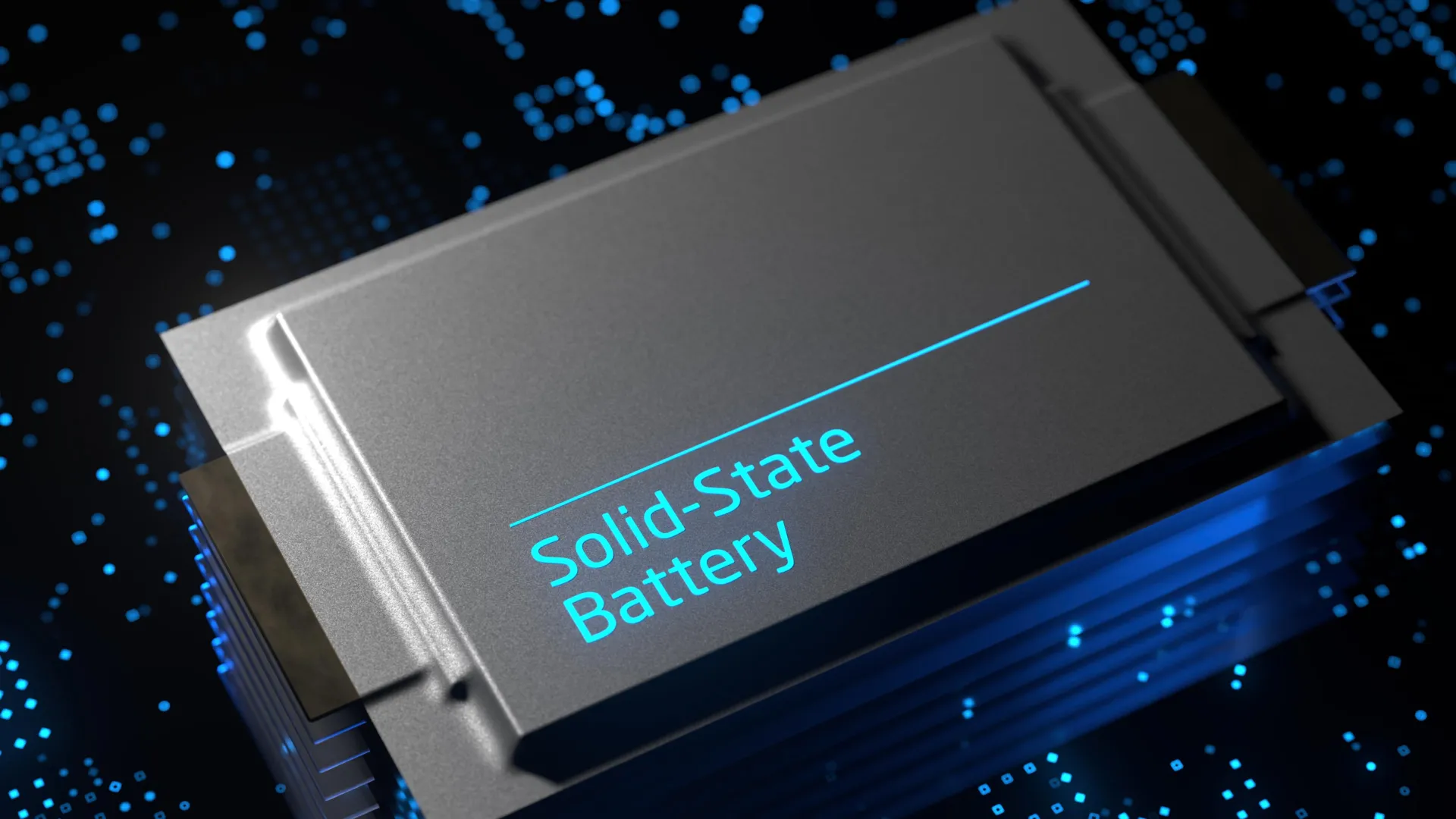
Inside every lithium-ion battery in your phone or car sits a flammable liquid. That liquid, the electrolyte, moves lithium ions between the two electrodes as the battery charges and discharges. Swap that liquid for a solid ceramic, and you get a solid-state battery: no fire risk, higher energy density, faster charging, longer life. The concept has existed for decades. The obstacle has been getting the solid parts to survive real-world charging cycles without cracking and short-circuiting. The most stubborn failure mode: dendrites.
Energy density (current Li-ion, pack level)
approx. 250 to 300 Wh/kg
Energy density target (solid-state)
400 to 500 Wh/kg
EV range today (typical)
250 to 400 miles
EV range (solid-state target)
600 to 750 miles
Fast-charge target (10% to 80%)
under 10 minutes
Battery fire risk (solid-state)
near zero, no flammable liquid
"The soft lithium metal is able to penetrate the stiff ceramic electrolyte, like a continuous waterjet that penetrates a rock. We calculated that hydrostatic stress in the dendrite leads to brittle fracture of the solid electrolyte in the end.
"Dr. Yuwei Zhang · Max Planck Institute · April 2026
The Waterjet Mechanism
Lithium dendrites are needle-like metal growths that form on the anode during charging. In a liquid-electrolyte battery they cause fires. In a solid-state battery, the team assumed the rigid ceramic would stop them. It does not. The MPI team found the answer using cryogenic electron microscopy, which lets you image lithium without it reacting to air or water. Once a dendrite enters even a tiny pre-existing crack in the ceramic (a crack created during normal manufacturing), it is confined on all sides. Confined lithium cannot deform to relieve pressure. So instead it builds up extreme hydrostatic stress, the same way water in a rock fissure can split a cliff face in winter. That stress transfers to the surrounding ceramic as tensile force and drives the crack forward. The dendrite does not punch through: it lets physics do it. The good news: those pre-existing cracks are a manufacturing artefact, not a fundamental law of chemistry. They can be controlled.
Fix one: tougher ceramics Engineers can increase the fracture toughness of the garnet electrolyte itself, so that even when confined lithium builds hydrostatic pressure, the crack cannot propagate. Ceramic composition and doping strategies are the main lever.
Fix two: engineered voids Deliberately designed micro-voids placed in the electrolyte during manufacture redirect dendrite growth paths and redistribute local stress. The crack that would have gone straight through instead deflects into a dead end.
Fix three is a protective coating on the lithium metal anode itself. If lithium never enters a defect crack in the first place, the confinement pressure mechanism cannot activate. Thin interfacial coatings are already a standard tool in battery engineering and are the most immediately deployable of the three fixes.
Who Is Closest
Toyota holds the largest global patent portfolio in solid-state batteries. Its sulfide-based cell received Japanese production approval in October 2025 and small-scale vehicle runs are targeted for 2027, with a 745-mile range and 10-minute charging. Samsung SDI is building the S-Line pilot plant in Suwon and targets 500 Wh/kg and a 9-minute charge by 2027. QuantumScape's Eagle Line facility opened in February 2026 and is already delivering its QSE-5 cell samples to Volkswagen's PowerCo. China's Changan is furthest along in deployment: its 400 Wh/kg cells entered EV and robotics validation testing in mid-2026, targeting 1500 km of range on China's CLTC cycle. The honest industry consensus: mass-market adoption before 2030 is unlikely, but the first solid-state vehicles on the road are a 2027 story, not a 2035 one.