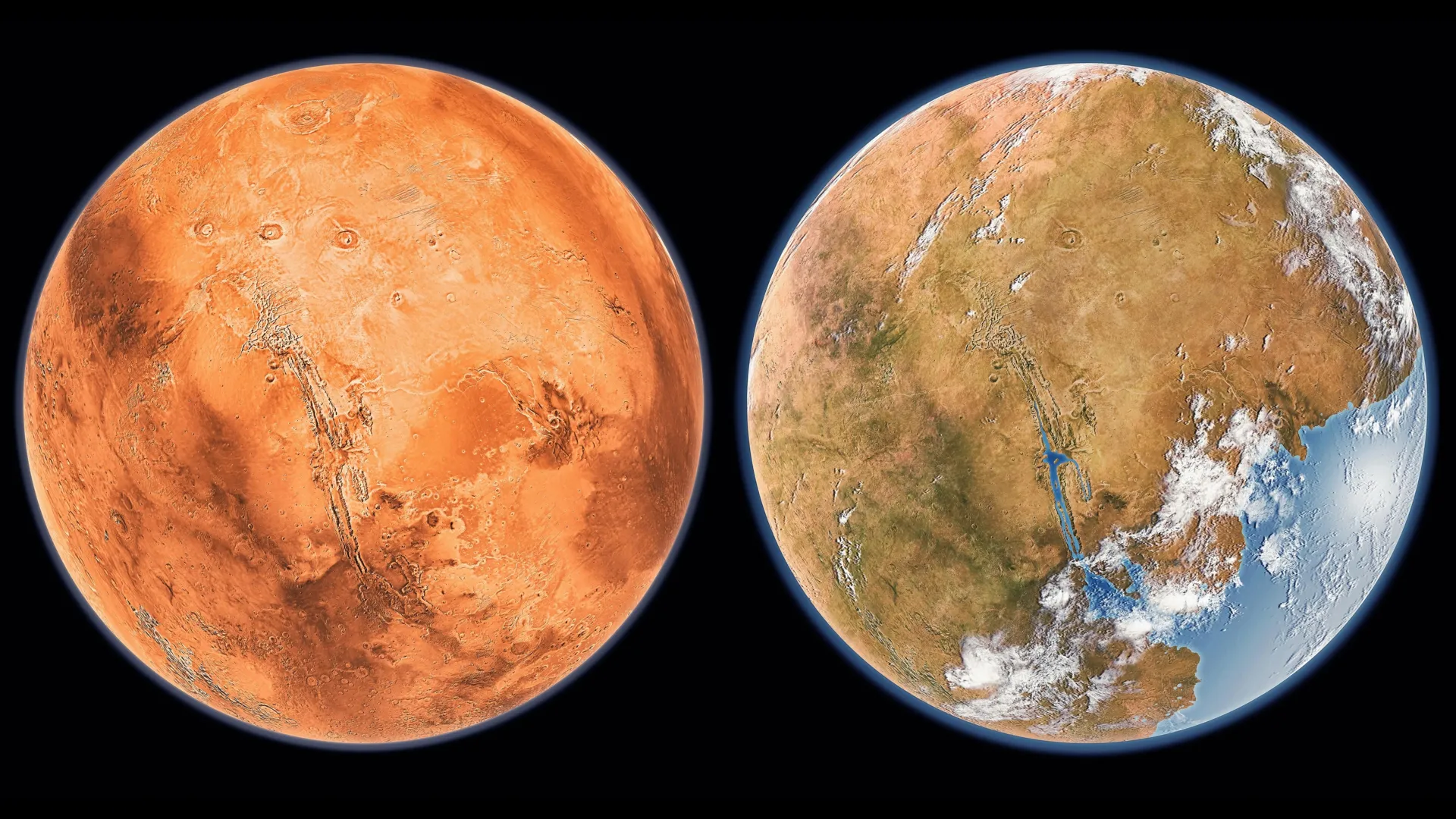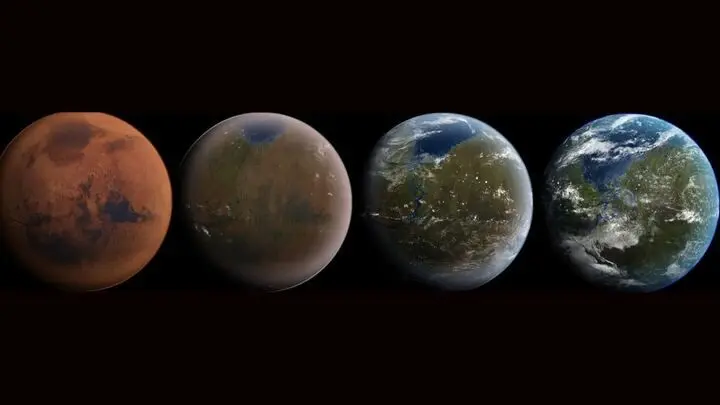
Terraforming Mars: The First Roadmap
3stages
The plan that just crossed from fiction to science
Nobody had published a rigorous scientific roadmap for terraforming Mars since 1991. That changed in July 2026 with a Perspective in Nature Astronomy authored by a 12-person international team led by Erika DeBenedictis, CEO of Pioneer Labs. Their conclusion is measured but striking: warming Mars to a point where plants could grow in pressurised domes, and humans could walk outside in oxygen masks, is no longer obviously impossible. Three breakthroughs made it thinkable again: SpaceX Starship slashing the cost of delivering mass to orbit, advances in synthetic biology making engineered extremophile organisms a real tool, and new three-dimensional global climate models of Mars that confirm the atmospheric feedbacks needed for warming actually work.
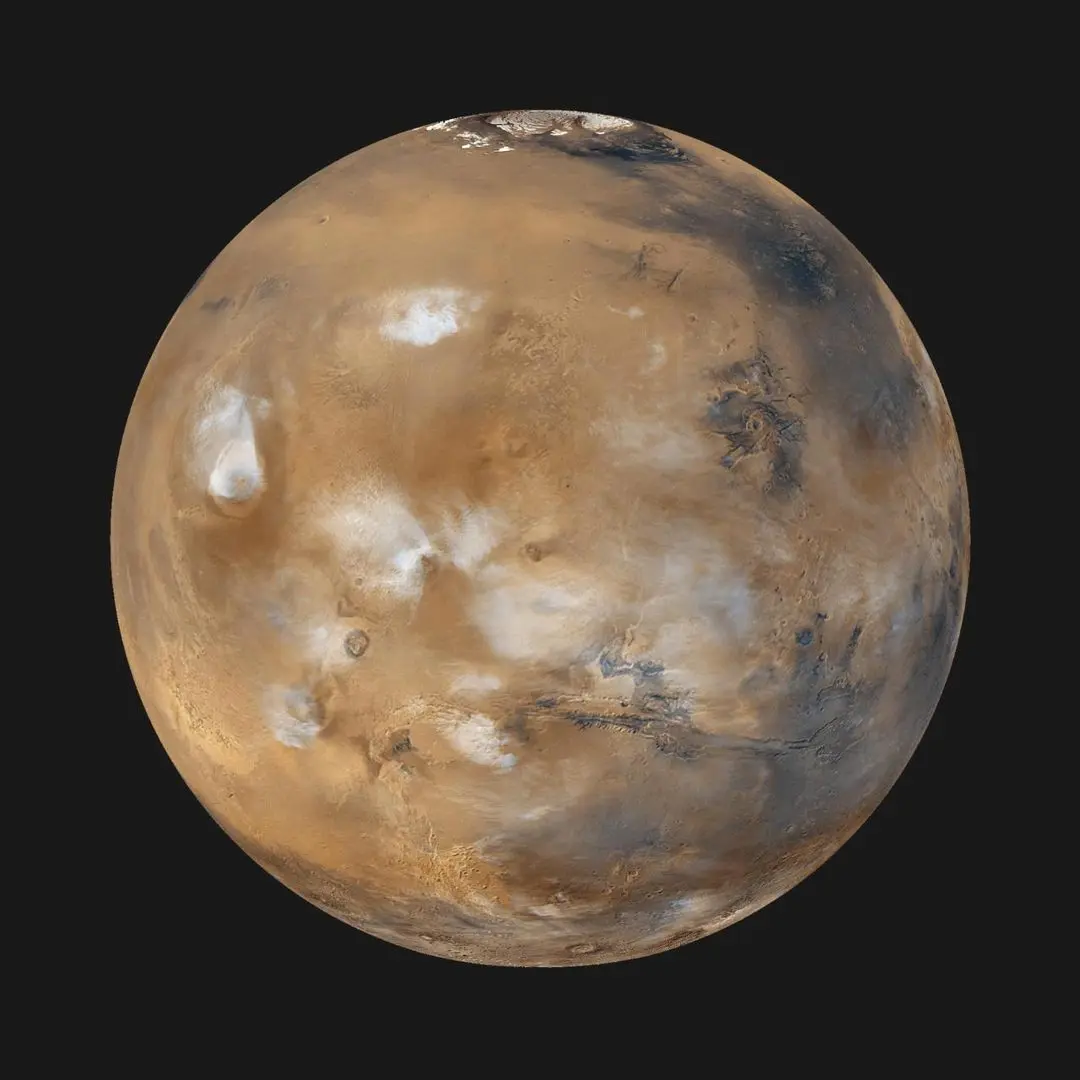
Current Mars average temperature
minus 60 degrees Celsius
Warming needed for liquid water
plus 30 to 50 degrees Celsius
Warming method
engineered metal nanoparticle aerosols
Aerosol flow rate needed
approx. 30 litres per second
Efficiency vs greenhouse gases
5,000 times more effective per kg
Time for measurable temperature rise
months after deployment begins
Time for plant-friendly surface (Stage 2)
decades, perhaps less than a century
Time for breathable atmosphere (Stage 3)
at least 1,000 years
Stage 1: warm the planet. Engineered iron or aluminium nanoparticles, released continuously into the Martian atmosphere at around 30 litres per second, would scatter infrared radiation back toward the surface 5,000 times more efficiently than conventional greenhouse gases. Martian winds spread them globally within weeks. Climate models confirm the effect is measurable within months of first release. Temperature rise of more than 30 Celsius is achievable over decades.
Stage 2: introduce biology. Once temperatures and atmospheric pressure climb enough to sustain liquid water near the equator, synthetic extremophiles, engineered descendants of cyanobacteria and lichens, would be seeded across ice-covered lowlands. Over decades they fix carbon, build organic soils, and begin releasing oxygen. Domed human settlements could exist in parallel, pressurised to breathable levels via electrolysis of meltwater. Agriculture becomes possible inside those domes. The paper
Stage 3: oxygenate the atmosphere. Scaling photosynthetic output to fill an entire planetary atmosphere with free oxygen is estimated to take at least 1,000 years. During that period, humans would live and work under domes. At the end of it, an open-air world becomes possible, without a need for a magnetic field, because Mars at that altitude would have enough atmospheric shielding to reduce radiation to survivable levels.
The ethical prerequisite Before any warming begins, the team says we must determine whether Mars harbours extant life, even microbial life deep in ice or rock. If it does, releasing nanoparticles to alter the climate could constitute an irreversible act of planetary-scale harm. The roadmap is explicit: search first, act second. This is its one non-negotiable condition.
Why now? "Believe it or not, no one has really addressed whether it is feasible to terraform Mars since 1991," said Nina Lanza, planetary scientist at Los Alamos National Laboratory. Since then: Mars orbiters and rovers have mapped the planet in detail, climate models have gone 3-D, synthetic biology has advanced by a generation, and Starship promises to deliver large masses to Mars for roughly the cost of a satellite launch.
"Thirty years ago, terraforming Mars was not just hard, it was impossible. New technology like Starship and synthetic biology have now made it a real possibility worth studying seriously.
"Erika DeBenedictis · Pioneer Labs · lead author · Nature Astronomy July 2026