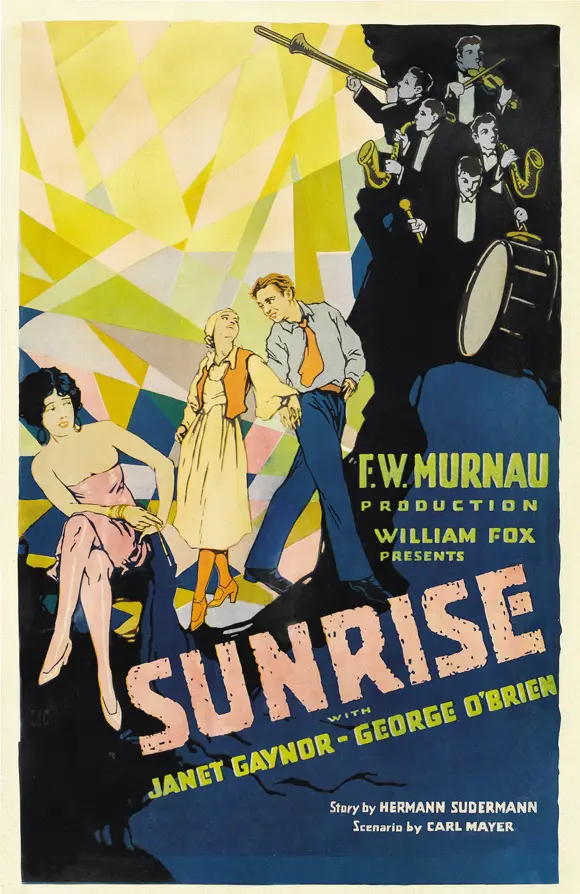
Sunrise: The Camera Comes Off Its Tripod
Sunrise (1927)
A silent film about a man who plans to drown his wife, and the first Academy Awards had to invent a category for it.
Runtime
91 minutes
Director
F. W. Murnau
Country
United States
Award
Academy Award for Best Actress
Score
Hugo Riesenfeld
The Unchained Camera Arrives In America
Murnau came to Hollywood from Germany with one idea he had proved in Der letzte Mann: the camera should move. Sunrise spends its money on that. Tracks run through a marsh built on a studio lot, a streetcar ride carries the couple out of the countryside and into a city constructed in false perspective, and the camera follows a man through reeds at night as he rehearses a murder he has already agreed to. The story is deliberately simple, close to a fable: a farmer, a wife, a woman from the city, a boat and a plan. Murnau strips the intertitles almost entirely, so the film has to carry its emotion in faces, weather and movement, and it does. The second half, which turns a day out into a courtship of the person you meant to kill, is one of the great tonal reversals in cinema.
Watching Sunrise
Weight
/
Section
"Couldn't she get drowned?
"The Woman from the City · Sunrise · 1927
Charles Rosher and Karl Struss shared the first Academy Award for Cinematography for this film, and the moving camera work was achieved with overhead rigs and tracks laid through built marsh.
Janet Gaynor won the first Best Actress award for this and two other films, and Sunrise took the only Unique and Artistic Production award ever given before the category was abolished.
Sunrise arrived in the last months before sound and is often called the summit of the silent film, which undersells it. Watched now it is a film about how a camera can hold an audience's sympathy while a character does something unforgivable, then win them back without asking for forgiveness. Its influence runs through Frank Borzage, through Malick's interest in weather as feeling, and through every director who has since discovered that a long unbroken move can do what a line of dialogue cannot