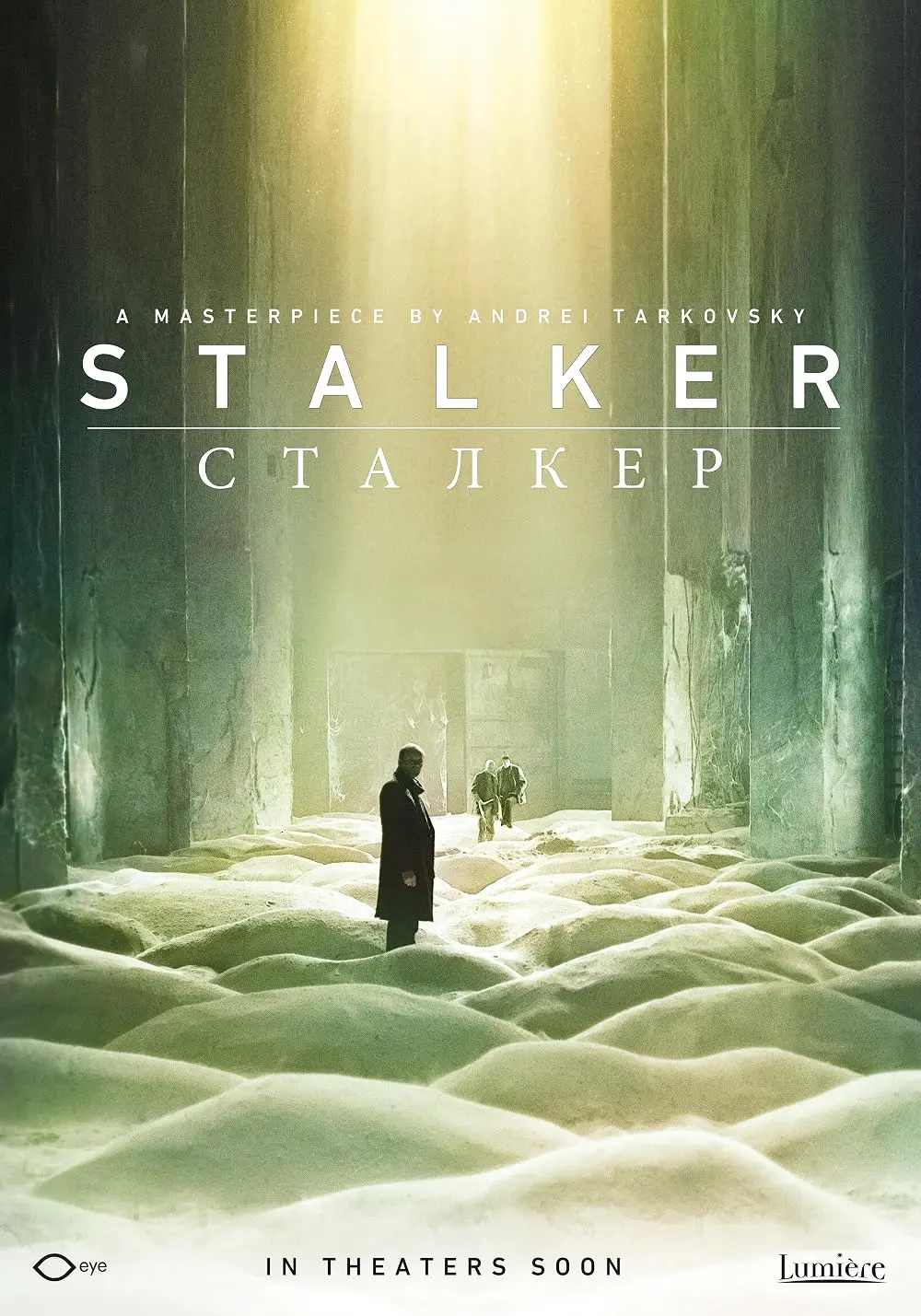
Stalker: A Year Of Footage Destroyed In The Lab
Stalker (1979)
Tarkovsky shot the whole film once, lost it to ruined stock, and made it again from the beginning.
A Wish Granting Room And No Special Effects
Three men pay a guide to take them illegally into the Zone, a cordoned area where the ordinary rules of space do not hold, to reach a room that is said to grant whatever the person entering it most deeply wants. That premise could carry a science fiction spectacle. Tarkovsky instead shoots wet grass, standing water, rusted machinery and ruined concrete in takes of four and five minutes, and makes the danger entirely a matter of behaviour: nuts tied with bandages are thrown ahead to test the way, routes are never walked twice, and the characters argue about faith. The Writer wants inspiration, the Professor wants to destroy the room, and the Stalker wants other people to have what he cannot ask for himself.
Runtime
163 minutes
Director
Andrei Tarkovsky
Country
Soviet Union
Cinematography
Alexander Knyazhinsky
Watching Stalker
Weight
/
Section
"Let everything that's been planned come true. Let them believe.
"The Stalker · Stalker · 1979
The first version was shot over about a year and destroyed by faulty processing of Kodak stock. Tarkovsky restarted with a new cameraman, Alexander Knyazhinsky, and rewrote as he went.
Locations near Tallinn included a disused hydroelectric station downstream from a chemical plant. Tarkovsky, his wife Larisa and the actor Anatoly Solonitsyn all later died of cancer, and several crew believed the shoot was the cause.
Adapted loosely from the Strugatsky brothers' Roadside Picnic, the film discards almost all of the novel's plot and keeps its central idea: that an encounter with something genuinely alien would not look like contact, it would look like a landscape behaving wrongly. It has since become the reference point for a whole mode of slow, contemplative science fiction, from Annihilation to the video game series that took its name.