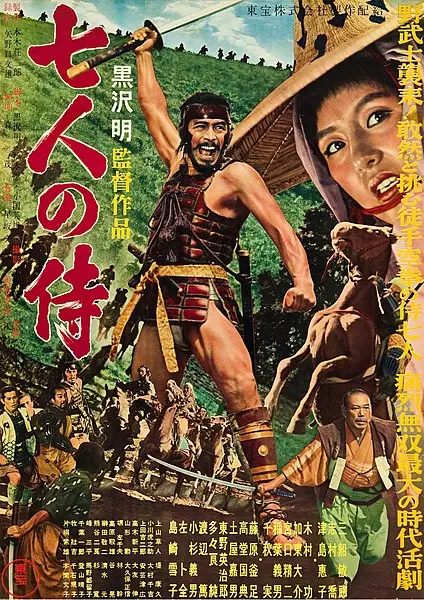
Seven Samurai: The Film That Invented Assembling A
Seven Samurai (1954)
A year of shooting, twice the budget, and the structure that every heist and team movie since has borrowed.
Runtime
207 minutes
Director
Akira Kurosawa
Budget
$210 million
Box office
$268 million worldwide
Cinematography
Asakazu Nakai
Recruitment As Story
A village of farmers, robbed of its harvest every year, decides to hire protection it cannot pay for. The first half of the film is recruitment: finding one masterless samurai who will listen, then using him to find six more, each introduced by a test that reveals character rather than skill. That structure, the gathering of specialists for an impossible job, has been reused so often that it now reads as a genre rather than an invention. Kurosawa shot with multiple cameras running long lenses simultaneously, which let him cut between distances inside a single continuous performance and gave the battles their sense of chaos observed rather than staged. Toho tried to shut the production down twice as it ran a year long and doubled its budget.
Watching Seven Samurai
Curiosity
/
Entry
"The farmers have won. We have lost.
"Kambei Shimada · Seven Samurai · 1954
What to watch for
Each samurai is introduced by a test rather than a description
Multiple cameras on long lenses in the battles, cutting inside one take
Kikuchiyo's speech reframing the farmers as neither innocent nor grateful
The flag with six circles and a triangle as a running casualty count
The final image of four graves above the rice planting
Kurosawa ran three cameras with telephoto lenses at once, a method he developed here and used for the rest of his career, and black ink was added to the rain to make it visible.
The structure was remade directly as The Magnificent Seven, borrowed by A Bug's Life, Battle Beyond the Stars and Rogue One, and quoted whenever a film says they need a crew.