Sensor Crop Factors: the Complete Cheat Sheet
No calculator needed. Every number in one place.
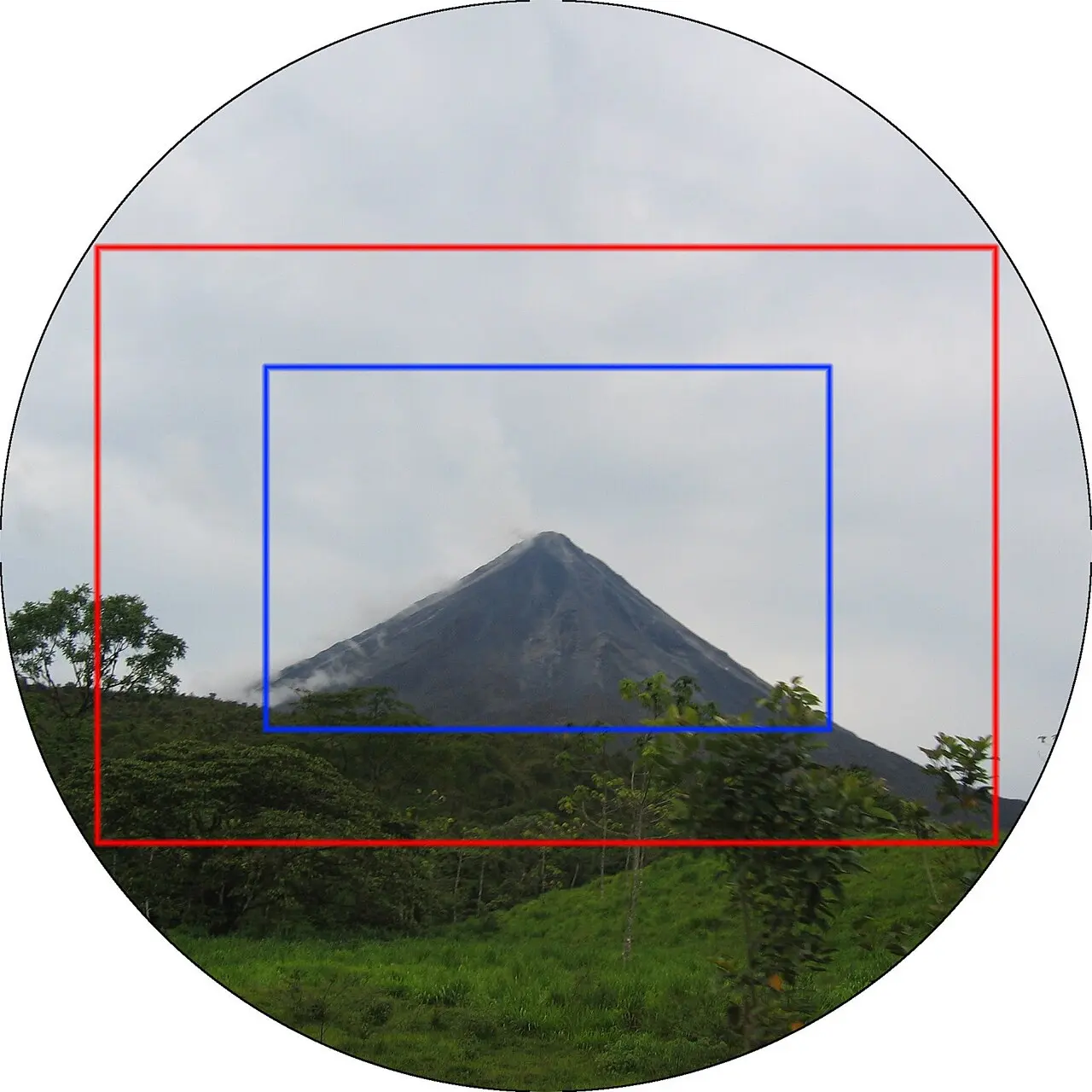
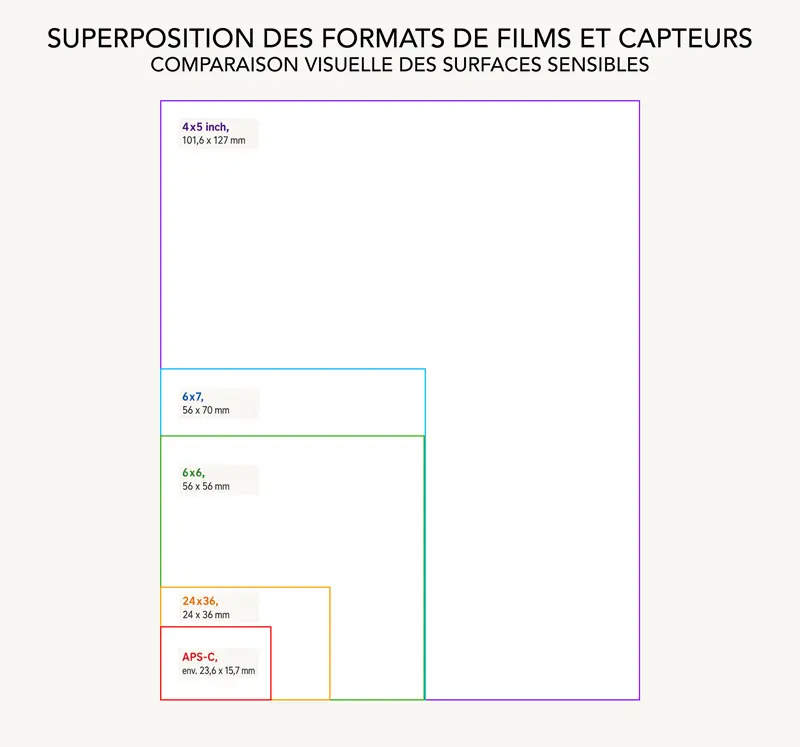
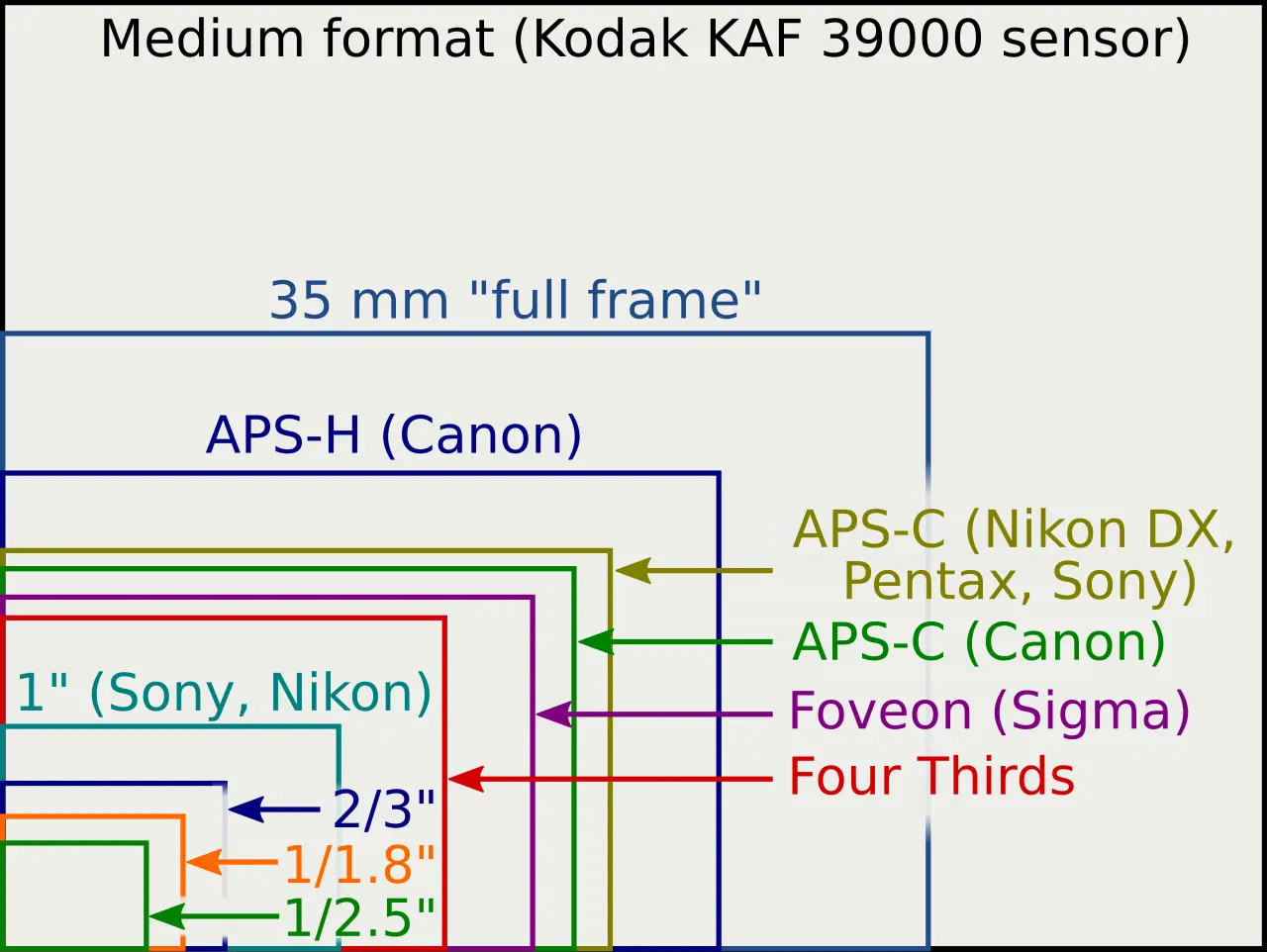
Crop factor tells you how a lens behaves on a given sensor compared to a full-frame 35mm body. It affects framing (a 50mm on APS-C crops like a 75mm) and depth of field (the same scene requires a wider aperture to get the same background blur). Both effects are covered here, across all eight major sensor formats you are likely to encounter, from full frame to the 1/2.3-inch sensors in compact cameras and drones. All dimensions from the Wikipedia Image Sensor Format reference (sourced from manufacturer data sheets). Crop factors computed as the ratio of the 35mm full-frame diagonal (43.27 mm) to each format's diagonal.
Sensor formats: physical dimensions and crop factor
| Format | Width (mm) | Height (mm) | Diagonal (mm) | Crop Factor | Common cameras |
|---|---|---|---|---|---|
| Full Frame (35mm) | 36.0 | 24.0 | 43.3 | 1.0x | Canon R6, Nikon Z6, Sony A7 |
| APS-H (Canon 1D series) | 28.7 | 19.1 | 34.5 | 1.26x | Canon EOS-1D (discontinued) |
| APS-C Canon | 22.3 | 14.9 | 26.8 | 1.6x | Canon R10, Canon R50, Canon 90D |
| APS-C Nikon / Sony / Fuji | 23.5 | 15.6 | 28.3 | 1.5x | Nikon Z50, Sony A6700, Fuji X-S20 |
| Micro Four Thirds (MFT) | 17.3 | 13.0 | 21.6 | 2.0x | Olympus OM-5, Panasonic G9 II |
| 1-inch | 13.2 | 8.8 | 15.9 | 2.73x | Sony RX100 VII, DJI Mavic 3 |
| 1/1.3-inch | 9.6 | 7.2 | 12.0 | 3.7x | Google Pixel 9 Pro, iPhone 16 Pro main |
| 1/2.3-inch | 6.17 | 4.55 | 7.7 | 5.64x | Most compact cameras, budget drones |
What crop factor actually means: two effects, not one
Two things change when you move a lens from full frame to a smaller sensor. The first is field of view. A 50mm lens on an APS-C Canon body (1.6x) frames the same scene as an 80mm lens would on full frame. This is what most guides cover. The second effect is depth of field: to get the same background separation, you need to open up by one crop factor's worth of stops. An f/2.8 lens on APS-C gives roughly the same depth of field as f/4.5 on full frame. Exposure (the brightness of the image) is NOT affected by crop factor: a lens at f/2.8 transmits the same amount of light per unit area regardless of sensor size, so your shutter speed and ISO stay the same for the same exposure. The tables below cover both effects separately.
Focal length equivalents on APS-C Canon (1.6x) and APS-C Nikon/Fuji (1.5x)
| Focal Length | APS-C Canon (x1.6) | APS-C Nikon/Sony/Fuji (x1.5) |
|---|---|---|
| 14mm | 22mm | 21mm |
| 16mm | 26mm | 24mm |
| 18mm | 29mm | 27mm |
| 24mm | 38mm | 36mm |
| 28mm | 45mm | 42mm |
| 35mm | 56mm | 53mm |
| 50mm | 80mm | 75mm |
| 85mm | 136mm | 128mm |
| 100mm | 160mm | 150mm |
| 135mm | 216mm | 203mm |
| 200mm | 320mm | 300mm |
Focal length equivalents on Micro Four Thirds (2.0x) and 1-inch (2.73x)
| Focal Length | MFT (x2.0) | 1-inch (x2.73) |
|---|---|---|
| 14mm | 28mm | 38mm |
| 16mm | 32mm | 44mm |
| 18mm | 36mm | 49mm |
| 24mm | 48mm | 66mm |
| 28mm | 56mm | 76mm |
| 35mm | 70mm | 96mm |
| 50mm | 100mm | 137mm |
| 85mm | 170mm | 232mm |
| 100mm | 200mm | 273mm |
| 135mm | 270mm | 368mm |
| 200mm | 400mm | 546mm |
APS-C is not one standard. Canon APS-C is 1.6x; Nikon, Sony and Fuji APS-C is 1.5x. On a 35mm lens the difference is 56mm vs 53mm equivalent: noticeable when choosing a portrait prime, invisible for wide or telephoto work.
Equivalent aperture for depth of field
Depth of field on a cropped sensor is shallower than exposure suggests. To match the background blur of a full-frame shot at a given aperture, multiply the f-number by the crop factor. The result is the equivalent aperture for depth of field purposes only. Exposure does not change. Example: a 25mm f/1.8 lens on MFT (2x) gives the field of view of a 50mm and the depth of field of a 50mm f/3.6 on full frame. You need a 50mm f/1.8 on full frame to match both the framing and the background blur.
Equivalent aperture for depth of field (multiply f-number by crop factor)
| Real f-stop | APS-C Canon (x1.6) | APS-C Nikon/Fuji (x1.5) | MFT (x2.0) | 1-inch (x2.73) |
|---|---|---|---|---|
| f/1.2 | f/1.9 | f/1.8 | f/2.4 | f/3.3 |
| f/1.4 | f/2.2 | f/2.1 | f/2.8 | f/3.8 |
| f/1.8 | f/2.9 | f/2.7 | f/3.6 | f/4.9 |
| f/2.0 | f/3.2 | f/3.0 | f/4.0 | f/5.5 |
| f/2.8 | f/4.5 | f/4.2 | f/5.6 | f/7.6 |
| f/4.0 | f/6.4 | f/6.0 | f/8.0 | f/10.9 |
| f/5.6 | f/9.0 | f/8.4 | f/11.2 | f/15.3 |
Equivalent aperture applies to depth of field only. Your camera meter, your histogram, and your shutter speed calculation are all based on the real f-number. Only switch to the equivalent figure when comparing background blur across sensor sizes.
Interchangeable-lens formats
Full frame: maximum light gathering, shallowest depth of field, widest usable angle. The reference format for all comparisons.
APS-C Canon (1.6x) / Nikon, Sony, Fuji (1.5x): the most common ILC format. Smaller and lighter than full frame. A 300mm gives 450mm-equivalent reach without a teleconverter, which is the main reason wildlife shooters choose it.
Micro Four Thirds (2.0x): the smallest interchangeable-lens system. Strong for telephoto and birding; the DoF penalty means you need f/1.4 glass to match f/2.8 full-frame background blur.
Fixed-lens and phone sensor formats
1-inch (2.73x): found in premium compact cameras (Sony RX100 VII) and prosumer drones (DJI Mavic 3). Meaningfully larger than a phone sensor; the difference in low-light and depth of field is visible in side-by-side shots.
1/1.3-inch (3.7x): the main sensor in flagship phones such as the Google Pixel 9 Pro and iPhone 16 Pro. Crop factor is high; "2x" and "5x" zoom modes on these phones use separate smaller sensors, not digital cropping.
1/2.3-inch (5.64x): most budget compacts and entry-level drones. Fast apertures help less here: f/2.0 on 1/2.3-inch equals f/11 depth of field on full frame, so nearly everything is in focus regardless of aperture.