Saturn Grew a New Polygon and Nobody Saw It Coming
Saturn Now Has Two Giant Polar Polygons, and the Second One Surprised Everyone
Astronomers have been looking for it since 1990. Saturn's northern pole has been wrapped in a hexagon, a six-sided atmospheric wave, for as long as anyone has measured it. Voyager 1 spotted it in 1980. It was there when Cassini arrived in 2004. It was still there when Cassini crashed into Saturn in 2017. The question that followed the hexagon for decades was simple: is there something like it on the south pole? The answer, published September 2, 2026 in Science Advances, is yes. But not a hexagon. A decagon. Ten sides. And it only started forming a few years ago.
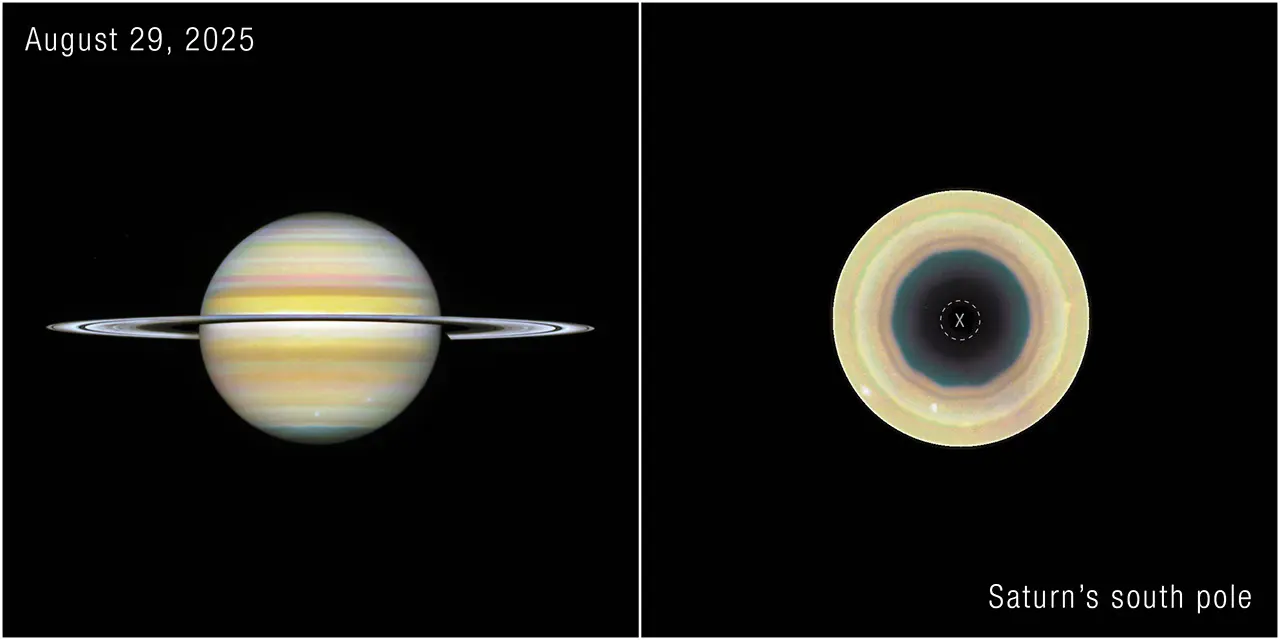
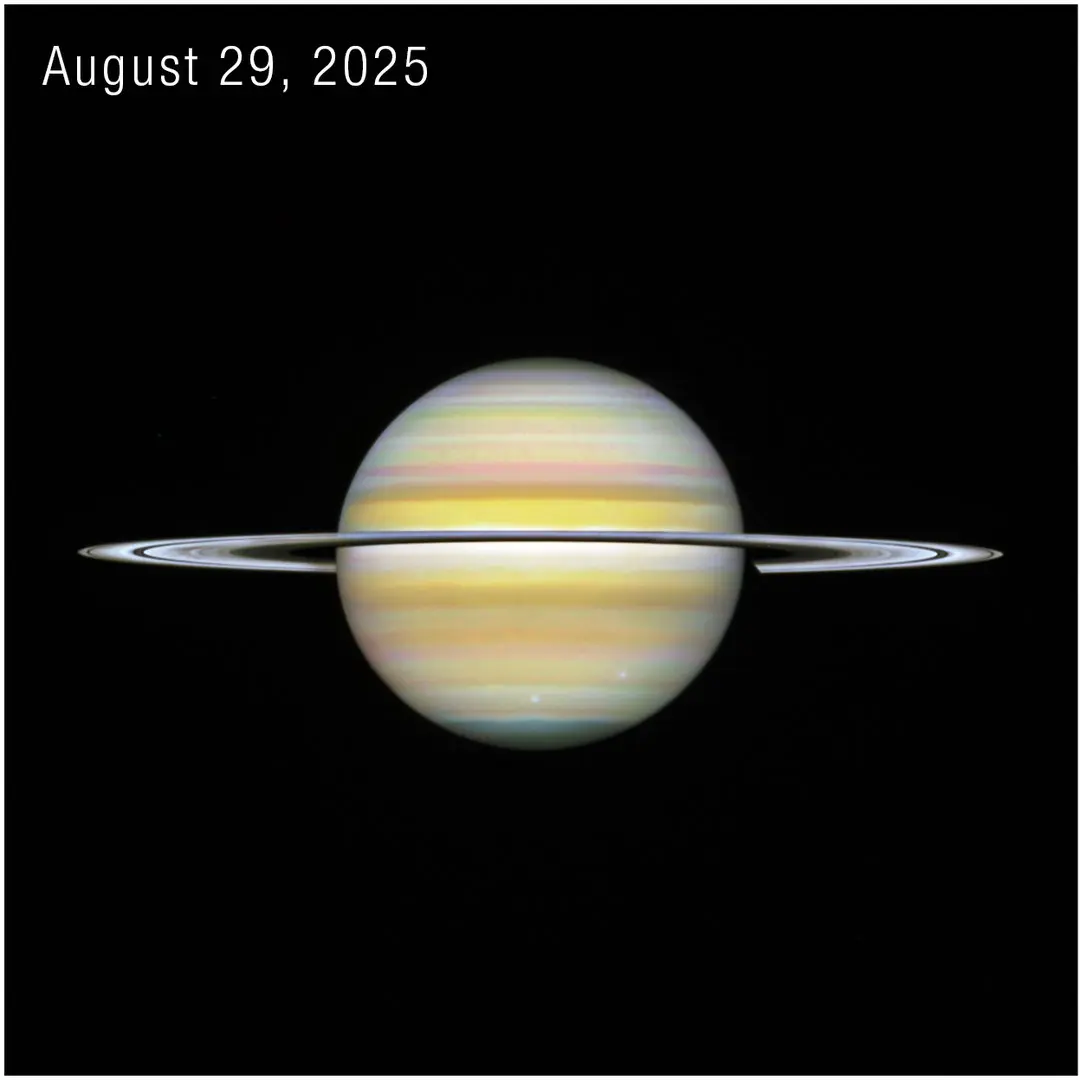
The face of Saturn as seen by Hubble's Wide Field Camera 3 on August 29, 2025.
The decagon sits at the south pole, invisible from this angle. The second image below is the pole-on view.
The Search That Took 36 Years
Lead author Agustin Sanchez-Lavega, a planetary scientist at the University of the Basque Country in Spain, put it plainly: "Given Saturn's symmetry in its north-south jet stream system, we have been searching for a counterpart to Saturn's northern hexagon on the south pole in Hubble images since 1990." The search failed for a long time. Cassini, which spent 13 years in Saturn orbit, "showed no inkling of a long-lived formation" at the south pole during its entire mission, according to the paper. Cassini ended in September 2017. Within a few years of its departure, the decagon appears to have quietly begun forming. Hubble's OPAL program, which systematically images the outer planets every year, caught the first faint hints in 2023. Ground-based observers noticed an undulating band in 2024. By August 2025, Hubble's images showed a fully defined 10-sided structure embedded in the jet stream around 63 degrees south latitude.
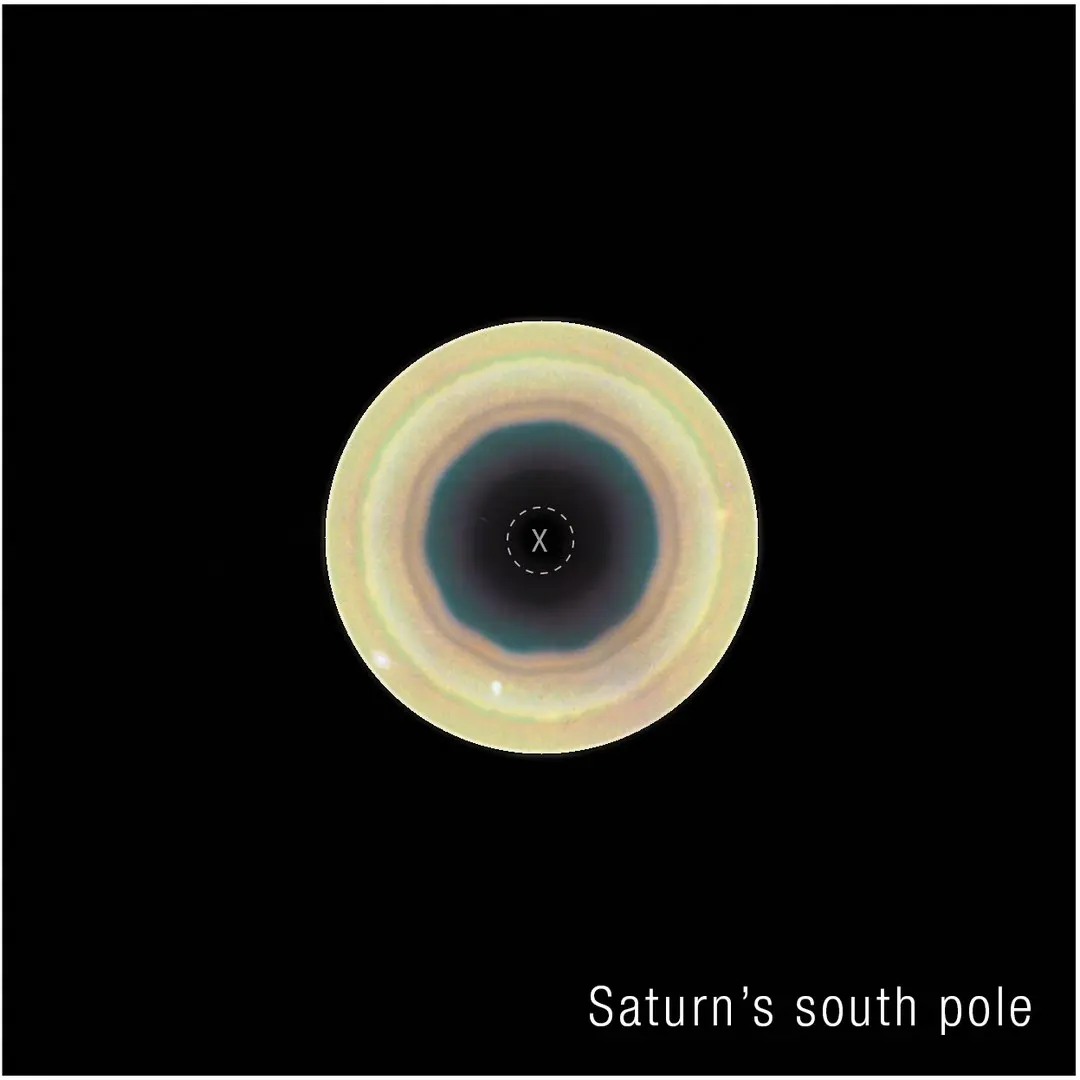
Saturn's south pole as seen by Hubble at ultraviolet and near-infrared wavelengths.
The decagon wave is the ring of undulating colour surrounding the dark polar vortex. The dashed circle marks the approximate pole.
Different From the Hexagon in an Important Way
The northern hexagon is a standing wave: stable, old, and not obviously changing. Amy Simon, the OPAL principal investigator at NASA Goddard, noted the contrast: "The northern hexagon has been there every time we've looked for more than 40 years. This feature is different. It appears to be strengthening, giving us the rare opportunity to watch a giant atmospheric pattern develop." That word, strengthening, is the key detail. The team is not reporting a feature that was simply missed. They are reporting one that is actively growing. Scientists do not yet know what triggered it, whether a shift in Saturn's seasonal winds or something else. Saturn's southern hemisphere is only now emerging from its winter. The hexagon appeared at the north during a similar seasonal transition and never left.
A Wave That Tilts as It Rises
Whether the decagon will persist like the hexagon remains an open question. Unlike the hexagon, the decagon extends through multiple layers of Saturn's atmosphere, making it vertically deeper than a simple surface wave. Hubble's multi-wavelength imaging reveals the structure at slightly different positions across different altitudes, a sign that the wave tilts as it rises through the atmosphere.
""This feature is different. It appears to be strengthening, giving us the rare opportunity to watch a giant atmospheric pattern develop." Amy Simon, OPAL Principal Investigator, NASA Goddard
"Steph1st of October 2026

Why 10 Sides and Not 6
The decagon raises a precise question: why 10 sides in the south when there are 6 in the north? The underlying physics is the same. Atmospheric waves lock to jet streams according to wind speed and latitude, and the number of corners a polygon develops depends on that speed. A different polygon count means the southern jet stream is spinning at a different rate than the northern one. That gives scientists a direct measurement of wind asymmetry between the two hemispheres across a full planetary orbit.
Still Watching, Still Forming
Amateur astronomers Trevor Barry and Jean-Paul Oger contributed ground-based images to the analysis, an unusual collaboration for a Science Advances paper. The team plans continued Hubble OPAL observations to track whether the decagon stabilises, intensifies, or dissolves. A planet photographed continuously for 46 years just showed something no one had recorded before. It was forming the whole time Cassini was there. We simply could not see it yet.