
REM Sleep Cuts Risk of 83 Diseases
95,000 wrist trackers. Nine years. REM sleep cut Parkinson's risk by 80 percent.
A study of 95,559 adults found that people who get more REM sleep had an 80 percent lower risk of Parkinson's disease over the following nine years. That is not a rounding error. It is a hazard ratio of 0.20: the strongest single association in the largest real-world sleep architecture study ever published. Published September 17, 2026 in PLOS Medicine by Shengzhi Sun and colleagues at Capital Medical University and Peking University in Beijing, the study is the first large-scale attempt to measure all four sleep stages continuously, in everyday life, and map each one to every major disease category. Prior lab-based studies established that poor sleep worsens inflammatory markers and that short sleep predicts cardiovascular events. None had the scale to test a thousand disease phenotypes at once.
REM sleep and heart failure risk
hazard ratio 0.74 (down 26%)
REM sleep and dementia risk
hazard ratio 0.54 (down 46%)
REM sleep and Parkinson's disease risk
hazard ratio 0.20 (down 80%)
Participants tracked by wrist accelerometer
95,559 adults
Median follow-up period
8.9 years
Total disease phenotypes tested
1,049
Diseases where more REM sleep meant lower risk
83
Diseases where more deep sleep meant lower risk
7
Diseases linked to sleeping under 5 hours/night
37
Why REM sleep may protect the brain
REM sleep, the stage when the eyes move rapidly and vivid dreams occur, accounts for roughly 20 to 25 percent of a healthy adult's night. Its role is not passive. During REM, the brain consolidates emotional memories, clears metabolic waste through the glymphatic system, and restores the prefrontal cortex's regulation of stress hormones. Research published before this study found that disrupted REM is an early marker of Parkinson's disease: patients are often diagnosed with REM sleep behaviour disorder (in which the protective paralysis that normally accompanies the stage fails) a decade before motor symptoms appear. The new finding inverts the inquiry. Where previous work used disrupted REM as a predictor of Parkinson's, this study asks whether more REM, sustained over years, is protective. The hazard ratio of 0.20 says it may be.
What 83 diseases have in common
The 83 REM-associated conditions span cardiovascular, neurological, metabolic, respiratory, and mental health categories. Heart failure (HR 0.74) and dementia (HR 0.54) sit at the moderate end. Parkinson's, at HR 0.20, is an outlier that demands an explanation. The authors suggest the glymphatic system's clearance of alpha-synuclein aggregates during sleep could be part of the mechanism, but note this remains a hypothesis rather than a demonstrated causal pathway. The confidence interval for the Parkinson's association is not narrow enough to treat the figure as settled science. It is striking enough to justify a dedicated clinical trial.
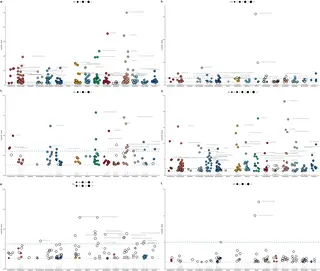
Credit: PLOS Medicine / Sun et al. 2026. Figure 4 shows the phenome-wide \
association between accelerometer-derived sleep metrics and incident disease. Blue circles passed false discovery rate correction; red passed Bonferroni correction.
Six to eight hours is a range, not a number
The study's secondary finding concerns total sleep duration. The lowest disease risk concentrated in the 6 to 8 hour window. Sleeping fewer than five hours per night was associated with elevated risk across 37 disease outcomes, far more than any single sleep-stage metric. Above eight hours, some associations reversed: the authors caution this likely reflects reverse causation, as people who are already ill tend to sleep longer. Deep sleep was associated with lower risk of seven conditions: type 2 diabetes, major depressive disorder, sleep apnea, and four others. That narrower range, relative to REM's 83, was unexpected and the authors do not offer a clear explanation.
Where the method falls short
Sleep irregularity and wakefulness after sleep onset showed harm rather than protection. Greater irregularity was linked to elevated anxiety and substance use disorder. Frequent nighttime awakenings were tied to alcohol dependence. These associations survived Bonferroni correction, the strictest multiple-comparison standard the authors applied. One caveat carries real weight. Wrist accelerometers cannot directly measure brain activity. The researchers used a deep-learning algorithm, SleepNet, to estimate sleep stages from movement data. That is an approximation of the gold standard, the polysomnography lab recording. The estimates correlate well with lab measurements in validation studies, but the error is not zero. This is observational data: the study cannot prove that improving your sleep prevents Parkinson's disease.
"Maintaining 6 to 8 hours of sleep is associated with a more favourable sleep architecture and lower disease risk.
"Sun et al. · PLOS Medicine · September 2026
What wearables and sleep medicine do with this
The more immediate implication is for consumer wearables. Devices from Apple, Samsung, and Fitbit already estimate sleep stages from wrist movement and heart rate variability. None currently flags when REM proportion is chronically low. If the Parkinson's association holds under further scrutiny, the case for a clinical-grade REM alert in those devices becomes considerably stronger. The UK Biobank cohort, having now run wrist trackers on 95,000 people for nine years, produces the statistical power that lab studies cannot match. The 156 significant associations the study reports after Bonferroni correction are not noise.
The risk differences above were measured across a 47.6-minute interquartile range increase in REM sleep, within the normal variation of healthy adults. Alcohol consumed within three hours of sleep is the single largest REM suppressant in otherwise healthy people. Consistent bedtimes preserve REM architecture better than total duration alone.