Read a Vinyl Record: Deadwax and Plant Codes
Two Layers of Identification on Every Record
Every vinyl LP carries two distinct layers of information about its pressing history. The first is visible on the paper label: catalog number, country of manufacture, label colour variant, and release year. The second is hidden in the deadwax, the smooth ring of bare vinyl between the last groove and the label, where pressing plants and mastering engineers stamped or hand-etched the codes that tell you exactly which cut you are holding. Neither layer is sufficient on its own. A label variant dates the pressing to a period; the deadwax narrows it to a specific lacquer cut and plant. Together they are how collectors confirm, before buying, whether a copy is a true original.
The Printed Label: Catalog Number and Colour Variant
The catalog number is the single most important line on the label. It is typically printed on the label face and embossed on the spine. A prefix identifies the label and sometimes the format: Atlantic used SD for stereo releases, RS for Reprise, PCS for Parlophone stereo. The number that follows links to the official release. When the same number appears in multiple countries, the country of manufacture printed on the label identifies which pressing you have. Label colour variants are one of the most reliable dating tools. EMI Parlophone switched from black to yellow labels in 1969. Atlantic changed from red and black to red and orange in 1969, then to the distributed-by Warner labels in 1975. Columbia US used red labels until 1970, then switched to an orange design. These transitions are documented on Discogs alongside the catalog numbers that fall on each side of the change, making it straightforward to date a pressing by colour alone.
The P-Year and What It Does Not Tell You
The phonographic copyright symbol followed by a year (the P-in-a-circle year) records when the master recording was first released commercially. It does not confirm an original pressing. A 1971 P-year on a record manufactured in 1980 is common for reissues; the P-year travels with the master, not with the disc. Check this alongside the label colour variant, not instead of it. When the P-year and the label colour suggest different eras, the label colour is more likely to be accurate because it was physically changed by the label at the time of pressing.
The Deadwax: How to Find It and How to Read It
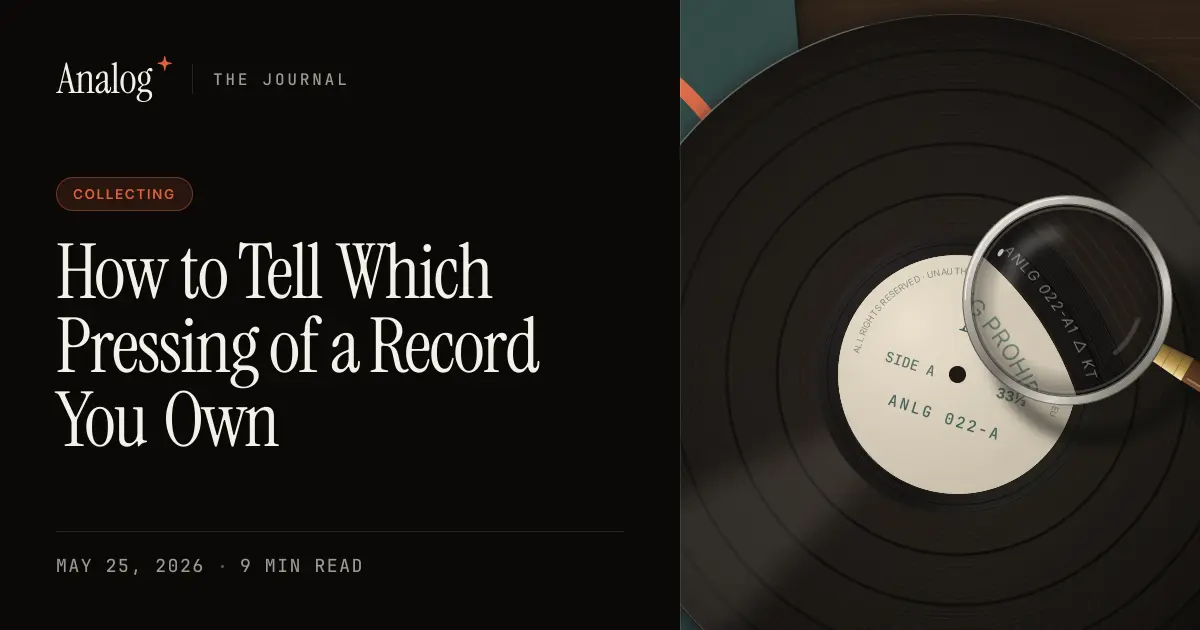
The deadwax is the smooth ring between the final music groove and the edge of the paper label. On a well-lit record it looks plain. Under a desk lamp or phone torch held at a low angle, the etched characters cast small shadows and become readable. Rotate the record slowly while keeping the light source fixed. A jeweller's loupe or 5x magnifying glass helps with very small or worn etchings. You are looking for two categories of marking: machine-stamped codes, which are uniform in depth and look pressed rather than written, and hand-etched characters, which show variations in pressure and angle from the cutting engineer's hand. Hand-etching is a sign of an early run. Later pressings and reissues are almost entirely machine-stamped. When a runout mixes both, the machine stamp came first from the plant, and the hand etching was added at the cutting stage before the lacquer left the mastering studio.
Decoding the Matrix String: Four Fields in Sequence
A typical matrix string reads as several distinct fields. Consider the example A 12345-1A RL SP. The first letter (A) is the side indicator. The number group (12345) is the catalog matrix, derived from the catalog number. The suffix (-1A) records the lacquer cut generation: 1 before the letter is the cut iteration (1 is the first lacquer cut from the tape; 2 is a recut), and A after it is the stamper generation (first stamper made from that lacquer; B is the second). A -1A suffix means you are as close to the original cut as a pressed record can be. The letters RL are the mastering engineer's initials. SP is the plant.
Matrix Variations: Not Every Plant Uses the Same Format
Not every pressing uses the standard structure. Some plants omit the stamper letter; others combine the cut and stamper into a single digit. British pressings from EMI often use a letter-number format that looks quite different from US Atlantic or Columbia matrices. What is almost always present is the catalog matrix and the side indicator. Use the cut number and any engineer mark as the primary quality indicators, and the plant code to cross-reference against the tables below. When a code is not in those tables, the Discogs thread linked above covers the full international range.
Plant
US code | Location | Active | Known for
Columbia Pitman
56 / CP | Pitman, NJ | 1961 to 1988 | East Coast Columbia/CBS pressings
Columbia Terre Haute
73 / CTH | Terre Haute, IN | 1953 to 1982 | Midwest Columbia; hand-etched T in runout
Columbia Santa Maria
25 / CSM | Santa Maria, CA | 1963 to 1981 | West Coast Columbia; code S or Z
Specialty Records Corp
49 / SR / SP | Olyphant, PA | 1960s to 1980s | Atlantic, WEA, many indie labels
RCA Indianapolis
70 | Indianapolis, IN | 1960s to 1970s | RCA Victor pressings
Rainbo Records
28 | Canoga Park, CA | 1960s to 2010s | West Coast indie labels and major reissues
Plant
Code | Location | Active | Common labels
EMI Hayes
G / YEX / XEX | Hayes, Middlesex | 1952 to 1980s | Parlophone, HMV, Capitol UK, Apple
CBS Aston Clinton
CBS / CSM | Aston Clinton, Bucks | 1964 to 1980 | CBS UK, Columbia UK, Epic, Atlantic UK
Philips Walthamstow
PH / PE | Walthamstow, London | c.1951 to 1988 | Philips, Phonogram, Polydor, Mercury
Pye / Lyntone
K / KT | Mitcham, Surrey | 1959 to 1980 | Pye, Dawn, Bronze, Harvest (some)
Mastering Engineer Signatures Worth Knowing
Certain engineers left marks that collectors actively seek. Robert Ludwig initialled his work RL, most visibly on Led Zeppelin albums for Atlantic. His 1970s Atlantic cuts are regarded as among the best-sounding pressings of that era. Ludwig later founded Masterdisk in New York. George Peckham pressed his name into the deadwax of British records from the late 1960s through the 1980s. His etching reads PORKY on side A and PECKO DUCK on side B. Peckham cut for Island, RSO, Virgin, and others, and his pressings are sought for level and warmth. If you see PORKY in the runout of a 1970s British LP, you have a Peckham cut. Bernie Grundman, who initialled his work BG, is the US equivalent: his name appears on Michael Jackson, Steely Dan, and Joni Mitchell titles among many others. On modern reissues from Analogue Productions and Classic Records, a BG initial is the single most reliable sign of a serious mastering job.
Putting It Together: Steps One and Two
Start with the label. Identify the catalog number, the country of manufacture, and the label colour variant. Cross-reference the colour against the label history on Discogs for that specific label: Atlantic, Columbia, Parlophone, and similar major labels all have documented colour timelines on Discogs' label pages. Move to the deadwax. Photograph both sides under angled light, then read every character. Record the full string exactly as it appears, noting which parts are hand-etched and which are machine-stamped. Both sides carry separate matrix strings; read both before drawing any conclusions.
Putting It Together: Steps Three and Four
Decode the matrix. Identify the side indicator, the cut number suffix, any engineer initials, and the plant code. Use the tables on this page for US and UK plants. For less common codes and international pressings, the Discogs thread linked here is the most comprehensive crowd-sourced database available. Cross-reference on Discogs. Search the artist and album, filter by the catalog number from the label, and compare your deadwax string against the documented pressings for that release. When your label variant, matrix string, and jacket details all match a documented entry, you have confirmed the pressing.
The deadwax is strong evidence, not a verdict on its own. Matrix strings were sometimes reused across plants, and early cut numbers were not always reserved for first pressings. A confirmed identification requires the deadwax to match alongside the label variant and the jacket. Condition remains the most important factor in sound quality regardless of pressing status.