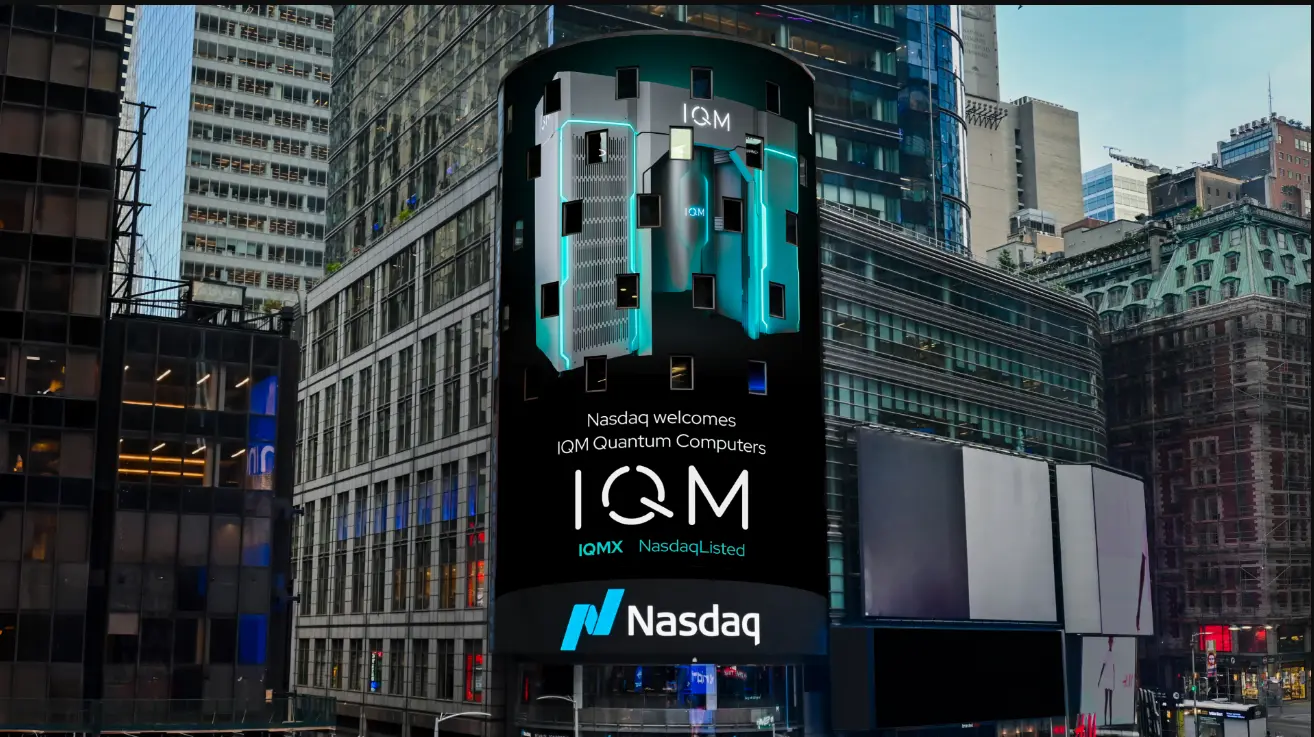
Quantum Computing Goes Public
IQM Quantum IPO valuation
$1.9 billion (Nasdaq, July 2 2026)
Cash raised at listing
$233.5 million (including $300M Series B from Sept 2025)
First European quantum firm on Nasdaq
ever
Global quantum computing market
exceeded $10 billion in 2026
IQM quantum computers sold
23 systems to date
IQM ticker
IQMX (Nasdaq Global Select Market)
IQM 2025 revenue
31 million euros (~$36 million)
Order backlog
over 67 million euros
An Honest IPO
IQM Quantum Computers went public on July 2, 2026, making history as the first European quantum computing company to list on a major US exchange. The Finnish firm, founded in 2018, builds full-stack superconducting quantum computers for national labs, supercomputing centres, and research institutions. Its customers include Italy's CINECA, Germany's Leibniz Supercomputing Center, and the US Department of Energy's Oak Ridge National Laboratory. The listing raised $233.5 million and valued the company at roughly $1.9 billion. By most measures, IQM is a serious, revenue-generating business with 23 systems delivered and a real order book. But the IPO prospectus contained a sentence that stopped readers cold: "large-scale commercial traction of quantum computing technology may never occur." That is not the usual language of a company selling its future. It is the language of a company that has decided honesty is a better long-term strategy than hype.
Is 2026 the real turning point for quantum computing?
IBM, Google, and IQM are all claiming milestones. The market is past $10 billion. But fault-tolerant commercial systems remain years away. Real turning point or another inflection-point story?
The Qubit Race: Where the Leaders Stand
Qubits are the basic unit of quantum information. More is not always better: error rates matter as much as count, and no current system is fully fault-tolerant. But qubit milestones tell you where each company is in the engineering journey. IBM's Heron r3 runs at 156 qubits with a median two-qubit gate error rate of 1.17 x 10^-3, one of the most precise in the field. IBM has also demonstrated chips up to 1,121 qubits, though at that scale error correction remains the hard problem. The IBM roadmap runs: Kookaburra in 2026 (first quantum error correction module), Cockatoo in 2027 (entanglement between QEC modules), and Starling in 2028 to 2029 (the first fully fault-tolerant system). IBM expects community-verified quantum advantage demonstrations by the end of 2026.
Where Google And IQM Stand
Google's Willow chip, at 105 physical qubits, was the basis of a landmark October 2025 result published in Nature: the Quantum Echoes algorithm ran roughly 13,000 times faster than the best classical estimate. Google called it "verifiable quantum advantage" because it is reproducible on other machines, not just a one-time internal benchmark. In March 2026, Google announced it is expanding into neutral atom hardware as a second modality, hedging its bets across qubit technologies. IQM uses superconducting qubits, the same physical approach as IBM and Google. Its competitive edge is vertical integration: it designs and manufactures its own chips, control electronics, and software stack, which lets it offer on-premises systems to customers who cannot or will not send their workloads to the cloud.
IBM: 156 qubits (Heron r3), target fault-tolerant system by 2028 to 2029. IBM celebrated 10 years of cloud-accessible quantum computing in 2026.
Google: 105 qubits (Willow), verifiable quantum advantage achieved Oct 2025. Expanding into neutral atom hardware in 2026.
IQM: superconducting full-stack systems, 23 delivered to national labs and supercomputing centres. First European quantum company on Nasdaq.
Others: Quantinuum, IonQ, D-Wave, QuEra, Rigetti, Pasqal, and Atom Computing are all active. The field has more serious competitors than ever before.
What "Quantum Advantage" Actually Means
Quantum advantage is the point at which a quantum computer solves a specific problem faster or more accurately than the best available classical computer. The definition matters because it is easy to claim and hard to verify. Google's 2019 claim used a task designed to be hard for classical machines but not commercially useful. The 2025 Quantum Echoes result is a step forward because it is verifiable: other quantum machines can reproduce it, so it is not a cherry-picked benchmark. But it is still a physics demonstration, not a business application.
The Gap That Remains
The gap that remains is fault tolerance. Current quantum computers make errors at a rate that limits the complexity of problems they can solve. Error correction requires encoding one logical qubit across many physical qubits, which is why IBM's roadmap shows 1,000-plus physical qubits being needed just to support a small number of reliable logical qubits. Until that engineering problem is solved, quantum computers are powerful for certain narrow tasks and not yet practical for most commercial applications. Most credible estimates place the arrival of fault-tolerant commercial quantum computers between 2029 and 2033.
IBM 10-year cloud quantum anniversary
2026 (first system: May 4 2016)
Google Willow qubits
105 physical qubits
IBM Heron r3 qubits
156 qubits
Google Quantum Echoes speedup
~13,000x faster than best classical estimate
Fault-tolerant commercial quantum ETA
2029 to 2033 (consensus estimate)
IBM first QEC module
Kookaburra, 2026
"Large-scale commercial traction of quantum computing technology may never occur.
"IQM Quantum Computers IPO prospectus · July 2026
That disclosure is not a red flag. It is a legal obligation and an accurate summary of where the industry stands. The market is past $10 billion and growing, meaningful milestones are being achieved, and serious engineers at serious companies are doing serious work. But anyone who tells you a fault-tolerant quantum computer will definitely arrive by a specific date is selling something. The honest answer is: probably this decade, but not guaranteed, and not soon.