
Quantinuum's Dark Horse Just Went Universal
54 qubits, one Nature paper, and the 90% overhead problem is gone
For decades, the biggest practical obstacle to fault-tolerant quantum computing has not been building a quantum processor. It has been the cost of protecting the information inside one. A technique called magic state distillation consumes up to 90 percent of a quantum computer's physical resources just to prepare the states needed for error-free operation. A machine that spends nine tenths of itself on housekeeping has very little left for actual computation.
On July 18 a team spanning Quantinuum, the University of Chicago Pritzker \
School of Molecular Engineering, Harvard and Stony Brook published a paper in Nature that offers a different path. Using 54 of the 56 qubits on Quantinuum's H2 trapped-ion processor, they demonstrated the first universal topological gate set built from non-Abelian anyons, exotic quasiparticles that store information in the geometry of their paths rather than in fragile physical states. The system prepared high-fidelity magic states without a single classical distillation cycle.
Why braiding alone was never enough
The topological approach to quantum computing has always had a compelling promise: if information is encoded not in the state of a particle but in the shape of a braid, local noise cannot corrupt it without untangling the entire braid first. The problem was that earlier anyons could braid but not compute universally. In 2024 the same Quantinuum hardware created anyons based on the D4 symmetry group, the rotations and reflections of a square. Braiding those anyons produced protected gates, but not enough of them to run arbitrary quantum algorithms. Braiding alone is mathematically incomplete for simpler anyonic systems. You can build a protected clock. You cannot build a universal computer.
The 2026 paper solved this by implementing a theoretical proposal that Carlos \
Mochon put forward in 2003 but that no hardware could test. The team switched to the S3 non-Abelian symmetry group and added a second operation alongside braiding: anyon fusion, physically merging two anyons and measuring their combined quantum state. Together the two operations yield three native topological primitives, one braid-induced entangling gate and two fusion-based measurements, which is precisely the combination that makes a gate set universal.
"We demonstrated a so-called universal gate set. If you store information in these emergent versions of quarks, and you move them around, you can do any quantum computation you might want to do.
"Ruben Verresen · UChicago Pritzker School of Molecular Engineering
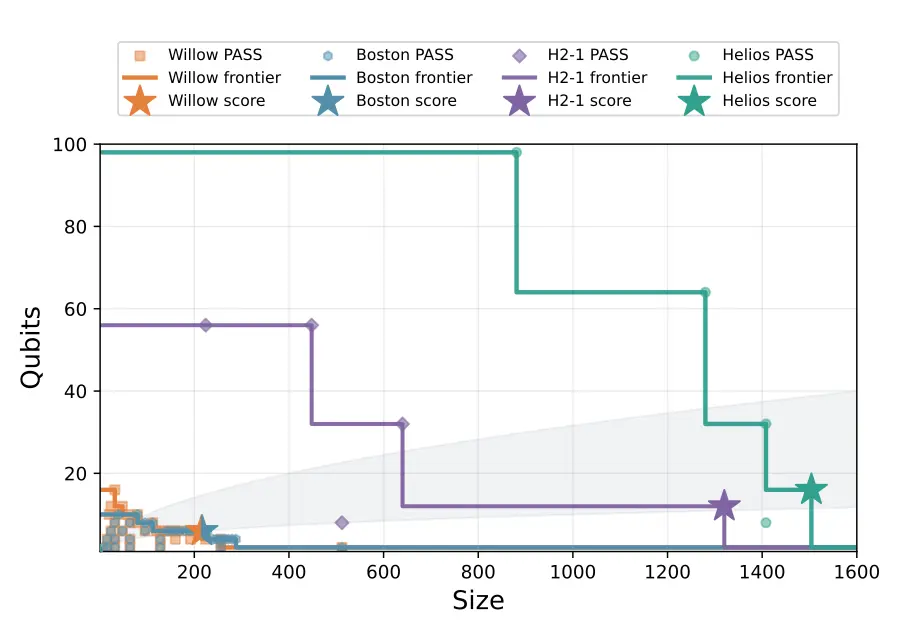
The chart below, from Quantinuum's own technical blog post on the paper, \
shows the performance of the topological operations compared with conventional approaches.
Credit: Quantinuum.
The S3-based topological gate set outperforms conventional reference implementations on the H2 processor at equivalent physical qubit counts, because the geometric protection reduces the baseline error rate before any additional error correction is applied.
The dark horse in the error-correction race
Non-Abelian anyons have been a theoretical favourite for years but a hardware afterthought. Trapped-ion systems are slow compared with superconducting chips, and the topological encoding adds further overhead. Quantinuum's managing director Henrik Dreyer acknowledged both the promise and the distance still to travel.
"Non-Abelian codes are a dark horse in the race to quantum error correction. Fault-tolerant computations can in principle be done without resorting to magic state distillation.
"Henrik Dreyer · Managing Director · Quantinuum Munich
Physical qubits used
54 of 56 on H2 processor
Magic state overhead eliminated
up to 90% in conventional systems
Topological operations demonstrated
braiding gate plus two fusion measurements
Theoretical basis
Carlos Mochon, 2003 (S3 non-Abelian states)
Prior milestone
D4 anyons created and braided on H2, 2024
Published
Nature, vol. 655, pp. 591, July 18 2026
What comes next
The immediate challenge is combining this approach with active error correction. Demonstrating a universal gate set in a clean experiment is not the same as running a full error-corrected computation. Noise from the physical qubits still enters the system, and the team has not yet shown that the topological protection holds at scale.
Ruben Verresen at UChicago is already working with other Pritzker \
researchers on stabilising non-Abelian quantum memories, the storage layer beneath the gate layer. If those efforts succeed, non-Abelian anyons would provide a foundation for fault-tolerant computing that requires a fraction of the physical resources of today's best approaches. A machine that does not spend 90 percent of itself on preparation could outperform far larger conventional quantum computers on real workloads. The paper's Harvard co-authors, Anasuya Lyons and Chiu Fan Bowen Lo, noted it plainly: "It is gratifying to see ideas we have spent our PhD work thinking about realized in the lab."