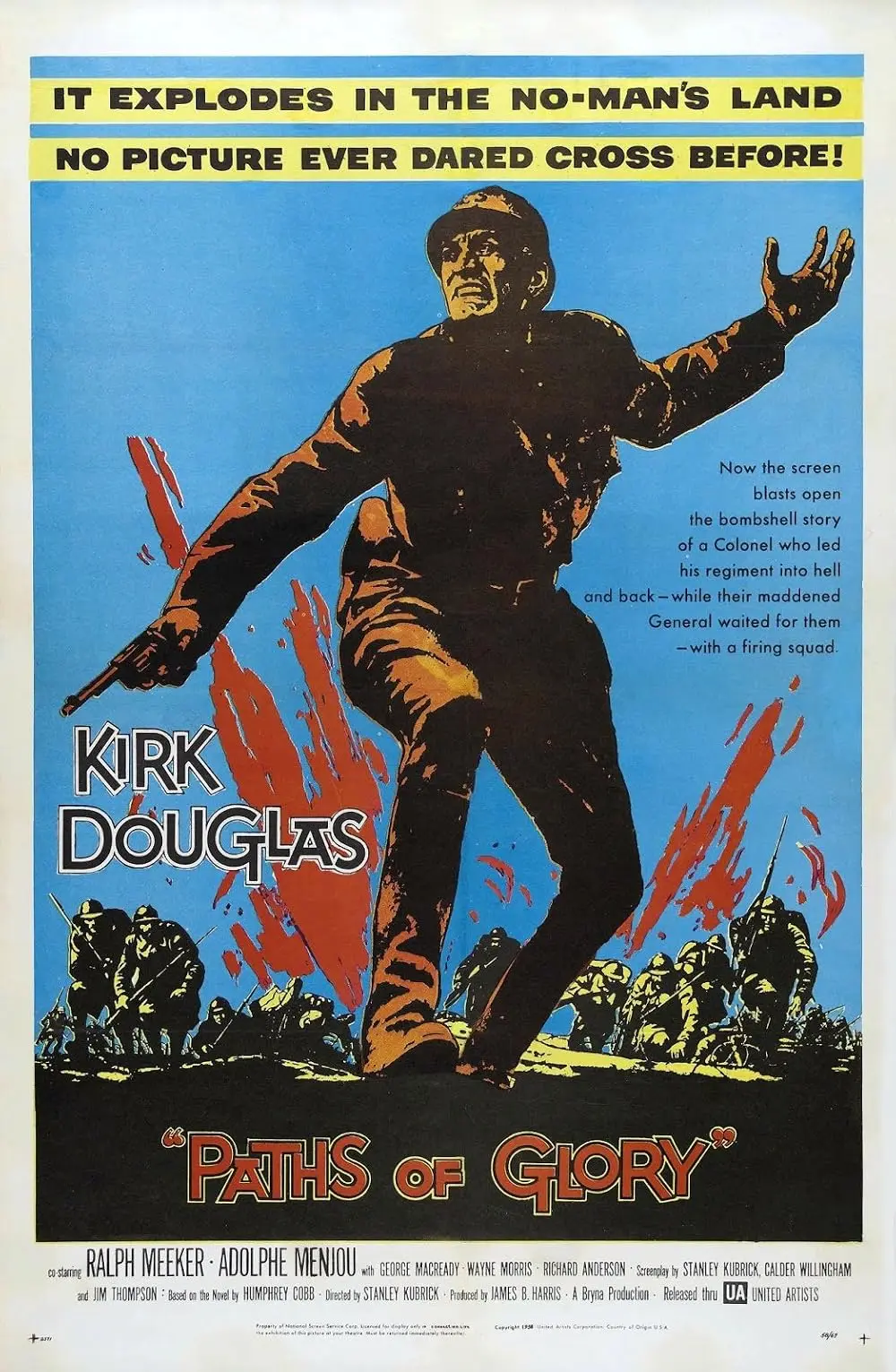
Paths of Glory: Banned In France For Eighteen Year
Paths of Glory (1957)
Kubrick at twenty nine tracks his camera down a trench and puts a general's vanity on trial instead of the soldiers.
Runtime
88 minutes
Director
Stanley Kubrick
Budget
$935,000
Cinematography
Georg Krause
Two Kinds Of Space
The film alternates between two architectures and lets the contrast make the argument. The generals meet in chateaux, all polished floors and mirrors, where the camera glides in wide arcs around men discussing percentages of acceptable loss. The soldiers live in trenches, where Kubrick puts the camera at chest height and walks backwards ahead of Kirk Douglas as he moves through the line, a shot that has been copied for seventy years. An impossible attack is ordered for the prestige of one officer, it fails, and three men are chosen at random to be tried for cowardice so that the failure has a cause other than the order. The court martial occupies the final third and is filmed as theatre, with the verdict known to everyone in the room before it begins.
Watching Paths of Glory
Emotional weight
/
Reel
"The men died wonderfully.
"General Mireau · Paths of Glory · 1957
What to watch for
Chateau scenes in sweeping arcs, trench scenes in straight backward tracks
Nobody in the film ever sees a German soldier
The insect names for military objectives
The chequerboard floor of the court martial as a game board
The final song and the faces of the men listening to it
The French government leaned on distributors and the film was not released in France until 1975. Switzerland banned it too, and it was kept off American military bases.
The German girl singing at the end is Christiane Harlan, who married Kubrick the following year and remained with him until his death in 1999.