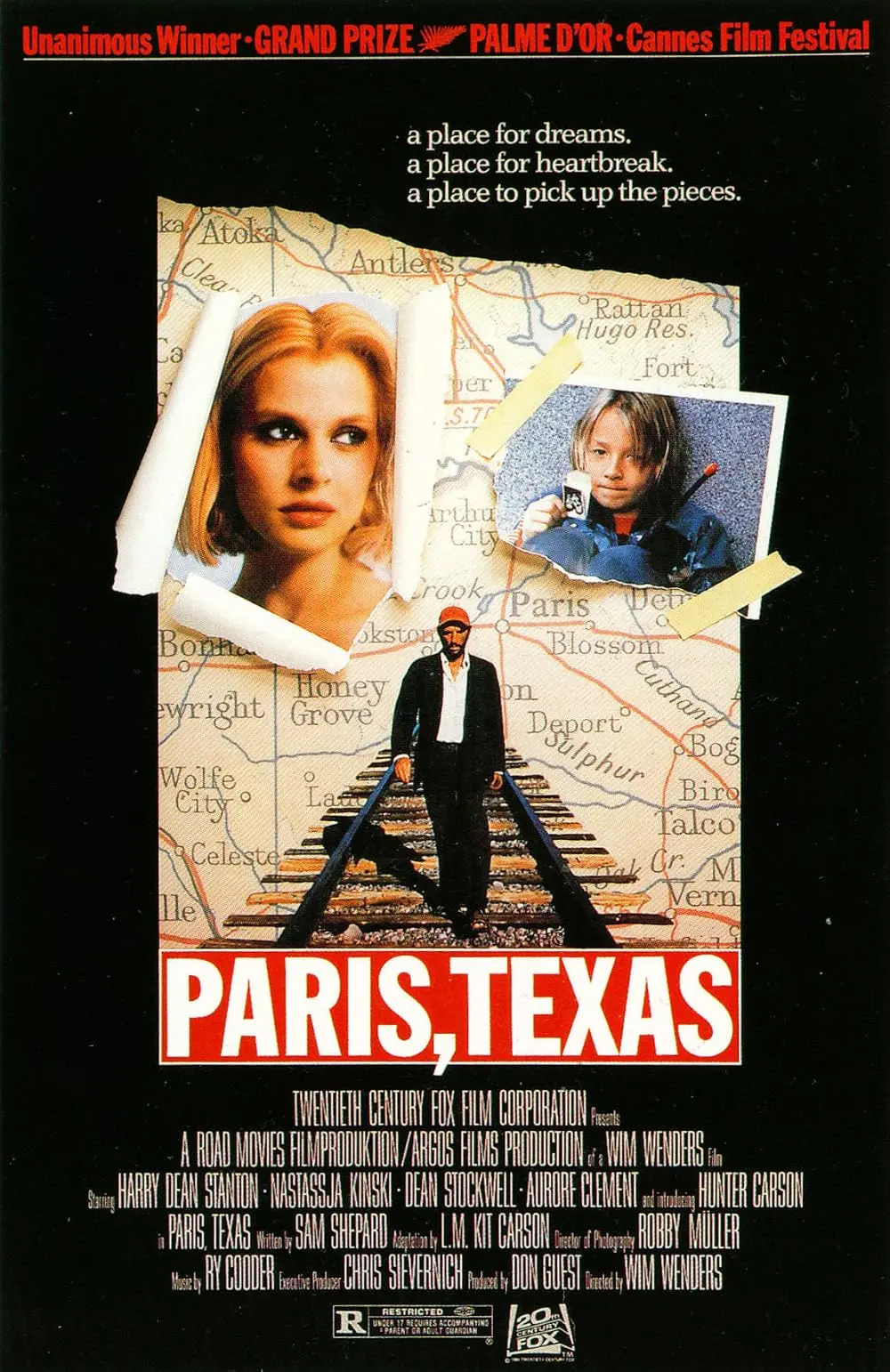
Paris Texas: A Confession Through Two Way Glass
Paris Texas (1984)
A man walks out of the desert unable to speak, and the film ends with him talking to his wife through a mirror he cannot see past.
Runtime
147 minutes
Director
Wim Wenders
Budget
$1.8 million
Box office
$2.2 million worldwide
Score
Ry Cooder
An American Film By A German Director
Wenders and Sam Shepard built the film around absence: a man missing for four years walks out of the Texas desert, will not speak for the first twenty minutes, and is slowly reassembled by his brother, his son and finally a conversation he has been avoiding since before the film began. Robby Muller photographs the southwest in saturated reds and greens, motel signs and car park lighting, so an American landscape looks freshly discovered rather than nostalgic. Ry Cooder's slide guitar does the rest. The last twenty minutes are one of the great sustained scenes in cinema: two people in a peep show booth, one of them able to see the other, both facing away, speaking into telephones about what happened.
"I knew these people. These two people. They were in love with each other.
"Travis Henderson · Paris Texas · 1984
Watching Paris Texas
Momentum
/
Act
Shepard was unavailable for the final sequence, so Wenders and Kit Carson wrote the peep show monologue during production and sent pages to Harry Dean Stanton by phone.
It won the Palme d'Or in 1984 and remains the only film by a German director to do so, though Wenders has said he considers it an American film made by a foreigner.
The final scene works because the film has spent two hours earning silence. Travis cannot look at Jane and talk at the same time, so he turns the chair, and the confession arrives as a story about two other people. It is the most influential piece of screen acting Harry Dean Stanton ever did, and the film has become the reference point for a whole strain of slow American cinema, from David Gordon Green to Kelly Reichardt to the Safdie brothers at their quietest.