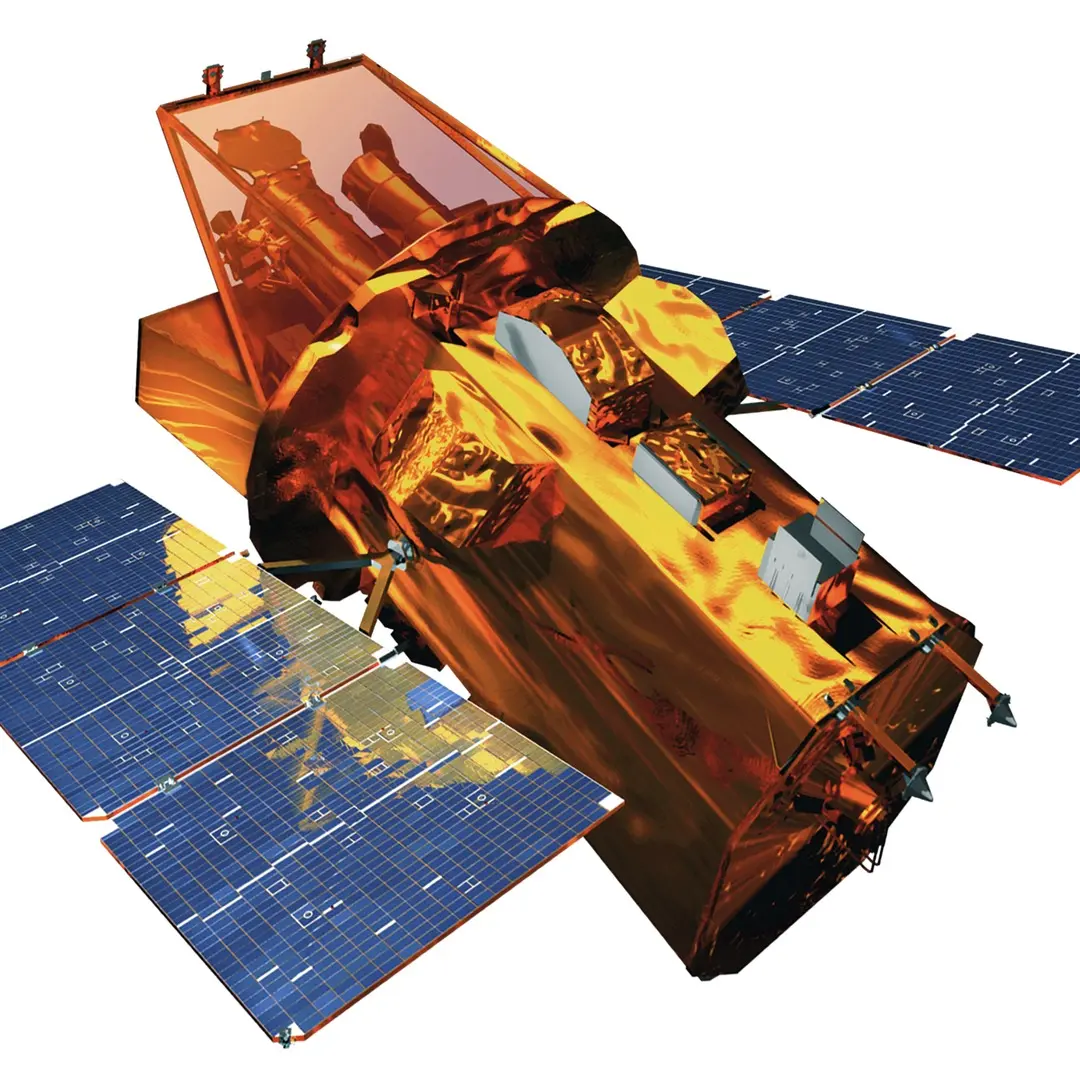
NASA Swift Telescope Falls Back to Earth Tomorrow
Swift Observatory re-entry expected around 08:30 UTC on November 4, with a window of plus or minus 11 hours -- Space Force and NASA are refining the prediction with every orbit.
Years in orbit
22
Mass
1.5 tonnes (3,200 lb)
Gamma-ray bursts detected
2,000+
Supernovae observed
1,400+
Orbital inclination
20.5 degrees
Re-entry velocity
~8 km/s
Risk of harm to any person
1 in 2,100
What survives re-entry
Most of the spacecraft burns up during the high-speed descent. Two categories of hardware are expected to reach the ground:
Tungsten components -- denser than lead, they shed heat slowly enough to land intact
Mirror parts from Swift's X-ray telescope -- fused metal structures that resist ablation
NASA says surviving pieces will most likely hit ocean (roughly 70% probability), with a small chance of landing in Africa, South or Southeast Asia, Australia or Central/South America.
Where surviving debris is most likely to land
The debris zone
Because Swift orbits at only 20.5 degrees inclination, its ground track never reaches higher than 20.6 degrees north or south of the equator. Everything outside that equatorial band is safe. The uncertain re-entry window means the zone spans thousands of kilometres along the track -- the exact impact corridor will only be known once debris is confirmed.
What happens next
LINK rescue spacecraft confirmed failed and re-entered (September 25)
Swift operations terminated (October 23)
US Space Force and Aerospace Corporation narrow re-entry window -- updated predictions each orbit
Re-entry and atmospheric breakup -- November 4 forecast
NASA and international space agencies confirm debris impact zone (within hours of re-entry)
Post-event analysis: orbit decay data fed into models for future uncontrolled re-entries
Sources: NASA Science Blog (primary, November 2, 2026) -- science.nasa.gov/blogs/swift; The Guardian (November 3, 2026, 19:50 UTC); ABC News Australia (November 3, 2026); Engadget (November 3, 2026); CBS News (November 2, 2026); The Aerospace Corporation reentry prediction. Cover: NASA/Sonoma State University/Aurore Simonnet, public domain (Swift Observatory spacecraft model, cropped and resized from 2100x1500 to 1080x1080).