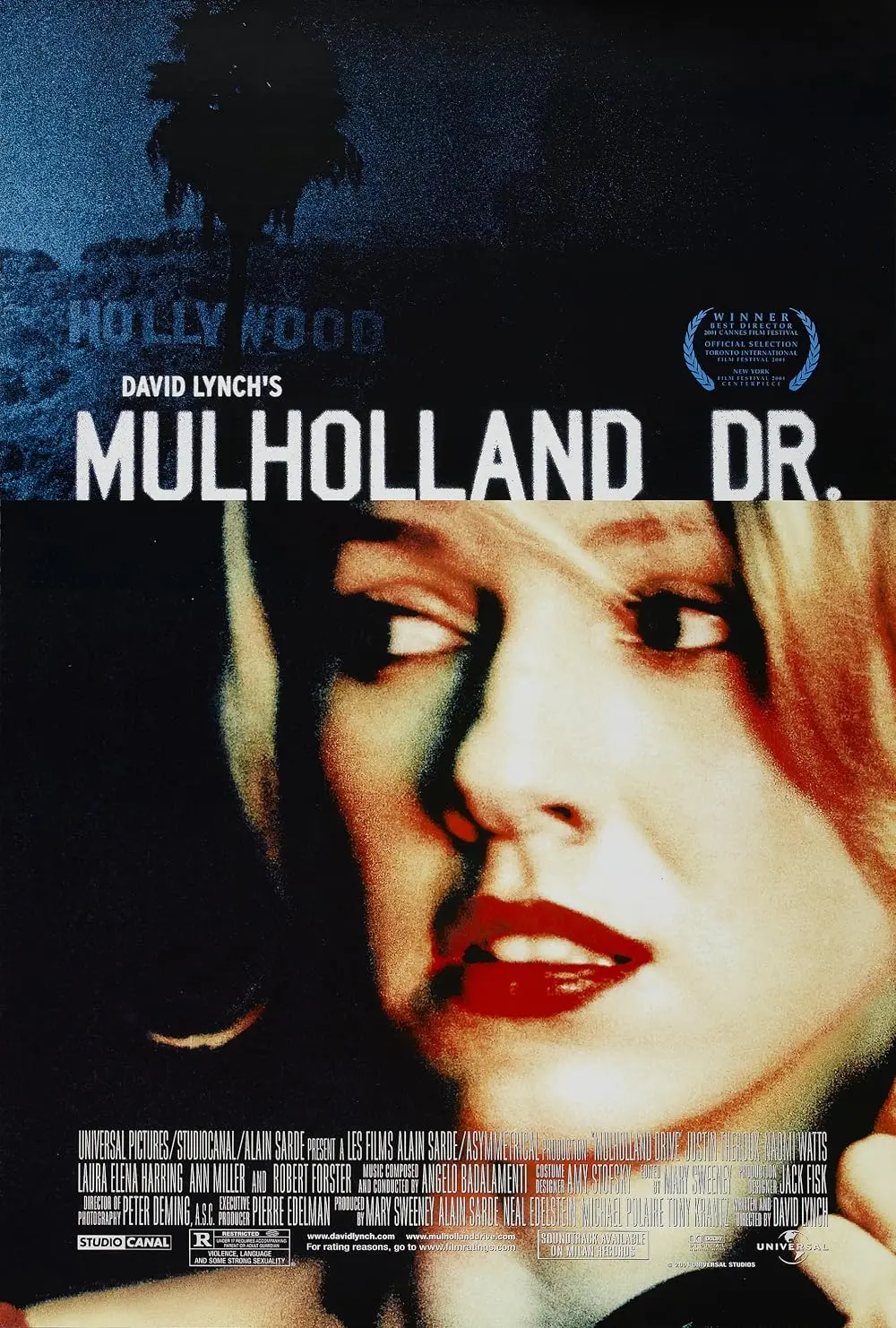
Mulholland Drive: A Dream and the Waking
Mulholland Drive (2001)
A rejected television pilot became the most acclaimed film of the century by refusing to explain itself.
Runtime
147 minutes
Director
David Lynch
Budget
$15 million
Box office
$20.3 million worldwide
Cinematography
Peter Deming
What The Film Is Doing
Lynch shot this as a pilot for ABC in 1999. The network hated it and dropped it. Canal Plus then paid for extra photography so the material could be finished as a feature, which meant Lynch had to close a story that had been built to stay open. The join is visible and that is the point. The first two thirds are a dream of arriving in Los Angeles, told in the grammar of a network show, complete with a spunky ingenue, a detective plot and a mystery woman with amnesia. The last third is what the dreamer is dreaming away from. Nothing is withheld from the audience. Every fact in the second half was seeded in the first as a name on a menu, a face in a diner, a key on a table. The film is not a puzzle with a solution. It is a portrait of the story somebody tells themselves to survive what this city actually did to them.
Watching Mulholland Drive
Unease
/
Part
"No hay banda. There is no band. And yet we hear a band.
"The magician at Club Silencio · Mulholland Drive · 2001
Angelo Badalamenti scores the dream in warm strings and the waking in low dissonant drones, so the soundtrack tells you which half you are in before the images do.
Naomi Watts had spent ten years in Los Angeles without a hit when Lynch cast her off a photograph, and the audition scene is the moment her career split in two.
Lynch never published an explanation and shipped the film with ten cryptic clues that resolve nothing. Critics have treated it as a Rorschach test ever since. The BBC's 2016 poll named it the greatest film of the twenty first century, and the 2022 Sight and Sound critics poll placed it in the all time top ten, the highest position of any film released after 1980. It is also the last of Lynch's Los Angeles films to hold a recognisable genre shape, the bridge between Lost Highway and the total dis