MoM-BH-1: The Star That Should Not Exist
"You have something that looks a bit like a star but is 100 billion times brighter. That means you cannot be powering this by nuclear fusion, the energy source at the heart of every star we have ever known.
"Rohan Naidu
'%3e%3cpath%20d='M34%206%20C32%2016%2024%2019%2024%2031%20C22%2029%2020%2026%2020%2022%20C14%2028%2012%2036%2012%2042%20C12%2052%2021%2058%2032%2058%20C43%2058%2052%2052%2052%2042%20C52%2031%2043%2028%2040%2019%20C38%2024%2035%2024%2035%2019%20C35%2014%2036%2010%2034%206%20Z'%20fill='url(%23r2v7fr_fill)'%20stroke='%23ffffff'%20stroke-width='6'%20paint-order='stroke'%20stroke-linejoin='round'%20/%3e%3cpath%20d='M32%2032%20C31%2038%2027%2039%2027%2045%20C27%2050%2030%2053%2032%2053%20C36%2053%2040%2050%2040%2045%20C40%2039%2035%2037%2034%2032%20C33%2035%2033%2035%2032%2032%20Z'%20fill='%23fff5c2'%20opacity='0.9'%20/%3e%3cellipse%20cx='22'%20cy='40'%20rx='3.4'%20ry='5'%20fill='%23ffffff'%20opacity='0.45'%20transform='rotate(-15%2022%2040)'%20/%3e%3c/g%3e%3c/svg%3e) 1
1MoM-BH-1: Born 660 Million Years After the Big Bang
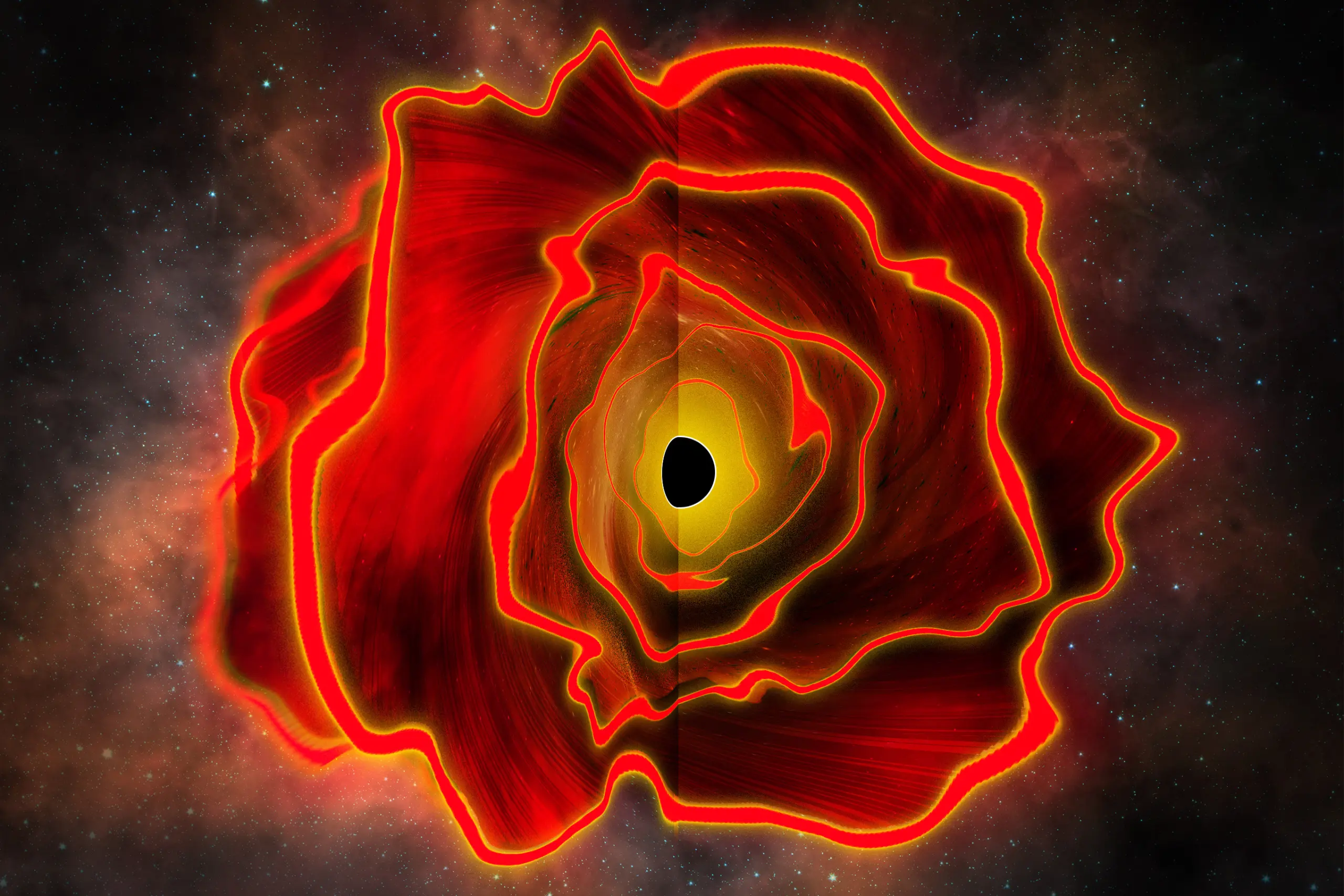
On August 12, 2026, a U.S.-led team published findings in Nature that stopped astrophysicists cold. The James Webb Space Telescope had spotted a tiny red dot in the infant universe, designated MoM-BH-1 after the team's "Mirage or Miracle" survey. It looks like an enormous star. But it shines with the energy of 100 billion suns, a brightness no star is physically capable of producing. The best model: a black hole about 100,000 times the mass of our Sun, wrapped inside a dense cocoon of hydrogen roughly the size of our entire solar system. The cocoon makes it look stellar. The black hole is the engine.
Object name
MoM-BH-1 (Mirage or Miracle Survey)
Age
660 million years after the Big Bang
Brightness
100 billion times brighter than any known star
Black hole mass
approx. 100,000 solar masses
Hydrogen cocoon size
roughly the diameter of our solar system
Candidate black hole stars found
241 across JWST observations
What It Looks Like From JWST's camera, MoM-BH-1 reads as a compact, extremely bright red dot. Its spectrum shows a sharp Balmer break, a signature of hydrogen absorbing light, the same fingerprint seen in stellar atmospheres. Everything about its appearance says: star.
What It Cannot Be No star produces 100 billion times its own solar luminosity. Nuclear fusion simply cannot generate energy at that scale. The red dot also contains almost no elements heavier than hydrogen and helium, ruling out the evolved chemistry of normal stars. Something else is at work here.
How did billion-solar-mass black holes grow so fast after the Big Bang?
The standard model says black holes grow slowly, feeding on one star at a time. Yet JWST keeps finding supermassive black holes in the infant universe that should have taken far longer to reach their size. If MoM-BH-1 is the answer, what does it mean for everything we thought we knew about the first billion years of time?
The Little Red Dots Problem
Since JWST began its deep-field surveys, it has repeatedly spotted mysterious compact red sources scattered across the earliest epochs of cosmic history. Astronomers called them "little red dots" and could not agree on what they were. Were they heavily dust-obscured galaxies? Odd active galactic nuclei? The MoM-BH-1 team ran simulations showing that when MoM-BH-1 and a nearby brighter galaxy eventually merge (in roughly 100 million years from that point in cosmic time), their combined spectrum would look almost exactly like those baffling little red dots. One discovery may explain dozens of unsolved cases at once.
[ ] Study published in Nature, August 12, 2026, led by Rohan Naidu at MIT
241 candidate black hole star objects identified across JWST survey data
MoM-BH-1 located close to a brighter galaxy, merger predicted in 100 million years
If confirmed, rewrites how supermassive black holes formed in the early universe
Follow-up observations planned to rule out alternative models
Future JWST deep surveys may reveal hundreds more black hole star candidates