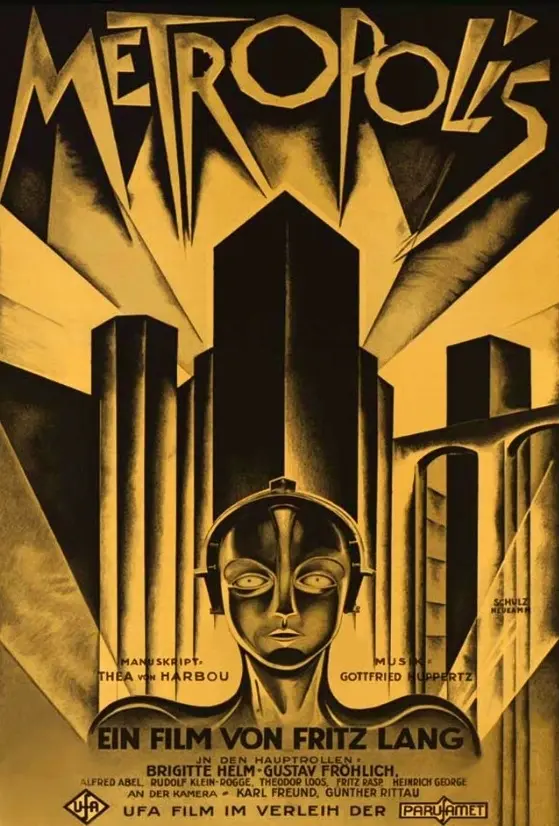
Metropolis: The Quarter Of It That Came Back
Metropolis (1927)
The most expensive silent film ever made in Germany was cut to pieces, then largely recovered in 2008.
Runtime
153 minutes
Director
Fritz Lang
Budget
$5.3 million
Cinematography
Karl Freund
A City Built To Be Owned
Lang and Thea von Harbou split a city in half vertically and let the image do the politics. Above ground there are towers, aeroplanes between them, gardens and a stadium. Below there are shift changes, a machine that eats its operators, and housing for people who are counted as parts. The film's plot is a strike, a false messiah and a flood, and its most durable invention is the Maschinenmensch, the robot given a woman's face by Brigitte Helm, who plays both the saint and the machine built to discredit her. Lang spent an unprecedented sum and nearly broke UFA doing it. Paramount cut a quarter of the film for American release, the original negative was lost, and for eighty years Metropolis was watched in versions everyone knew were incomplete.
Watching Metropolis
Register
/
Chapter
"The mediator between the head and the hands must be the heart.
"The film's closing intertitle · Metropolis · 1927
In 2008 a near complete print turned up in the Museo del Cine in Buenos Aires, adding roughly twenty five minutes and two subplots. The 2010 restoration is the first version close to what premiered in Berlin.
The Maschinenmensch was designed by Walter Schulze-Mittendorff and sets the template for C-3PO, the replicants of Blade Runner and almost every robot given a gendered body since.
H. G. Wells called it the silliest film he had ever seen and he had a point about the politics: a strike resolved by a handshake between a factory owner and a foreman is a fantasy, and von Harbou's later career makes the fantasy harder to read charitably. None of that touches the images. The vertical city, the shift change, the transfer of a face onto a machine: these are the visual grammar that science fiction cinema has been rearranging ever since, from Blade Runner to Dark City to the elevato