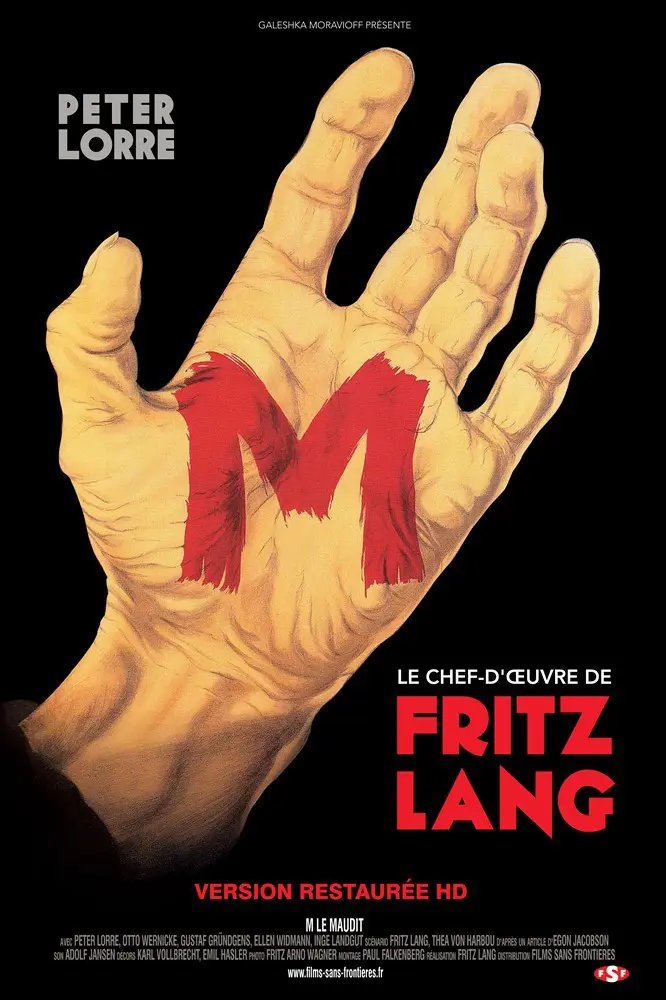
M: The First Film To Use Sound As Evidence
M (1931)
Lang's first talkie turns a whistled tune into a fingerprint, and hands the manhunt to the criminals.
Runtime
117 minutes
Director
Fritz Lang
Country
Germany
Cinematography
Fritz Arno Wagner
A City Hunting Itself
Children are disappearing in a German city and the police response is to raid everything, which ruins business for the organised underworld. So the criminals form their own investigative bureau, deputise the beggars' union to watch every street corner, and catch the killer the police cannot. Lang cuts the two manhunts together as parallel bureaucracies with identical methods and different letterheads. Peter Lorre, twenty six and previously a comic stage actor, plays Hans Beckert as something more upsetting than a monster: a soft, panicked man who describes his own compulsion as a pursuit he cannot stop. It was Lang's first sound film and he used silence as aggressively as noise, letting long stretches run without audio and then hanging the entire identification of the killer on a tune he whistles when the urge arrives.
Watching M
Wonder
/
Reel
Peter Lorre could not whistle, so the tune from Grieg's In the Hall of the Mountain King that identifies the killer is whistled by Fritz Lang himself.
Lang always denied the film was about the rise of Nazism, but he left Germany in 1933 after Goebbels offered him control of the state film industry, and M was later banned.
"I cannot help what I do. I cannot help it.
"Hans Beckert at the cellar trial · M · 1931