
Lisbon Baixa Food Walk: Five Bites in One Morning
Walking time
About 35 minutes across all five stops
Budget per person
EUR 15 to 22 for all five stops
Start point
Rossio Square, 2 minutes walk to A Ginjinha
Total stops
5 across Baixa, Chiado and Cais do Sodre
Best days
Tuesday to Friday, before 18:30 (bifana stop closes then)
Rossio to the waterfront, one bite at a time
Lisbon has a core group of foods that every visitor eventually encounters, but they tend to find them separately: the ginja bar on the way to the Se, the bifana counter someone mentions in a Reddit thread, the custard tart queue that defeats them on the first morning. This route puts all five in order on a single morning walk from Rossio to the waterfront at Cais do Sodre. The five stops are walkable in 35 minutes of actual movement. The eating and lingering add another 60 to 90 minutes, so the full route is a morning or a long lunch. Two of the five stops are cash only: bring at least EUR 10 in coins and small notes. Time Out Market, the last stop, is cards only.
Getting there
Take the Metro to Rossio Station (Green Line, Rossio stop) or walk from Baixa-Chiado station (Blue and Green Lines, 5 minutes north on Rua do Carmo). A Ginjinha is a 90-second walk north of Rossio Square along Rua das Portas de Santo Antao, turning left onto Largo de Sao Domingos.
Stop 1. A Ginjinha, Largo de Sao Domingos 8, Baixa
Open daily 09:00 to 22:00. Founded 1840 by Galician immigrant Francisco Espinheira, still run by the same family. A ginja, or ginjinha, is a sour cherry liqueur made from ginja berries, sugar, and aguardente, steeped for weeks in clay pots and served cold in a small chocolate cup or a plain shot glass. The shop is literally a one-metre counter cut into a building facade. Walk to the opening, say how many you want, and ask "com elas" (with the cherries, pit included) or "sem" (without). One shot costs EUR 1.40 to 1.50. Drink it on the square outside in front of the Igreja de Sao Domingos. Cash only. The neighbour bar "Ginjinha Sem Rival" at the same address block is equally historic: if one has a short queue, use it.

Stop 2. As Bifanas do Afonso, Rua da Madalena 146, Baixa
Open Monday to Friday 08:00 to 18:30, Saturday 09:00 to 13:30, closed Sunday. From A Ginjinha, walk east along Rua de Sao Domingos and south on Rua da Madalena, about 7 minutes on foot. This is a lunchtime stop: plan to arrive before 17:30 on weekdays. Missing it because you arrived after closing is the most common complaint in every online thread about Lisbon street food. A bifana is pork shoulder sliced thin, marinated in white wine and garlic, and stewed until the liquid reduces to a glossy sauce. It is served in a soft white roll called a papo-seco with the cooking juices soaked in. At the counter, say "uma bifana, se faz favor" and add "com mostarda" if you want mustard. Each one costs EUR 2.50 to 3.50. Takeaway only. Queue of 20 to 40 people is normal and moves in under 10 minutes. Cash only. Eat on park benches 50 metres north at Praca da Figueira.
Stop 3. Casa Portuguesa do Pastel de Bacalhau, Rua Augusta 106, Baixa
Open daily 10:00 to 23:00. Cards accepted. Walk south from As Bifanas do Afonso and you will reach Rua Augusta, Lisbon's main pedestrian street, in about 4 minutes. The item here is the pastel de bacalhau com queijo Serra da Estrela: a salt cod croquette filled with melted sheep's cheese from the Serra da Estrela mountains. It costs EUR 8. The plain version without cheese is EUR 6. Order at the counter and eat standing. The staff will aggressively offer a Port wine pairing at EUR 4 to 6 more: it is optional. The croquette is worth the stop on its own. Crowds are heaviest from noon to 16:00; before 11:00 or after 18:00 is easier.
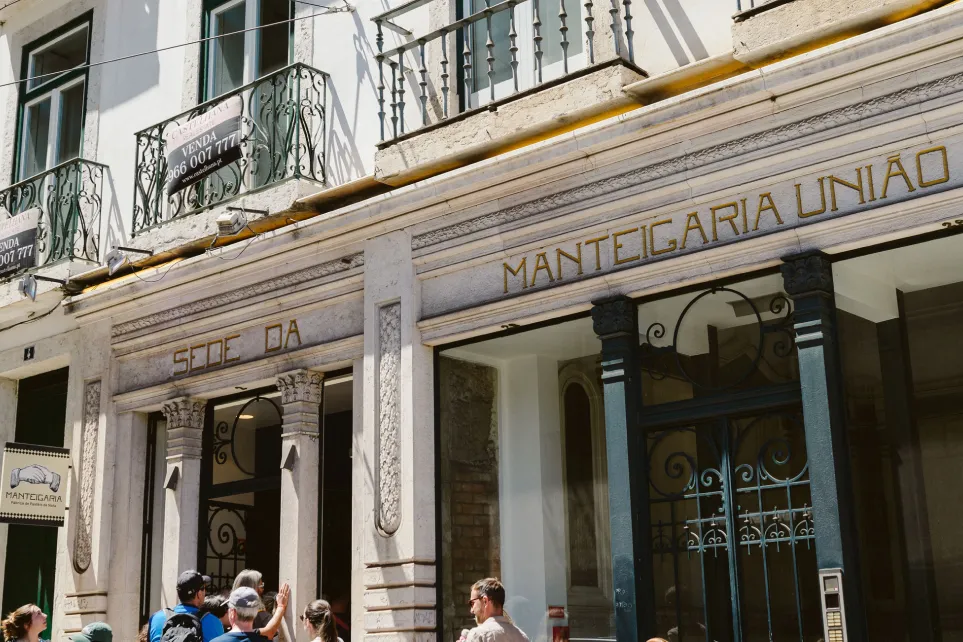
Stop 4. Manteigaria, Rua do Loreto 2, Chiado
Open daily 08:00 to midnight. Cards accepted. Walk west along the Rua do Carmo shopping street or take the Santa Justa Lift adjacent and continue 5 minutes into Chiado. Manteigaria is in a 1900 Art Nouveau building at the bottom of Rua do Loreto. A pastel de nata is a small custard tart baked in a fluted tin at very high heat until the custard scorches in spots on top. The pastry is shatteringly crisp, the custard just set and still warm from the oven. Each tart costs EUR 1.50. A bell rings when a fresh batch emerges: buy then, eat immediately at the standing counter with cinnamon and icing sugar from the pots provided. The queue is 5 to 15 minutes but moves fast. This is the best city-centre option for pastel de nata. The original Pasteis de Belem is 7 km west and requires a tram or Uber: treat that as a separate half-day trip, not an add-on to this walk.
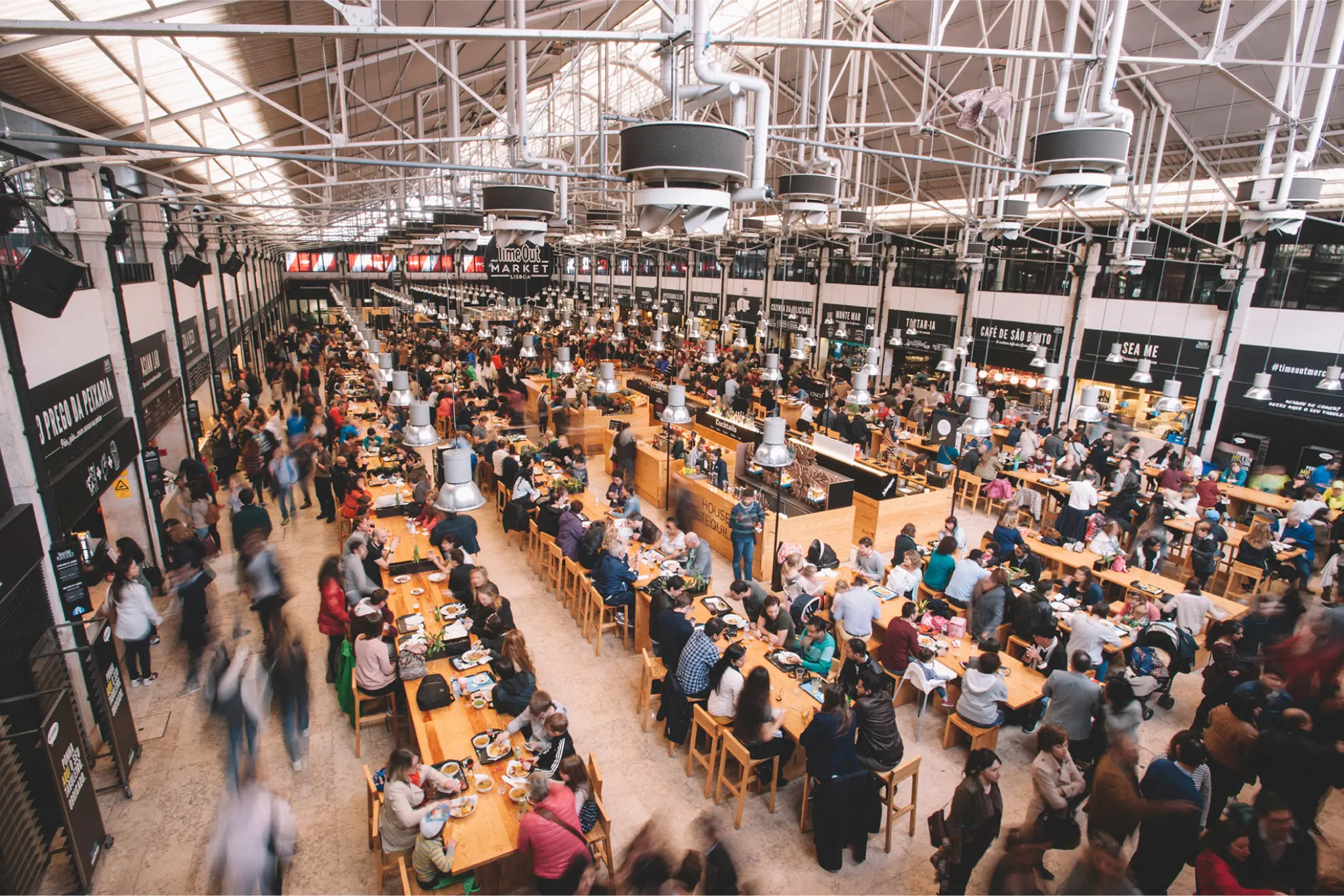
Stop 5. Time Out Market Lisboa, Avenida 24 de Julho 49, Cais do Sodre
Open Sunday to Wednesday 10:00 to midnight, Thursday to Saturday 10:00 to 02:00. Cards only, no cash. From Manteigaria, walk downhill through Chiado toward Cais do Sodre station (about 10 minutes) or take the Metro (Blue Line) one stop from Baixa-Chiado to Cais do Sodre. The market is directly across from the station. Time Out Market Lisboa opened in 2014 inside the 1892 Mercado da Ribeira, a cast-iron covered market hall. Twenty-six restaurant stalls curated by Time Out Portugal fill the central hall, with eight bars around the perimeter. Typical spend is EUR 10 to 18 per person. Good for a final plate of bacalhau a bras, a glass of vinho verde, or a seafood dish from one of the fish counter stalls. If you are continuing to Belem for the original pasteis, the Tram 15E stop and the Cascais suburban rail line both depart from Cais do Sodre station across the street.
Two things that most guides miss. First, fresh sardines (sardinhas asadas) are only available June to September. Outside those months they are frozen. If you are visiting in autumn or winter and a restaurant advertises fresh sardines, ask if they are fresh or frozen before ordering. Second, the original Pastelaria Belem (Rua de Belem 84, founded 1837) is not on this walk. It is 7 km west of Rossio, a 25 to 40 minute journey by Tram 15E or Uber. It sells roughly 20,000 tarts per day. If you go, w