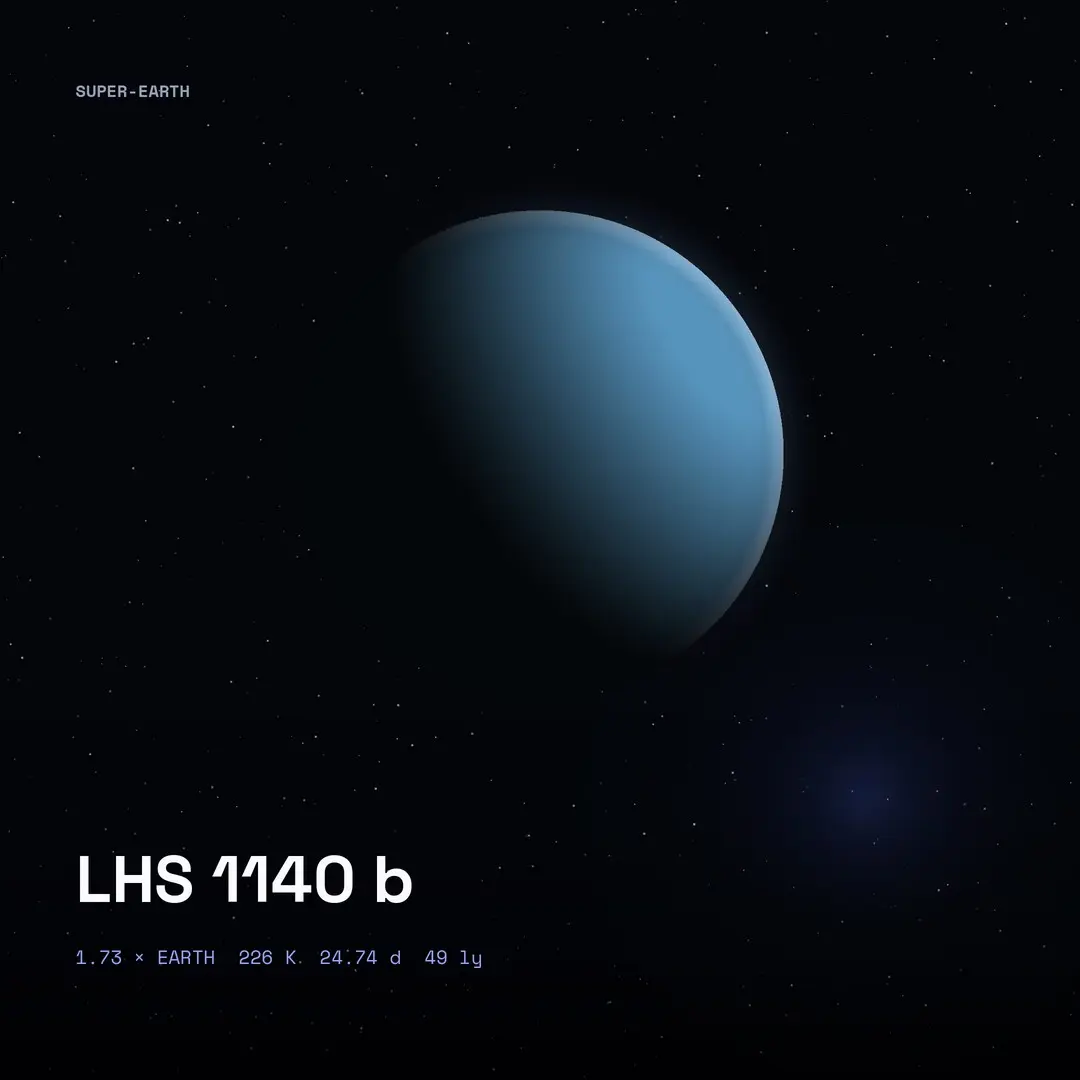
LHS 1140 b: Habitable Zone, 25-Day Year
Super-earth around LHS 1140
It is 1.73 times Earth's radius, closest in size to Earth, and 5.6 times Earth's mass, at 5.90 g/cm3, denser than Earth. A year there lasts 24.74 days, on an orbit 4 times closer to its star than Mercury is to the Sun. Its equilibrium temperature is 226 K, in the range where liquid water is possible. The host star LHS 1140 runs at 3096 K with 0.18 times the Sun's mass.
The habitability checklist, honestly scored
Orbits within the zone where liquid water could persist. Yes.
Dense enough to be rock rather than gas, at 5.90 g/cm3. Yes.
A measured mass, not just a radius. Yes.
A measured temperature rather than one derived from the star. Yes.
Any detection of an atmosphere. Not recorded in the archive.
Radius
1.73 Earth radii
Mass
5.6 Earth masses
Equilibrium temperature
226 K (measured)
One year
24.74 days
Orbit radius
0.0946 AU
Host star
LHS 1140 at 3096 K
Distance
49 light-years
Starlight blocked
0.538% at each transit
What the dip tells you
How deep the star dims fixes the planet's size relative to it.
The size came from a crossing, the mass did not. That pairing is uncommon and it is what lets anyone say whether this is rock or gas.
LHS 1140 has 2 known planets. Multi-planet systems are where orbital dynamics can be measured rather than assumed.
Found by MEarth Project in 2017.
LHS 1140 b sits in the habitable zone on the arithmetic alone. That says where \
it orbits, not what it is like. What would you want measured next before calling it promising?
