Leonid Meteor Shower 2026: How to Watch the Peak
The fastest major shower of the year, and the moon clears the sky at midnight
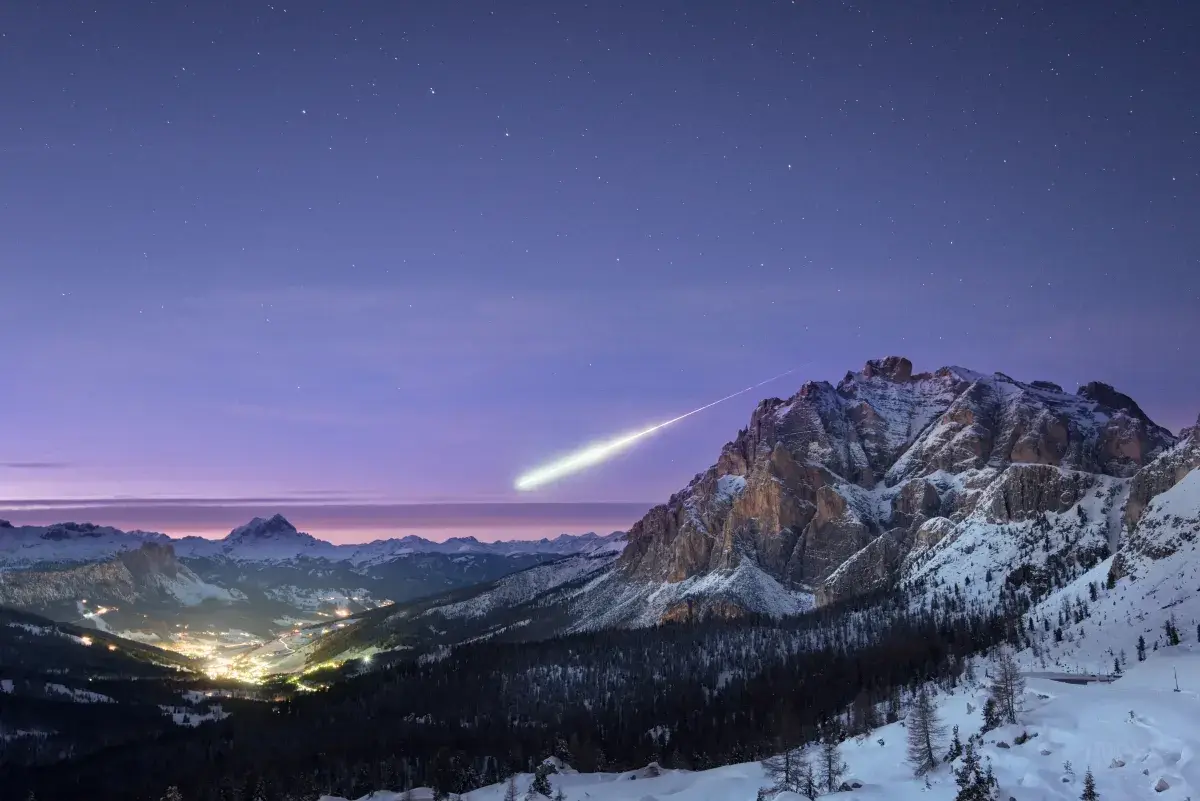
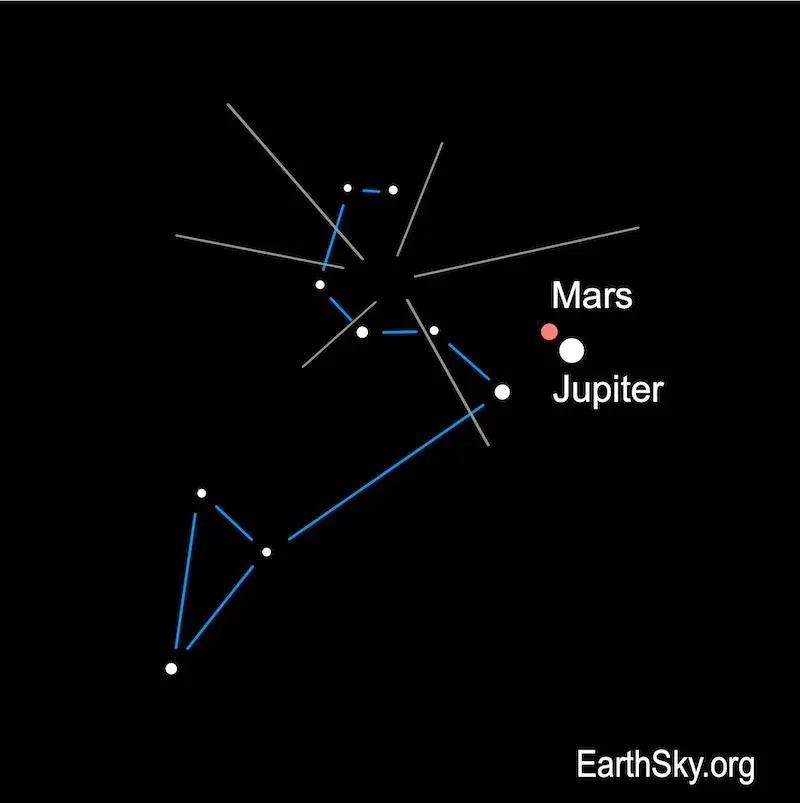
Every year in mid-November, Earth sweeps through the debris trail of Comet 55P/Tempel-Tuttle and the Leonids light up the sky. The 2026 shower peaks on the night of November 17 to 18. What makes it worth setting an alarm this year: the first-quarter moon sets around midnight, leaving two to four hours of moonless sky before dawn, the period when rates are highest and fireballs most likely. The Leonids enter the atmosphere at 71 kilometres per second, faster than any other major shower, and that speed produces a higher proportion of bright meteors with long glowing trains. Under a good rural sky with the moon gone you can expect 10 to 15 per hour at peak. Two bonus objects sit near the radiant this year: Jupiter and Mars rise together just below Leo, separated by about two full-moon widths.
When to watch on November 17 to 18
| Time zone | Moon sets | Radiant usable from | Best window (pre-dawn) |
|---|---|---|---|
| UTC | ~00:00 Nov 18 | ~02:15 Nov 18 | 02:15 to 05:30 Nov 18 |
| EST (UTC-5) | ~19:00 Nov 17 | ~21:15 Nov 17 | 21:15 Nov 17 to 00:30 Nov 18 |
| CST (UTC-6) | ~18:00 Nov 17 | ~20:15 Nov 17 | 20:15 Nov 17 to 23:30 Nov 17 |
| MST (UTC-7) | ~17:00 Nov 17 | ~19:15 Nov 17 | 19:15 to 22:30 Nov 17 |
| PST (UTC-8) | ~16:00 Nov 17 | ~18:15 Nov 17 | 18:15 to 21:30 Nov 17 |
| CET (UTC+1) | ~01:00 Nov 18 | ~03:15 Nov 18 | 03:15 to 06:30 Nov 18 |
| AEDT (UTC+11) | ~11:00 Nov 18 | n/a | Watch evening Nov 17, rates lower |
Why the radiant does not rise until midnight
The Leonid radiant sits inside the Sickle asterism of Leo, the backwards question mark of stars anchored by Regulus. Its coordinates are approximately right ascension 10h 12m, declination plus 22 degrees. Leo does not clear the horizon for most northern observers until around midnight local time, and the radiant does not climb above the thickest low-horizon air until roughly 02:15. Before midnight the rates are noticeably lower and the meteors near the horizon are foreshortened into short streaks. After 02:15, as the radiant rises toward its pre-dawn peak at around 06:30, meteors appear longer and more spectacular. You do not need to stare at the radiant: meteors stream away in all directions. Looking 45 degrees away from it gives longer trails in your field of view. The Leonids are best from the northern hemisphere because the radiant stays north of the celestial equator, but observers as far south as 30 degrees south can catch a reduced display.
Moon conditions: a clear window this year
The first-quarter moon on November 17 at approximately 11:48 UTC sets around midnight for most northern-hemisphere observers. That is unusually good fortune: a half-lit moon would otherwise wash out the fainter Leonids for the whole night. The window between moonset and the start of dawn, roughly two to four hours depending on your latitude, is when rates peak and fireballs are easiest to record. If your skies cloud over before midnight, the shower is effectively over for you: do not wait for a clear gap at 1 or 2 a.m. hoping the radiant is fully up, because that window is the only clean darkness of the night.
Leonid storm and outburst history
| Year | ZHR (peak) | Circumstance |
|---|---|---|
| 1833 | approx 150,000/hr | Great Leonid storm, newspapers reported meteors like snowflakes |
| 1866 | approx 5,000/hr | First storm correctly linked to Comet Tempel-Tuttle orbit |
| 1966 | approx 70/second (peak burst) | 15-minute outburst in western US, highest rate ever recorded |
| 1999 | approx 3,700/hr | First of the 1999 to 2002 returns near Tempel-Tuttle perihelion |
| 2001 | approx 3,800/hr | Best of the modern returns, visible across North America |
| 2026 | 10 to 15/hr | Normal annual return, no outburst predicted |
Why the Leonids produce fireballs
Entry speed determines how much energy a particle releases as light. At 71 km/s, the Leonids are the fastest of the established annual showers, roughly twice the speed of the August Perseids (59 km/s) and three times the speed of the December Geminids (35 km/s). A Leonid grain the size of a pea releases energy equivalent to a much larger Geminid particle. The result is a higher fireball fraction: a greater share of Leonids burn bright enough to cast visible light for a second or more after the initial flash, leaving a glowing train that can persist for several seconds and drift visibly on upper atmosphere winds. Photographing a train requires only a modern smartphone on night mode with a stable support or tripod, wide field, and a ten-second exposure. Manual focus set to infinity prevents the autofocus hunting that kills most attempts.
Jupiter and Mars near the radiant this year
In November 2026, Jupiter and Mars rise together in the eastern sky in the same region as the Leonid radiant in Leo. The two planets are separated by roughly two full-moon widths, making them easy to identify as a bright pairing. Jupiter is the brightest object in that part of the sky and shows no twinkling; Mars sits just below and to the south, slightly orange-tinted. Watching the sky in that direction means you are also looking toward the radiant, so the planet pairing serves as a natural aiming point for the pre-dawn session. Neither planet interferes with the shower. A wide-angle photo of that sky sector will capture the planets as fixed bright points with any meteor streaks passing across the frame.
Five things to do before you go out. Drive at least 20 to 40 minutes from the nearest town to escape the worst light pollution. Dress for temperatures several degrees colder than the forecast: lying still on the ground at 3 a.m. is colder than standing in the garden. Bring a reclining chair or sleeping mat so you can scan a wide arc of sky without neck strain. Turn off your phone screen or use red-light mode: 20 minutes of dark adaptation is lost in seconds by a bright screen. No telescope or bi