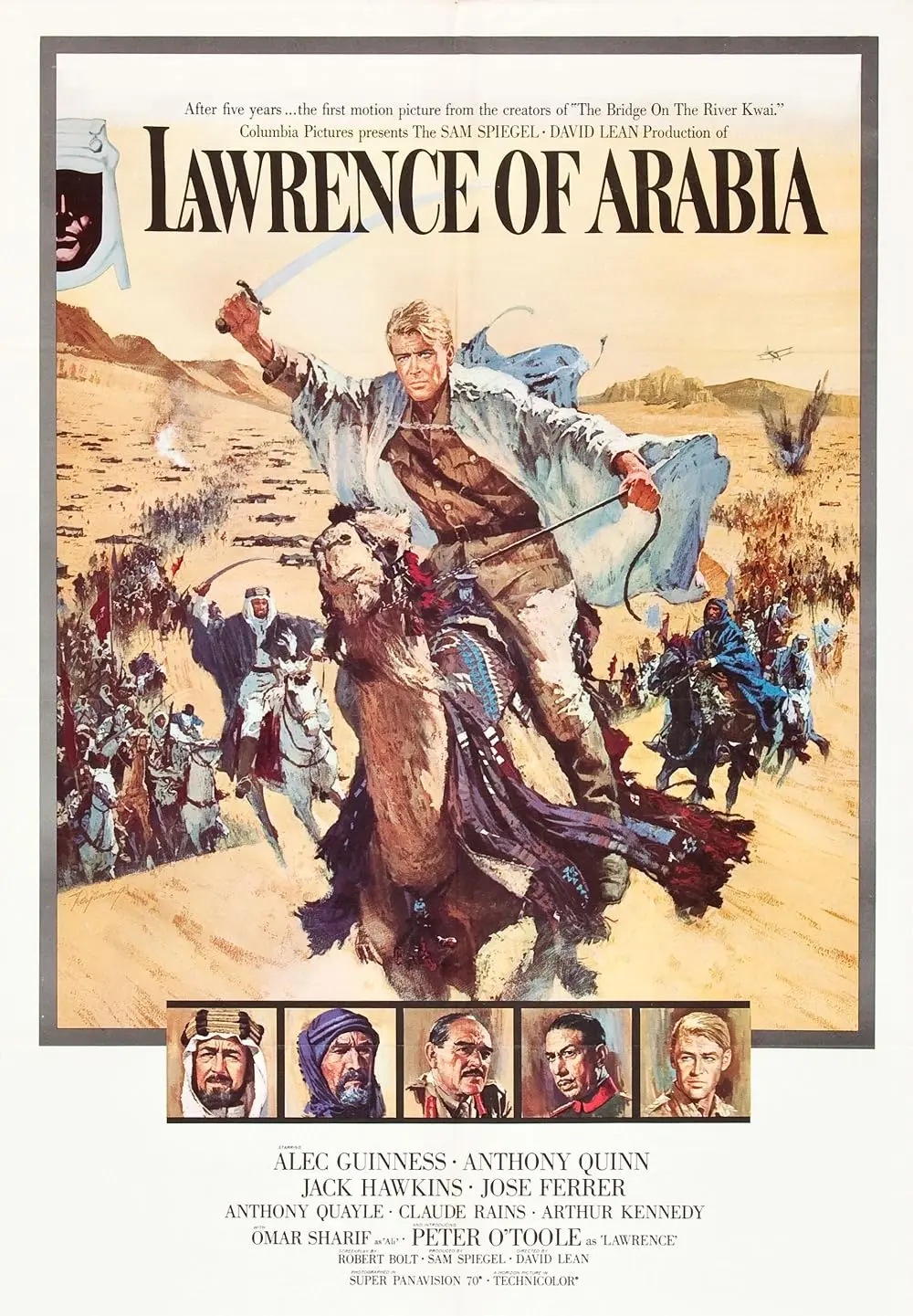
Lawrence of Arabia: Two Hundred Minutes And No Spe
Lawrence of Arabia (1962)
Lean shot the desert in 70mm with an unknown lead, and made an epic that spends four hours doubting its own hero.
Runtime
216 minutes
Director
David Lean
Budget
$15 million
Box office
$45.7 million worldwide
Cinematography
Freddie Young
A Spectacle About Self Invention
Lean had the largest canvas in cinema and used it for a character study. T. E. Lawrence arrives as a junior officer with a talent for insubordination, crosses deserts nobody thought crossable, unites tribes for a British war effort he does not fully believe in, and comes apart under the weight of his own legend. Peter O'Toole had done nothing of note and was cast on a screen test. Freddie Young shot it in Super Panavision 70, using long lenses to compress heat haze into solid distance, which is how the Omar Sharif entrance works: a black dot in a mirage that takes two full minutes to become a man. Maurice Jarre wrote the score in six weeks after two other composers dropped out.
"Nothing is written.
"T. E. Lawrence · Lawrence of Arabia · 1962
Watching Lawrence of Arabia
Curiosity
/
Part
The match cut from a blown out match to a desert sunrise is the most celebrated edit in the film, and Anne Coates has said it came from watching the rushes rather than the script.
There is no woman with a speaking part in two hundred and twenty two minutes, a fact Lean was asked about for the rest of his life and never satisfactorily answered.
Spielberg calls it the film that made him want to direct and has watched it before starting each of his own productions. Its real achievement is tonal: an epic financed as a patriotic spectacle that ends with its hero discredited, the Arab cause betrayed at the negotiating table and the desert indifferent to both. The 1989 restoration by Robert Harris recovered twenty minutes Columbia had cut, and is the version now screened.