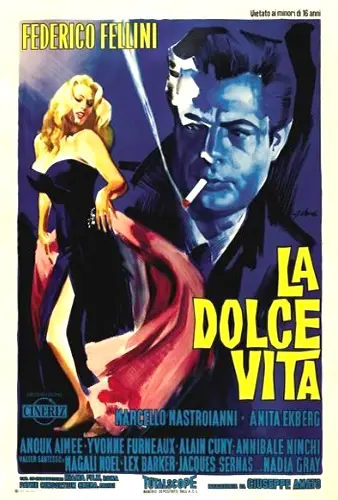
La Dolce Vita: The Film That Gave Us The Word Papa
La Dolce Vita (1960)
Seven nights in Rome with a journalist who wants to write something real, condemned from the pulpit and awarded the Palme d'Or.
Runtime
174 minutes
Director
Federico Fellini
Box office
$19.5 million worldwide
Cinematography
Otello Martelli
Episodes Instead Of A Plot
Fellini abandoned narrative and built the film out of seven nights and the mornings that follow them, each one a party, a scandal or a vigil that Marcello attends as a gossip reporter and fails to leave as a writer. There is no arc in the conventional sense, only accumulation: a helicopter carrying a statue of Christ over the aqueducts, a film star wading into the Trevi Fountain at four in the morning, a fake miracle staged for television in a field, an intellectual whose calm turns out to be the most frightening thing in the film. Marcello Mastroianni plays the journalist as a man with taste and no spine, and the photographer who trails him is named Paparazzo, a word the world took and kept.
"By 1965 there'll be total depravity. How squalid everything will be.
"A partygoer · La Dolce Vita · 1960
Watching La Dolce Vita
Pull
/
Movement
The photographer character is called Paparazzo, from a Sicilian word for a buzzing insect, and the plural entered English, French and half a dozen other languages within a decade.
L'Osservatore Romano ran a campaign against the film and some Italian dioceses forbade attendance, which did nothing but sell tickets. It took the Palme d'Or at Cannes the same year.
Fellini is often read as celebrating the decadence he films, which gets it backwards. The parties get emptier, the rooms get bigger, and the only characters with any peace are a suicide and a girl on a beach who cannot be heard over the surf. What the film established permanently is the idea of the celebrity press as a swarm, and the image of Rome as a beautiful place where nothing means anything, which Sorrentino remade almost shot for shot in The Great Beauty.