Kumamoto Earthquake 2026: What Happened
Confirmed dead
25 (9 more under investigation)
Injured
at least 86 people
Earthquake magnitude
MJMA 7.1 (Mww 6.8), depth 10 km
Strike time
16:27 JST, 28 July 2026
Homes without power
34,900 at peak
Homes without water
15,000 and counting
People in evacuation shelters
more than 8,800 across 400+ centres
Why Kumamoto Again
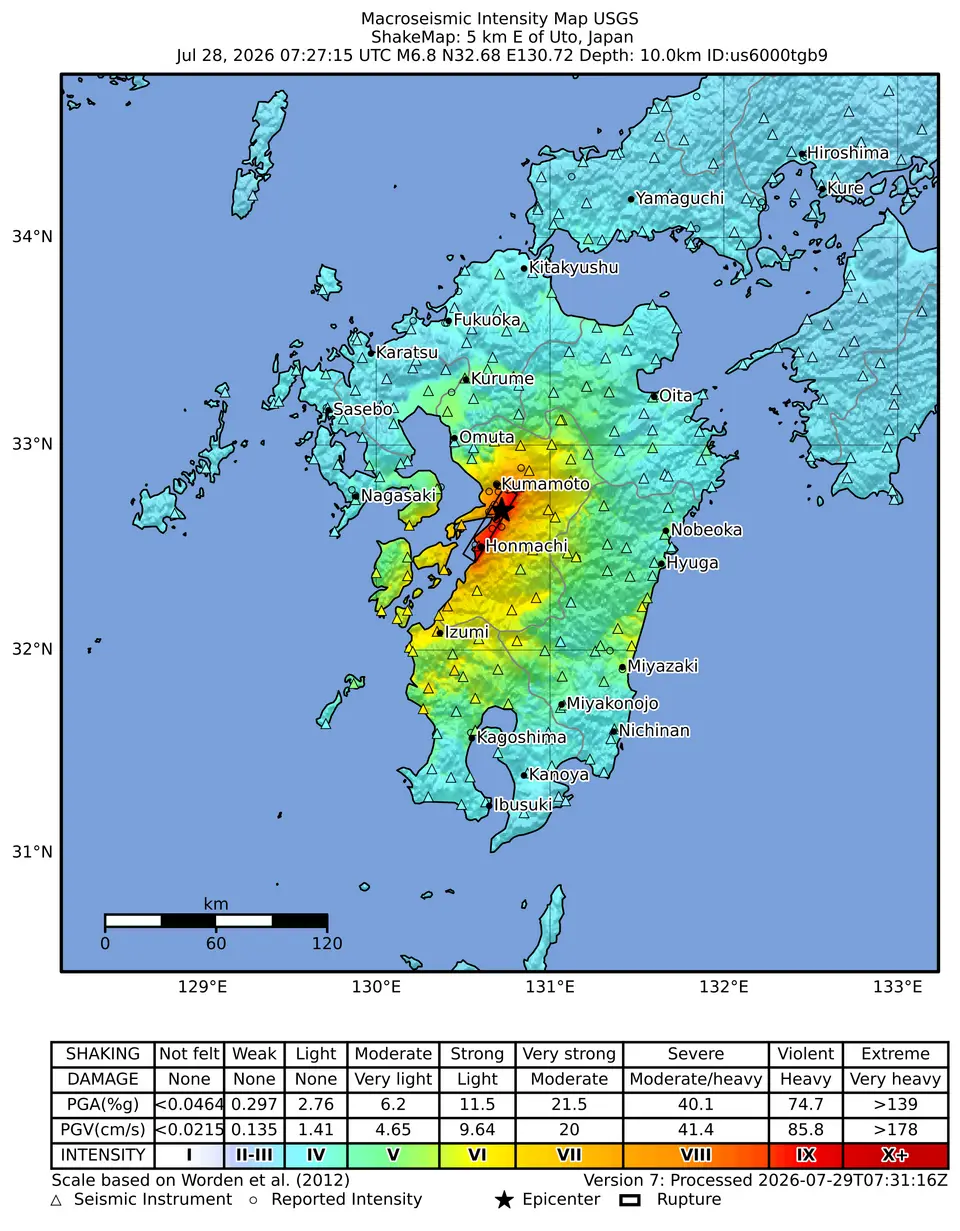
Kumamoto Prefecture sits at the southern end of Japan's longest fault system, the Japan Median Tectonic Line, where the earth bends in two directions at the Beppu-Haneyama Fault Zone. Strike-slip faulting with a strong downward component ruptured about 10 km beneath the surface, 5 km east of Uto City. The Japan Meteorological Agency gave it a domestic scale of MJMA 7.1. The USGS independently measured Mww 6.8. Both figures describe the same event. Maximum shaking of intensity 7 on the JMA scale, the highest level, was recorded in Uki City and Hikawa. Tremors were felt as far away as Busan, South Korea, where 291 reports came in. The JMA issued a tsunami advisory for the Ariake and Yatsushiro seas within minutes. No damaging wave arrived, and the advisory was lifted. A one-week aftershock warning remains in effect.
This is the second major earthquake in Kumamoto in a decade. In April 2016, a magnitude 6.5 on April 14 was followed 28 hours later by a magnitude 7.3, killing 273 people. The JMA warned in 2016 that it was the first time in observational history that intensity 7 was recorded twice in a single sequence. The agency has issued an identical caution this week: significant aftershocks remain possible for at least seven days.
Hour by hour: how the disaster unfolded
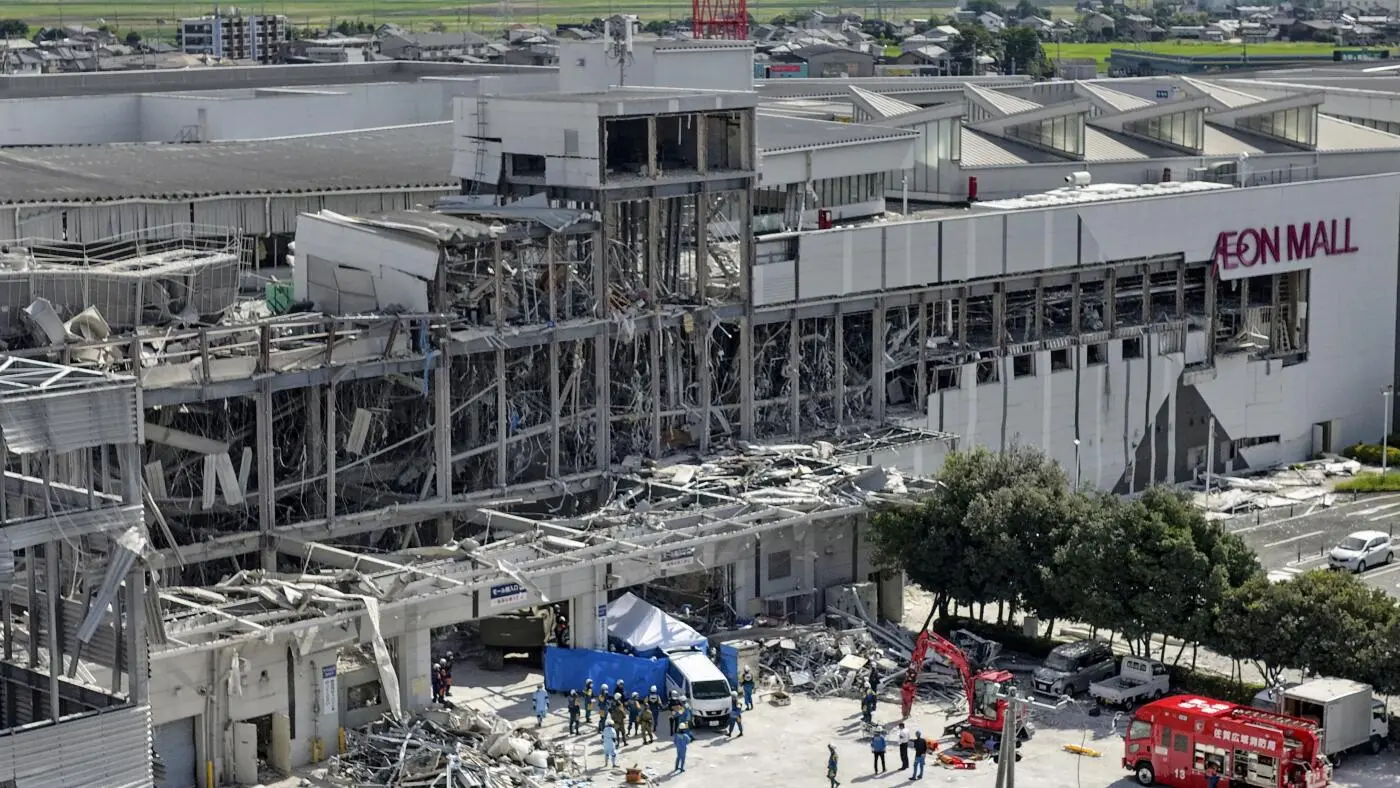
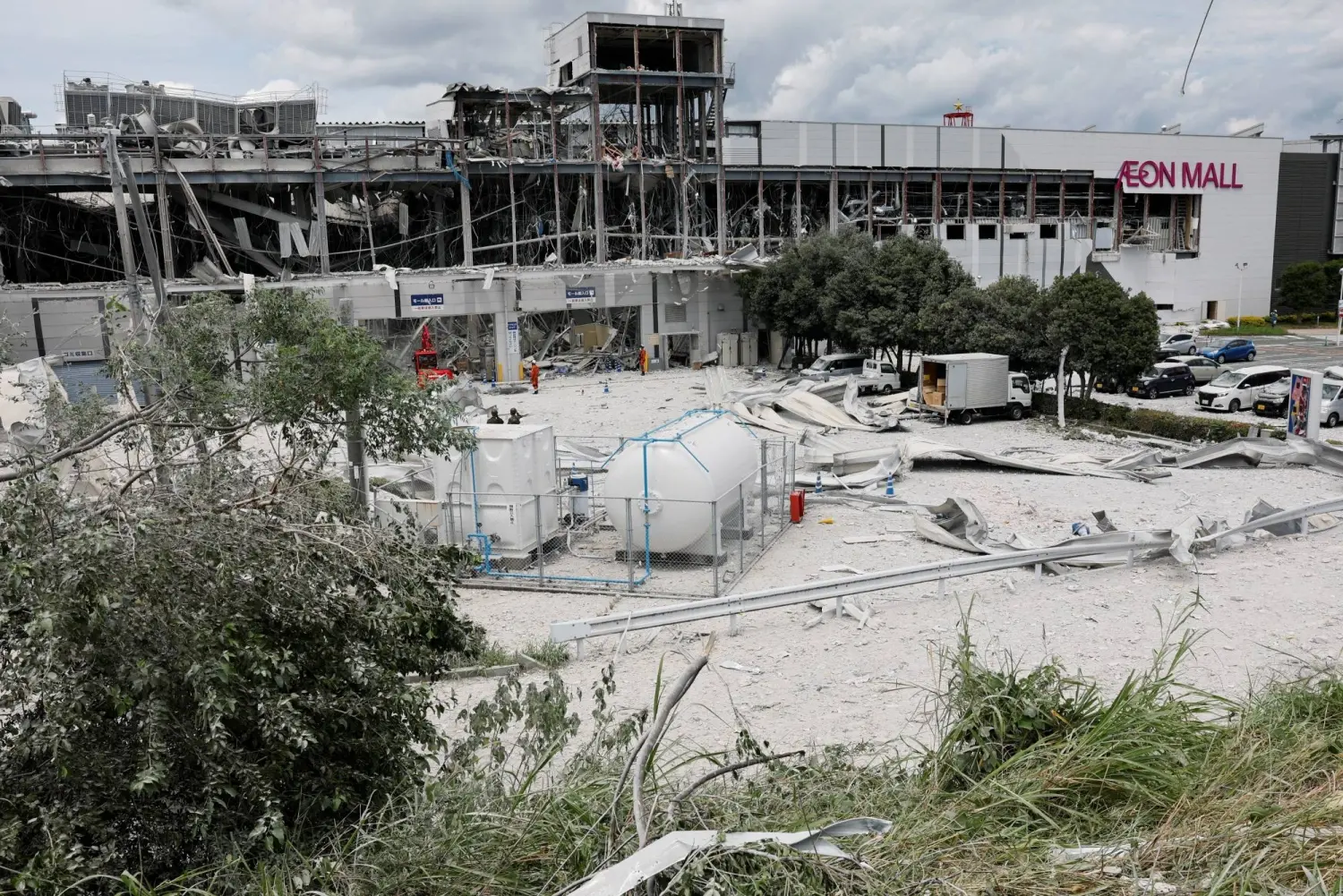
16:27 JST (28 July). The main shock. The magnitude 7.1 earthquake strikes with its epicentre 5 km east of Uto City, Kumamoto Prefecture. Intensity 7 shaking, the maximum on Japan's scale, hits Uki City and Hikawa instantly. Bullet train services across Kyushu are halted. All flights at Kumamoto Airport are cancelled. Power fails in roughly 46,000 households. 16:30 to 17:00 JST (28 July). Tsunami advisory. The Japan Meteorological Agency issues a tsunami advisory for the Ariake and Yatsushiro seas. Coastal communities are warned of possible waves up to one metre. Evacuation orders go out. No damaging wave arrives. The advisory is lifted within the hour, but fear keeps tens of thousands away from the coast. 17:00 to 18:00 JST (28 July). Aeon Mall Kashima. Roughly 3,000 customers at the Aeon Mall in Kashima Town have been evacuated to the parking lot when a gas explosion tears through another part of the building about an hour after the quake. The mall's second floor collapses. Staff still inside are trapped. Rescue workers report the smell of gas. Authorities believe a gas leak caused the blast. 18:00 to 20:00 JST (28 July). Nippon Paper Industries, Yatsushiro. A chimney at the Nippon Paper factory in Yatsushiro collapses onto workers. Eight people die, one remains missing. Ten workers are rescued from the wreckage. It becomes one of the single deadliest incidents of the disaster. 20:00 JST onwards (28 July). Self-Defense Forces deployed. Prime Minister Sanae Takaichi holds a press conference. She says "every second counts" and confirms the Japan Self-Defense Forces have accepted a disaster dispatch request from Kumamoto Prefecture. Hundreds of military personnel, alongside firefighters including a team from Taiwan, begin working through the night. Kumamoto Castle is reported to have sustained partial damage to its stone walls. 29 July (all day). Rubble search. Rescue teams comb the collapsed sections of Aeon Mall and damaged homes in Kashima and Uki. The death toll climbs steadily: 18 confirmed by late 29 July. Six of those are confirmed at the mall site, from the 11 people pulled from the wreckage. Nine people remain unaccounted for at the Nippon Paper factory. Sweltering summer heat, with daily highs near 35 degrees Celsius, raises alarm for any survivors still trapped. 30 July (morning). Hope dwindles. The confirmed death toll reaches 25, with nine further deaths under investigation as likely connected. At least 86 people are injured, five seriously. Rural communities around Uki, Kashima, and Yatsushiro are struggling to resume normal life. More than 8,800 people remain in over 400 evacuation shelters. Nearly 34,900 homes are still without electricity. 15,000 homes remain without running water. A highway bridge has buckled. The JMA one-week aftershock warning stays in force.
The 2016 Kumamoto earthquakes rebuilt much of central Kumamoto in the decade that followed. Kumamoto Castle, which took catastrophic damage in 2016, had only recently completed a major phase of reconstruction. Authorities are now assessing whether the new restoration work has been set back. Separately, the JMA has flagged that because this week's quake covers a wide seismic area, any aftershock could strike in a location where ground motion exceeds that of the main event.
Japan's earthquake intensity scale
Japan uses its own JMA seismic intensity scale, separate from magnitude. It runs from 0 to 7, with 5 and 6 split into lower and upper. Intensity 7 is the highest rung and means violent shaking capable of toppling reinforced concrete structures. This week intensity 7 was recorded in Uki City and Hikawa. Intensity 6 upper and lower were measured across a wide belt including Yatsushiro, Uto, Misato, Mashiki, Nishihara, Koshi, and Ozu. The scale measures what the ground actually does at each location, not the energy released at the source, so two places at the same distance from the epicentre can register very different intensities depending on their soil.