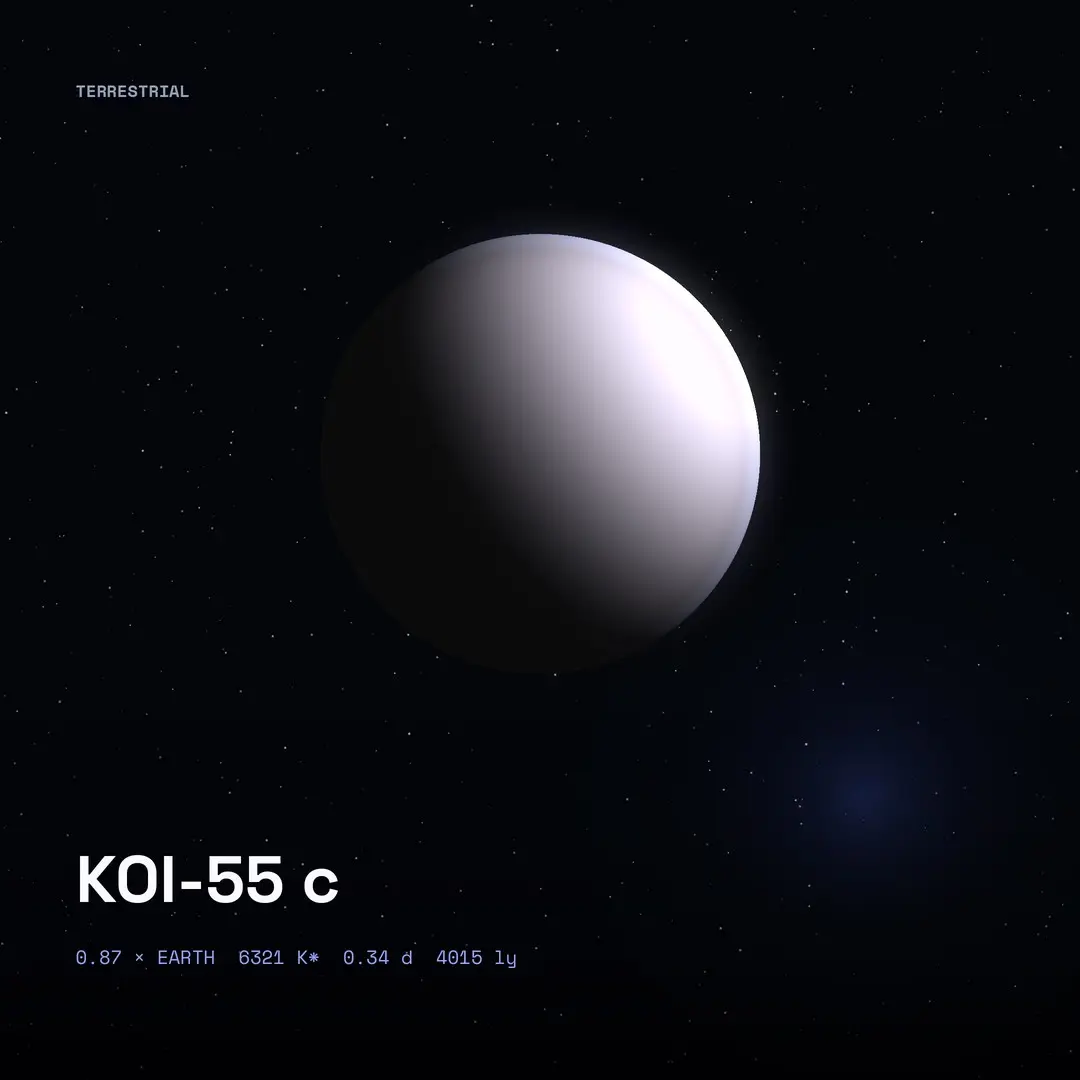
KOI-55 c: A Year In 8.2 Hours
Terrestrial around KOI-55
It is 0.87 times Earth's radius, closest in size to Venus, and 0.7 times Earth's mass. A year there lasts 8.2 hours, on an orbit 51 times closer to its star than Mercury is to the Sun. Its equilibrium temperature is 6321 K (derived from the star rather than measured), hotter than the surface of many stars. The host star KOI-55 runs at 27730 K with 0.50 times the Sun's mass.
6321K: hot enough to vaporise rock on the dayside
Radius
0.87 Earth radii
Mass
0.7 Earth masses
Equilibrium temperature
6321 K (derived)
One year
8.2 hours
Orbit radius
0.0076 AU
Host star
KOI-55 at 27730 K
Distance
4015 light-years
The state of the record for this planet
A measured radius. Yes.
A weight, not just a width. Yes.
A density, which decides rock or gas. No.
A semi-major axis. Yes.
A measured temperature rather than a derived one. No.
An eccentricity, so we know if the orbit is a circle. No.
The archive lists no measured equilibrium temperature for this planet. The 6321 K quoted here is derived from the star's output and the orbital distance, assuming a third of the light is reflected. It is an estimate from two numbers, not an observation.
KOI-55 has 2 known planets. Planets in company tug on each other, and those tugs are measurable, which is how masses get pinned down without a wobble.
Found by Kepler in 2011. Kepler stared at one patch of sky for four years, which is why so many of its planets have short periods: a planet only counts once you have seen it cross several times.
Half the temperatures quoted for exoplanets are calculated from the star, not \
measured at the planet. Should a page like this show them at all, or leave the field blank?
