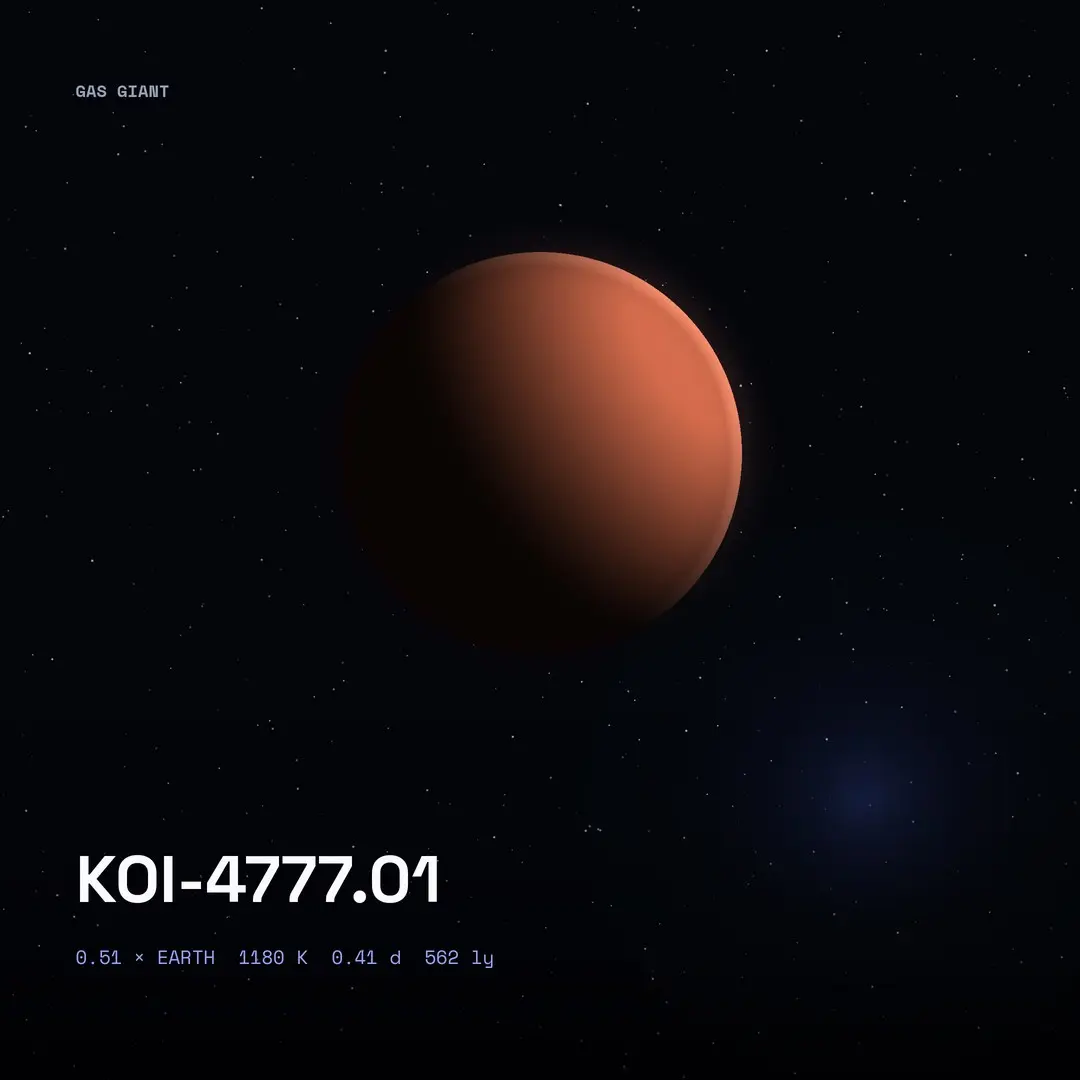
KOI-4777.01: A Year In 9.9 Hours
Gas giant around KOI-4777
It is 0.51 times Earth's radius, closest in size to Mars, and 99.2 times Earth's mass. A year there lasts 9.9 hours, on an orbit 48 times closer to its star than Mercury is to the Sun. Its equilibrium temperature is 1180 K, hot enough to melt lead. The host star KOI-4777 runs at 3515 K with 0.41 times the Sun's mass.
9.9hours: one full year, start to finish
Radius
0.51 Earth radii
Mass
99.2 Earth masses
Equilibrium temperature
1180 K (measured)
One year
9.9 hours
Orbit radius
0.0080 AU
Host star
KOI-4777 at 3515 K
Distance
562 light-years
Starlight blocked
0.014% at each transit
The state of the record for this planet
A size. Yes.
A measured mass. Yes.
A density, so rock and gas can be told apart. No.
A semi-major axis. Yes.
A temperature someone observed rather than calculated. Yes.
An eccentricity, so the orbit shape is known. Yes.
What the transit gives
How deep the star dims fixes the planet's size relative to it.
Two independent measurements sit behind this page: a dip in starlight for the size, and something else entirely for the mass. Together they make a density.
Found by Kepler in 2022. Kepler watched a single field continuously, so it found the planets that come round often. A world with a long year simply never repeated within the mission.
