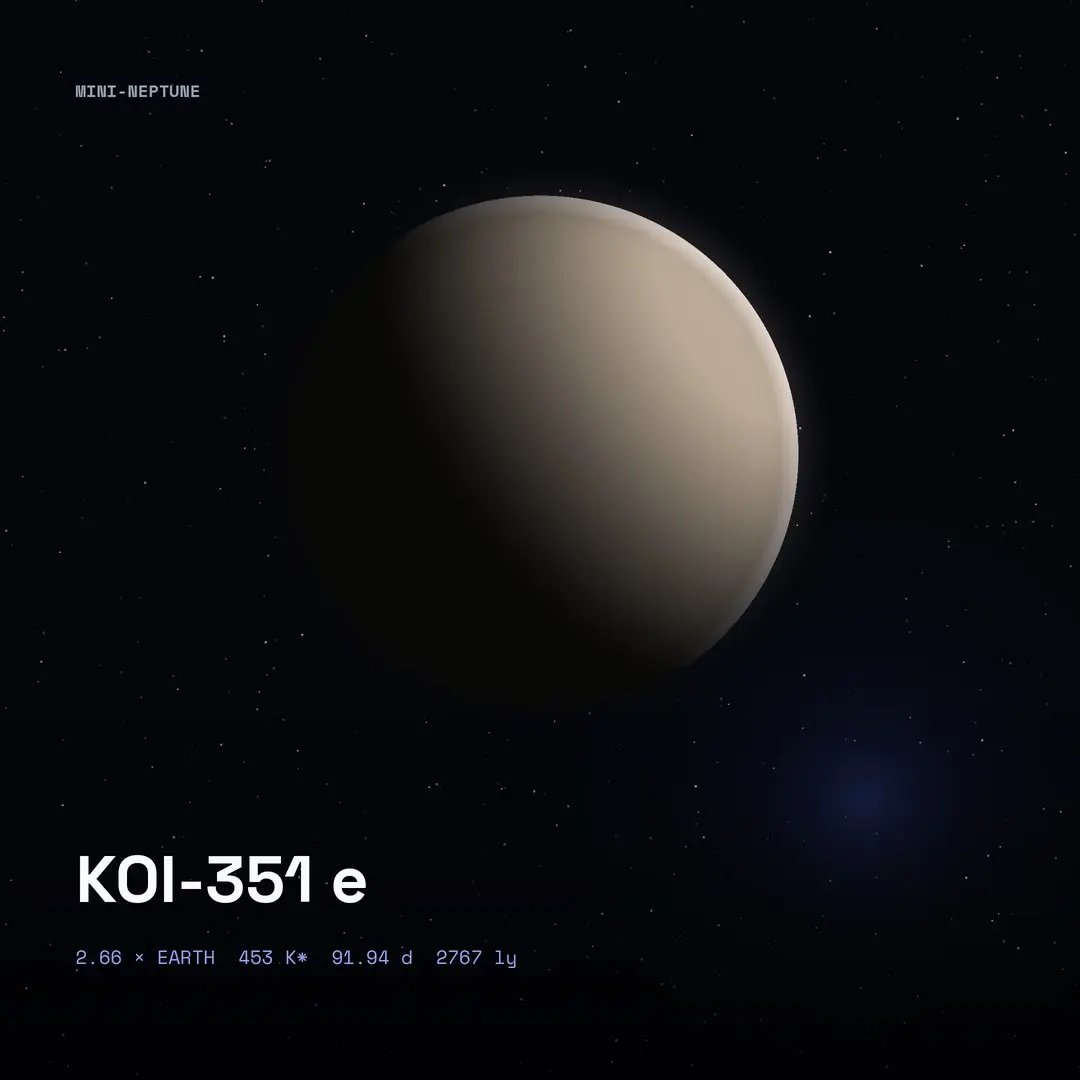
KOI-351 e: 8-Planet System, 0.420 AU Out
Mini-neptune around KOI-351
It is 2.66 times Earth's radius, closest in size to Neptune. A year there lasts 91.94 days, on an orbit 1.1 times Mercury's distance from the Sun. Its equilibrium temperature is 453 K (derived from the star rather than measured), hotter than any desert. The host star KOI-351 runs at 6080 K with 1.20 times the Sun's mass.
KOI-351 from the inside out
Orbit
/
Planet
Radius
2.66 Earth radii
Equilibrium temperature
453 K (derived)
One year
91.94 days
Orbit radius
0.4200 AU
Host star
KOI-351 at 6080 K
Distance
2767 light-years
Starlight blocked
0.041% at each transit
What a crossing measures
The depth of the dip is the ratio of the two discs, so the radius follows.
What has been measured here and what has not
A measured radius. Yes.
A mass. No.
A density, which decides rock or gas. No.
A semi-major axis. Yes.
A temperature someone observed rather than calculated. No.
An eccentricity, so the orbit shape is known. No.
The archive lists no measured equilibrium temperature for this planet. The 453 K quoted here is derived from the star's output and the orbital distance, assuming a third of the light is reflected. It is an estimate from two numbers, not an observation.
Found by watching its star dim as it crossed in front. That measures size and not weight, which is why there is a radius here and no mass.
KOI-351 has 8 known planets. A crowded system is worth more than the sum of its planets: the timing of each transit constrains the others.
Found by Kepler in 2013. Kepler watched a single field continuously, so it found the planets that come round often. A world with a long year simply never repeated within the mission.
Half the temperatures quoted for exoplanets are calculated from the star, not \
measured at the planet. Should a page like this show them at all, or leave the field blank?
