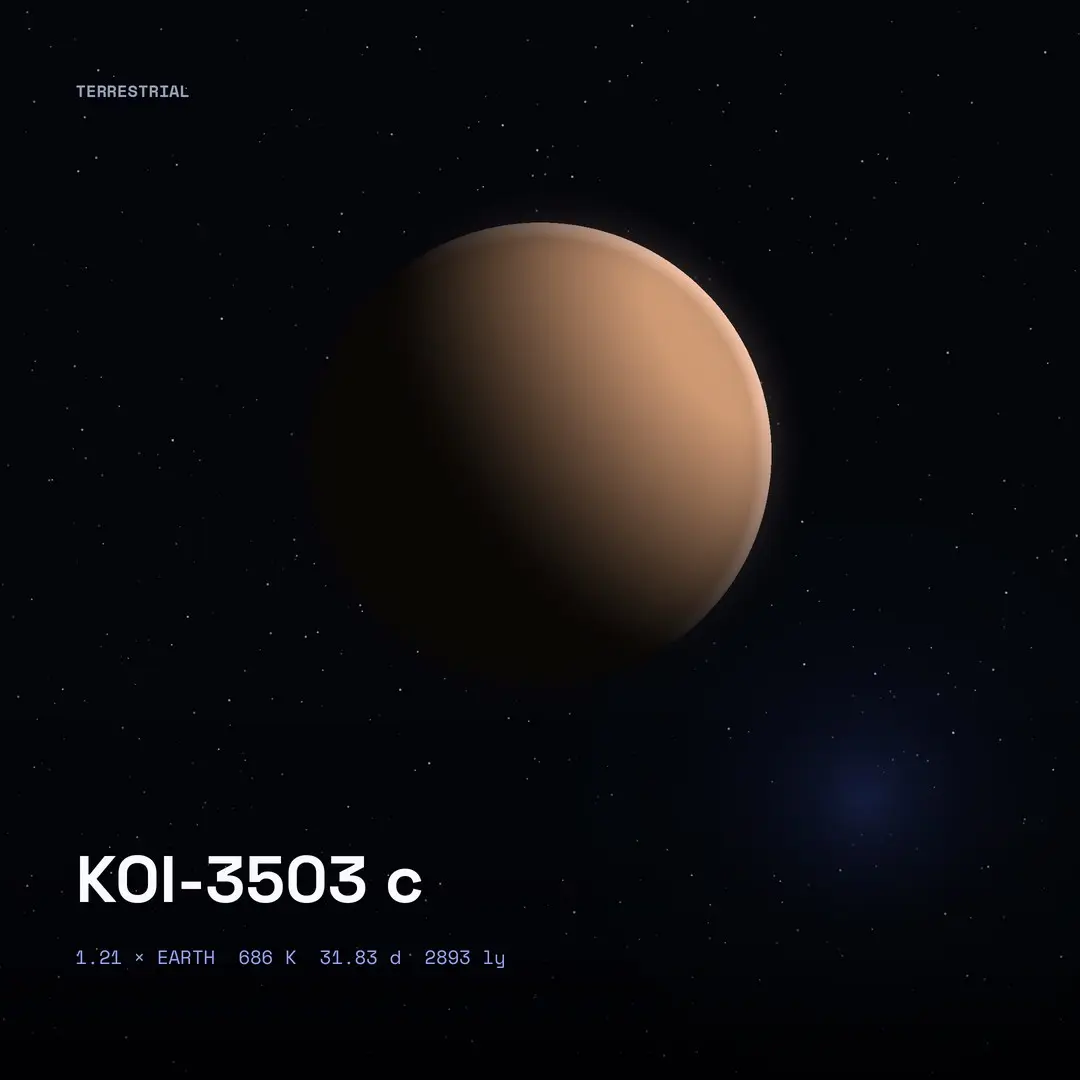
KOI-3503 c: 10.0 Grams Per Cubic Centimetre
Terrestrial around KOI-3503
It is 1.21 times Earth's radius, closest in size to Earth, and 10.4 times Earth's mass, at 10.00 g/cm3, denser than Earth. A year there lasts 31.83 days. Its equilibrium temperature is 686 K, hotter than any desert. The host star KOI-3503 runs at 6001 K with 0.86 times the Sun's mass.
10.0g/cm3: denser than iron at Earth surface pressure
Radius
1.21 Earth radii
Mass
10.4 Earth masses
Equilibrium temperature
686 K (measured)
One year
31.83 days
Host star
KOI-3503 at 6001 K
Distance
2893 light-years
Starlight blocked
0.008% at each transit
What the archive holds on this planet
A radius from transit photometry. Yes.
A mass. Yes.
A density, which decides rock or gas. Yes.
A semi-major axis. No.
A temperature someone observed rather than calculated. Yes.
The shape of the orbit. No.
What a crossing measures
Block a known fraction of a known star and you have measured a width.
Found by Kepler in 2021. The mission traded sky coverage for depth, holding one view for years. That bias runs through its whole catalogue and through this planet's discovery.
KOI-3503 has 2 known planets. Multi-planet systems are where orbital dynamics can be measured rather than assumed.
A transit gives the radius and a separate measurement gives the mass. Having both is what makes a density, and a density is the only clue to composition at this range.
