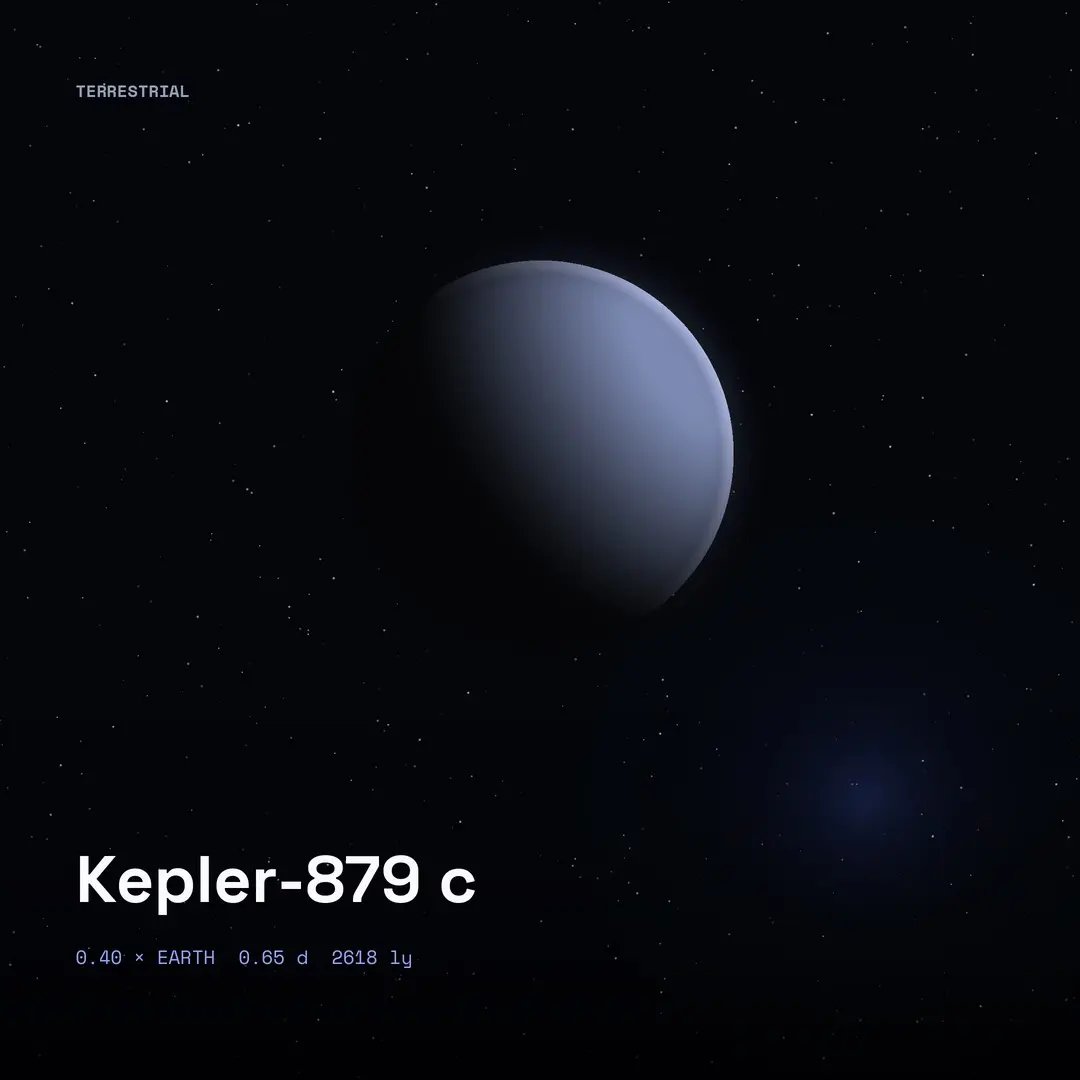
Kepler-879 c: A Year In 15.5 Hours
Terrestrial around Kepler-879
It is 0.40 times Earth's radius, closest in size to Mars. A year there lasts 15.5 hours. The host star Kepler-879 runs at 5457 K with 0.97 times the Sun's mass.
Radius
0.40 Earth radii
One year
15.5 hours
Host star
Kepler-879 at 5457 K
Distance
2618 light-years
Starlight blocked
0.001% at each transit
What you get from the shadow
Block a known fraction of a known star and you have measured a width.
15.5hours: one full year, start to finish
What has been measured here and what has not
A radius from transit photometry. Yes.
A mass. No.
A density, the one clue to composition. No.
How far out it orbits. No.
A temperature someone observed rather than calculated. No.
An eccentricity, so we know if the orbit is a circle. No.
Kepler-879 has 2 known planets. Planets in company tug on each other, and those tugs are measurable, which is how masses get pinned down without a wobble.
Found by watching its star dim as it crossed in front. That measures size and not weight, which is why there is a radius here and no mass.
Found by Kepler in 2024. The mission traded sky coverage for depth, holding one view for years. That bias runs through its whole catalogue and through this planet's discovery.
