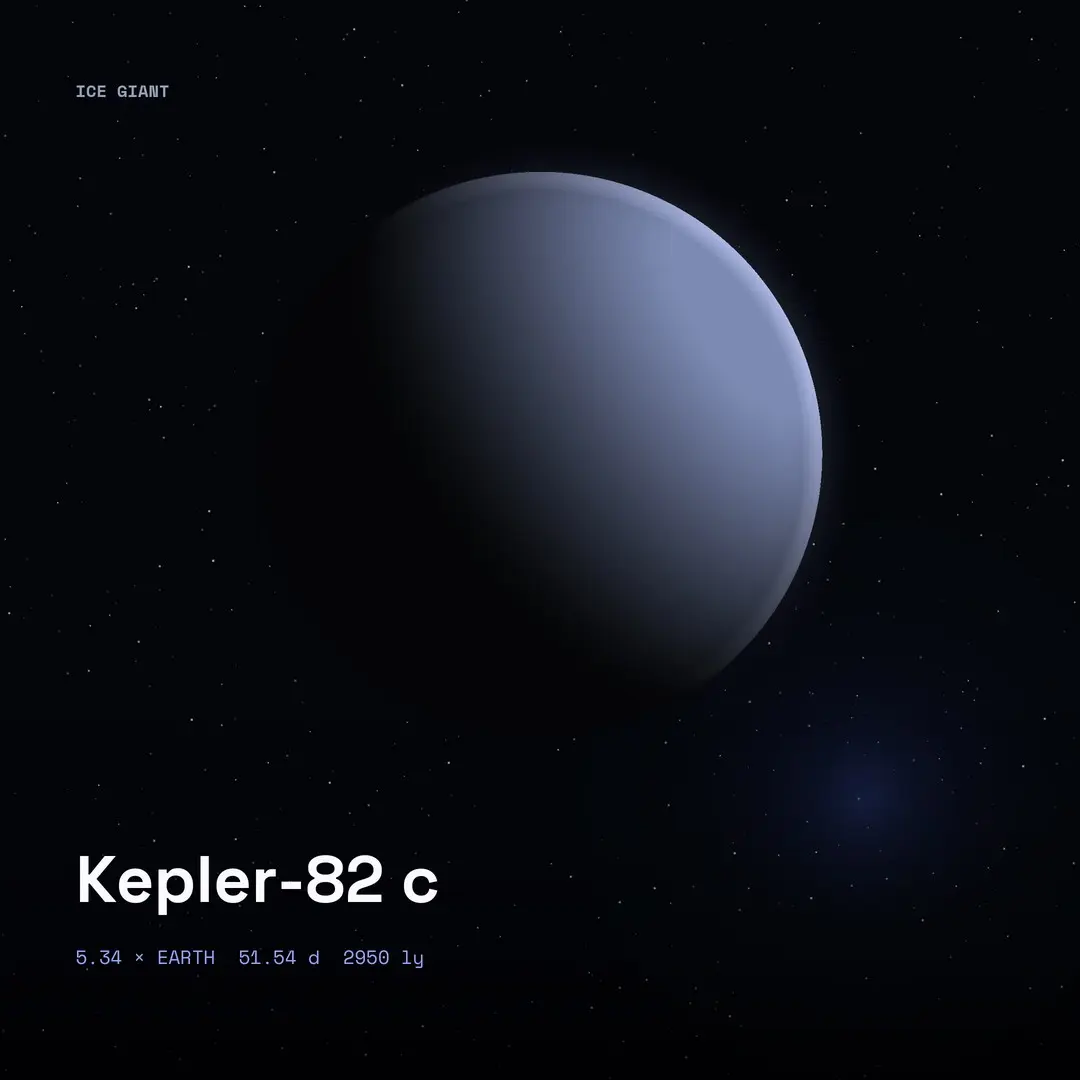
Kepler-82 c: 5-Planet System, 0.263 AU Out
Ice giant around Kepler-82
It is 5.34 times Earth's radius, closest in size to Uranus, and 13.9 times Earth's mass, at 0.49 g/cm3, less dense than Earth. A year there lasts 51.54 days, on an orbit 1 times closer to its star than Mercury is to the Sun.
Kepler-82 from the inside out
Orbit
/
Planet
Radius
5.34 Earth radii
Mass
13.9 Earth masses
One year
51.54 days
Orbit radius
0.2626 AU
Distance
2950 light-years
Starlight blocked
0.297% at each transit
What the transit gives
Block a known fraction of a known star and you have measured a width.
The size came from a crossing, the mass did not. That pairing is uncommon and it is what lets anyone say whether this is rock or gas.
Found by Kepler in 2012. The mission traded sky coverage for depth, holding one view for years. That bias runs through its whole catalogue and through this planet's discovery.
Kepler-82 has 5 known planets. Systems like this are the ones where architecture can be studied instead of guessed at.
