Kepler-62 f: Habitable Zone, 267-Day Year
Super-earth around Kepler-62
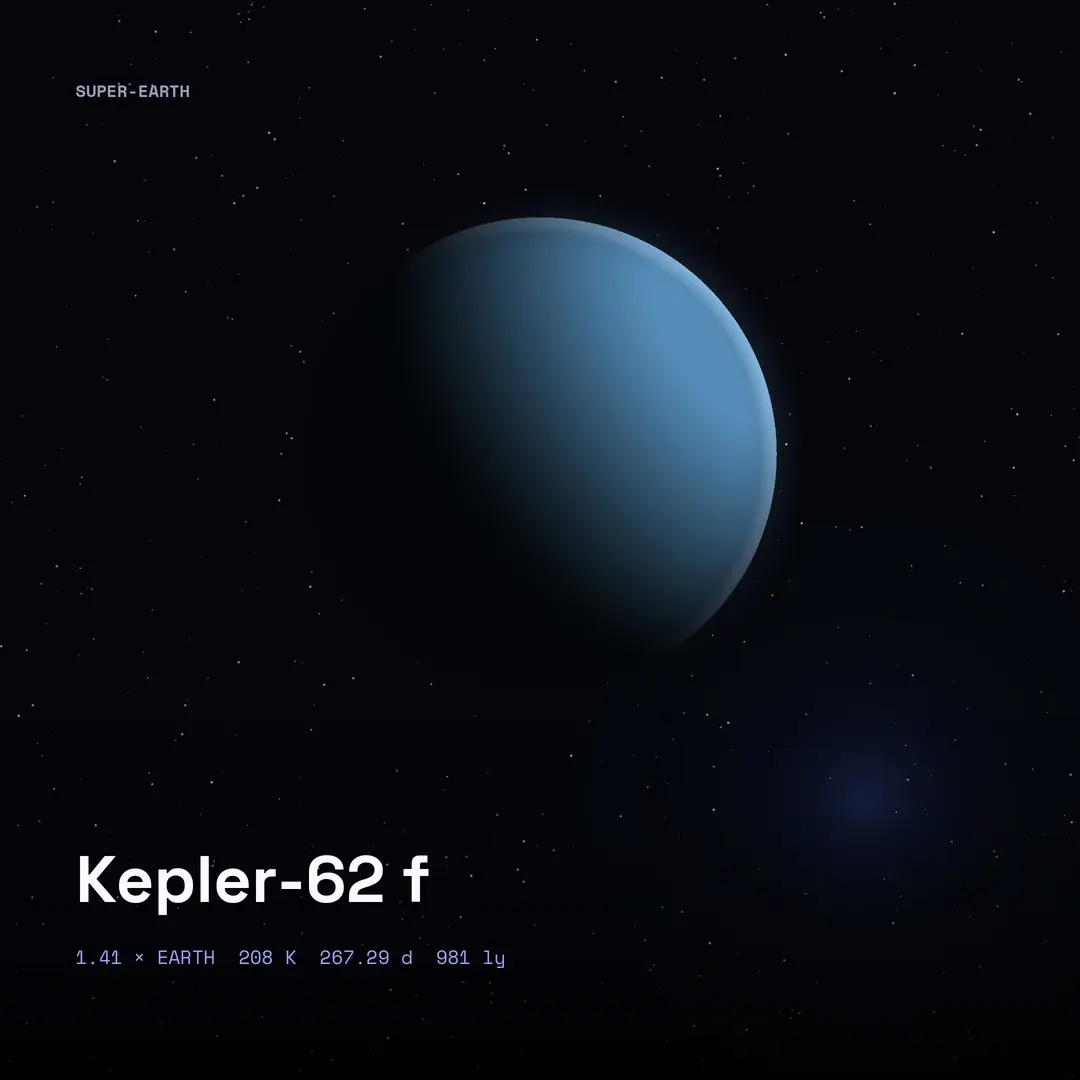
It is 1.41 times Earth's radius, closest in size to Earth, and 35.0 times Earth's mass. A year there lasts 267.29 days, on an orbit 1.9 times Mercury's distance from the Sun. Its equilibrium temperature is 208 K, in the range where liquid water is possible. The host star Kepler-62 runs at 4925 K with 0.69 times the Sun's mass.
What is established here and what is missing
Sits inside the computed habitable zone of its star. Yes.
A measured mass, not just a radius. Yes.
A measured temperature rather than one derived from the star. Yes.
Any detection of an atmosphere. Not recorded in the archive.
Kepler-62 from the inside out
Orbit
/
Planet
Radius
1.41 Earth radii
Mass
35.0 Earth masses
Equilibrium temperature
208 K (measured)
One year
267.29 days
Orbit radius
0.7180 AU
Host star
Kepler-62 at 4925 K
Distance
981 light-years
Starlight blocked
0.041% at each transit
What the dip tells you
How deep the star dims fixes the planet's size relative to it.
Size from the shadow, mass from elsewhere. Most transiting planets never get the second half, and without it composition stays a guess.
Kepler-62 has 5 known planets. Multi-planet systems are where orbital dynamics can be measured rather than assumed.
Found by Kepler in 2013. Kepler watched a single field continuously, so it found the planets that come round often. A world with a long year simply never repeated within the mission.
Kepler-62 f sits in the habitable zone on the arithmetic alone. That says \
where it orbits, not what it is like. What would you want measured next before calling it promising?
