Kepler-51 d: Less Dense Than Cork
Ice giant around Kepler-51
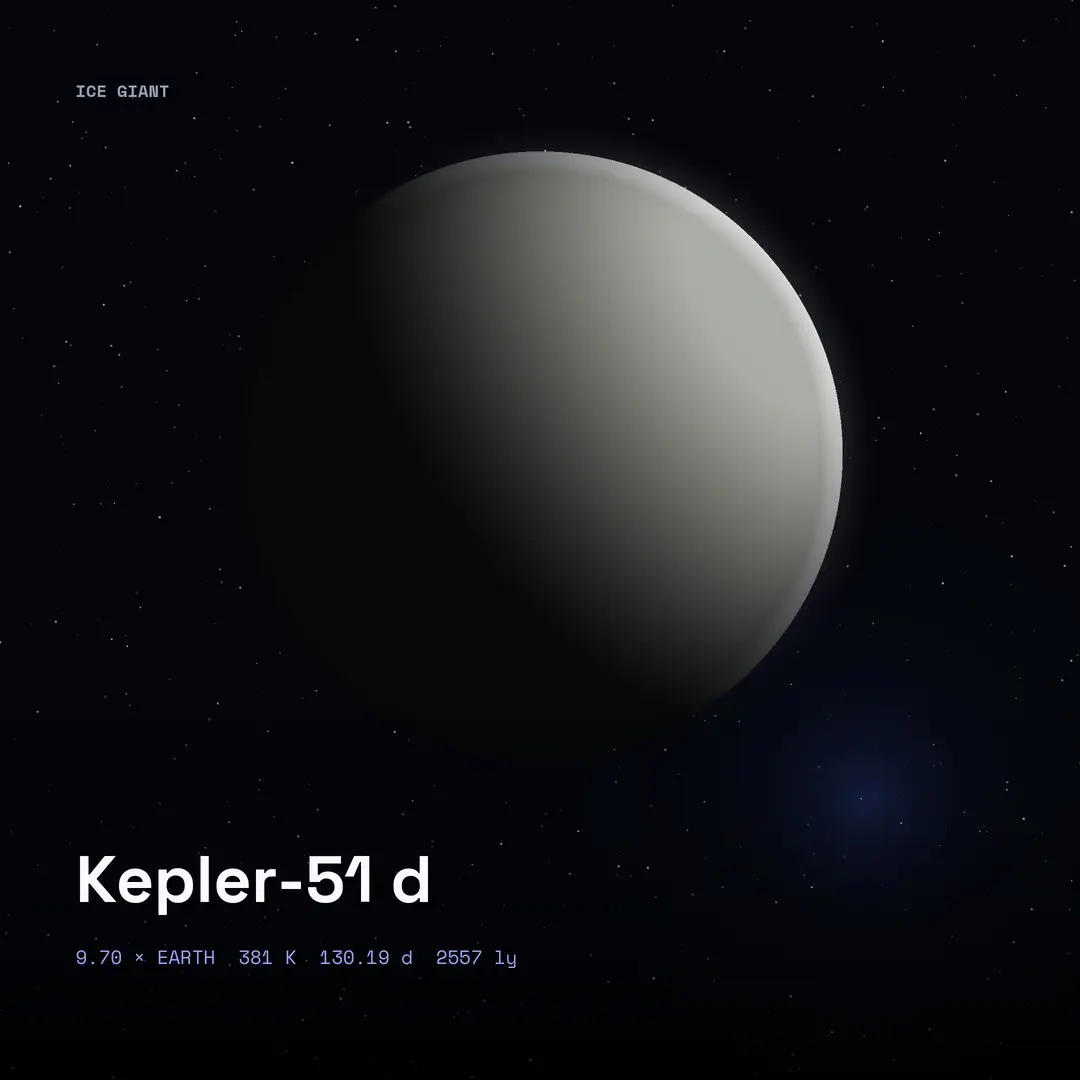
It is 0.87 times Jupiter's radius, closest in size to Saturn, and 7.6 times Earth's mass, at 0.05 g/cm3, less dense than Earth. A year there lasts 130.19 days, on an orbit 1.3 times Mercury's distance from the Sun. Its equilibrium temperature is 381 K, hotter than any desert. The host star Kepler-51 runs at 6018 K with 1.04 times the Sun's mass.
Kepler-51 from the inside out
Orbit
/
Planet
Radius
9.70 Earth radii
Mass
7.6 Earth masses
Equilibrium temperature
381 K (measured)
One year
130.19 days
Orbit radius
0.5090 AU
Host star
Kepler-51 at 6018 K
Distance
2557 light-years
Starlight blocked
0.893% at each transit
0.05g/cm3: less dense than cork
Where this planet stands on each testable criterion
Inside the habitable zone. No.
Dense enough to be rock rather than gas, at 0.05 g/cm3. No.
A measured mass, not just a radius. Yes.
A measured temperature rather than one derived from the star. Yes.
Any detection of an atmosphere. Not recorded in the archive.
What a crossing measures
The fraction of starlight blocked sets the radius against the star's.
Found by Kepler in 2014. Kepler's method needed repetition, not brightness. It could find small planets around faint stars, provided they came round quickly enough to be seen twice.
Kepler-51 has 4 known planets. Systems like this are the ones where architecture can be studied instead of guessed at.
The size came from a crossing, the mass did not. That pairing is uncommon and it is what lets anyone say whether this is rock or gas.
