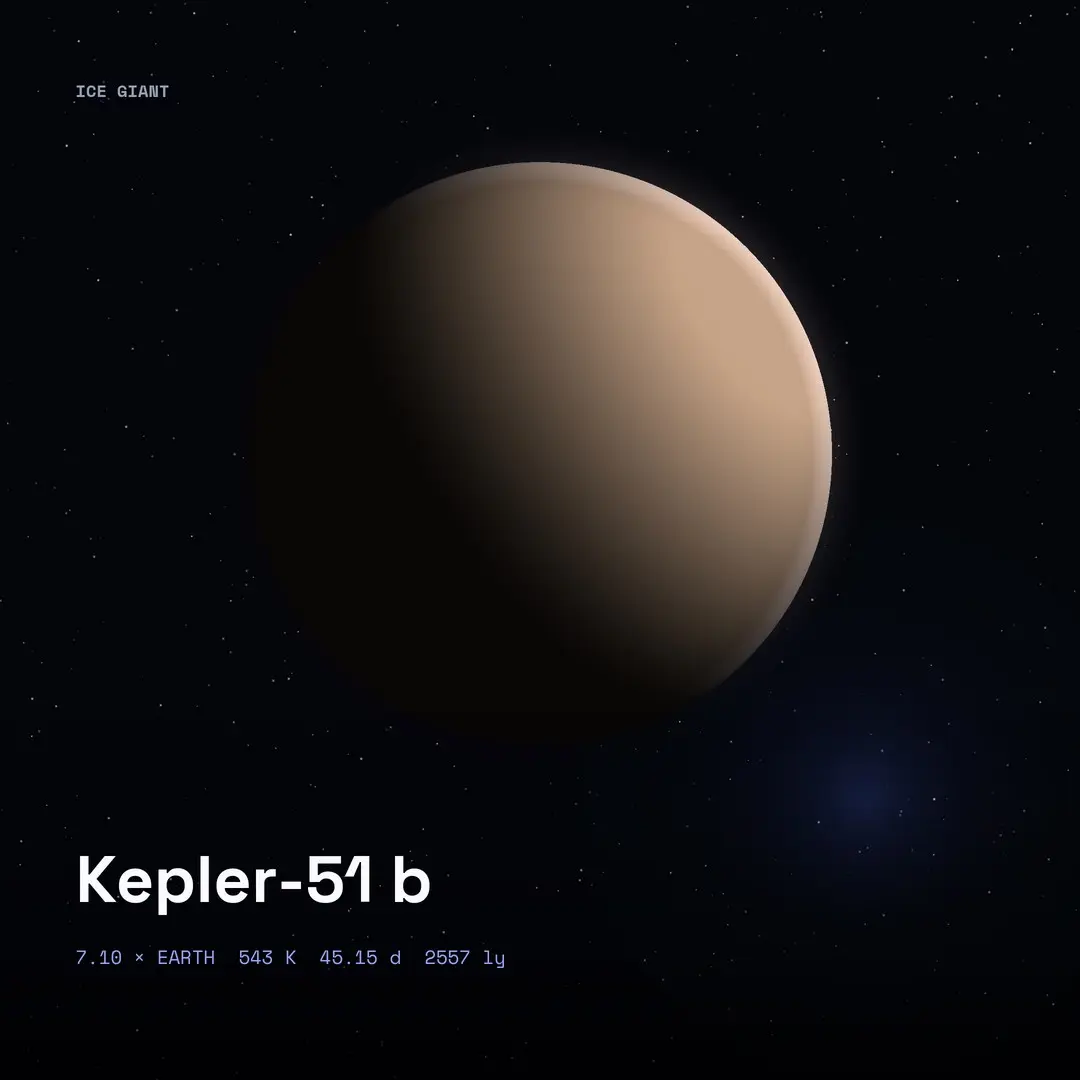
Kepler-51 b: Less Dense Than Cork
Ice giant around Kepler-51
It is 7.10 times Earth's radius, closest in size to Saturn, and 2.1 times Earth's mass, at 0.03 g/cm3, less dense than Earth. A year there lasts 45.15 days, on an orbit 2 times closer to its star than Mercury is to the Sun. Its equilibrium temperature is 543 K, hotter than any desert. The host star Kepler-51 runs at 6018 K with 1.04 times the Sun's mass.
Kepler-51 from the inside out
Orbit
/
Planet
Radius
7.10 Earth radii
Mass
2.1 Earth masses
Equilibrium temperature
543 K (measured)
One year
45.15 days
Orbit radius
0.2514 AU
Host star
Kepler-51 at 6018 K
Distance
2557 light-years
Starlight blocked
0.478% at each transit
0.03g/cm3: less dense than cork
What the dip tells you
The depth of the dip is the ratio of the two discs, so the radius follows.
Found by Kepler in 2012. Kepler stared at one patch of sky for four years, which is why so many of its planets have short periods: a planet only counts once you have seen it cross several times.
Kepler-51 has 4 known planets. Systems like this are the ones where architecture can be studied instead of guessed at.
Size from the shadow, mass from elsewhere. Most transiting planets never get the second half, and without it composition stays a guess.
